
SERIES OVERVIEW
This series focuses on the role of accountability systems built to meet federal and state requirements to ensure that schools and districts are meeting their obligation to graduate all students ready for college and career.
Explore the full series from Bellwether experts on the role of state accountability in K-12 education systems.
Accountability debates often return to the same question: Are states measuring the right things?
It’s an understandable focus. For K-12 schools, ratings are highly visible and often feel high stakes. They generate headlines, shape how families and communities perceive schools, and determine which schools are identified as needing improvement. So policymakers spend a lot of time trying to design the perfect identification system, debating which measures to include and how much each should count.
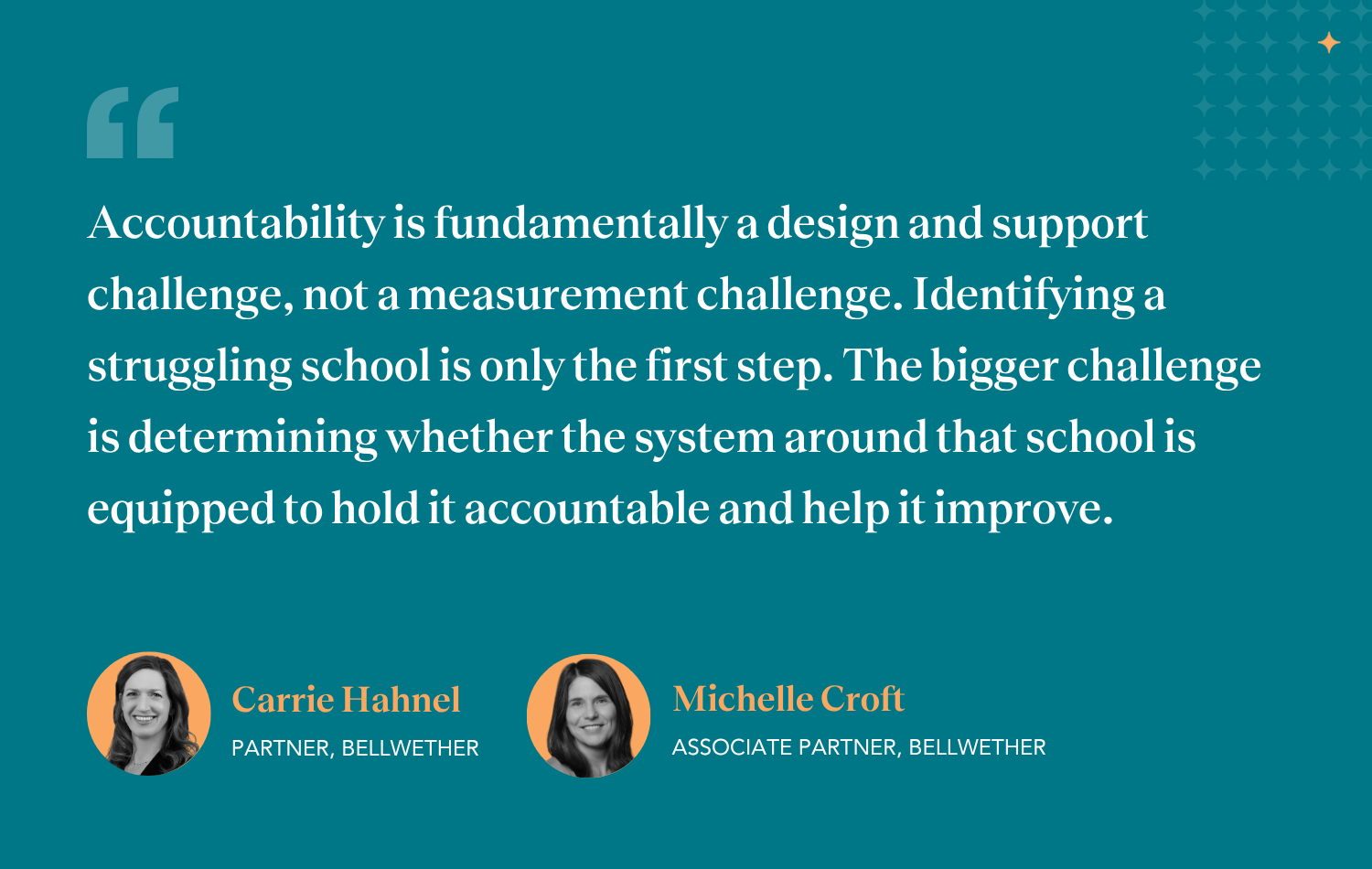
But accountability is fundamentally a design and support challenge, not a measurement challenge. Identifying a struggling school is only the first step. The bigger challenge is determining whether the system around that school is equipped to hold it accountable and help it improve.
Every state has built an accountability system that identifies low-performing schools, and every state determines what happens next. Identification is supposed to kick-start the improvement process. The school assesses its needs, develops an improvement plan, selects evidence-based strategies, and receives additional resources and support — all aimed at improving student outcomes. Yet federal policy says far more about how states should identify schools than about the systems states should build to help those schools improve. This leaves it to states to determine what quality support should look like. And the evidence increasingly points to challenges, from insufficient resources to difficulties selecting and implementing effective strategies.
But Washington’s silence on this front gives states room to define accountability not just as data and letter grades, but also as coherent improvement systems. California and Texas illustrate two approaches.
California has invested heavily in support structures, and largely on its own terms rather than in response to federal requirements. Its system includes 58 county offices of education, seven geographic leads, specialized resource leads, and the California Collaborative for Educational Excellence, in addition to the California Department of Education. Together, these entities provide increasingly intensive tiers of assistance to districts depending on local needs. But all that capacity doesn’t automatically add up to a coherent system. A state-convened design team recently found that districts face overlapping planning processes and fragmented support structures, and recommended reorganizing the whole system around a small set of shared statewide goals. California built a complex infrastructure and is now working out what it should all point toward.
Texas offers a different approach. Whereas California built capacity and is now seeking direction, Texas started with direction and built its support system to deliver it. Its Effective Schools Framework lays out a common vision of what effective schools should do across areas including instruction, staffing, instructional materials and assessments, school culture, and leadership. The state then uses that framework across its needs assessment, improvement planning, training, regional support, and directory of technical assistance providers. Beyond including high-quality instructional materials (HQIM) as part of the Effective Schools Framework, Texas has built a broader statewide HQIM strategy. In addition to reviewing curricular materials at the state level, Texas provides districts with funding to purchase approved materials, as well as grants, training, and technical assistance to support implementation.
Neither state has solved school improvement, and rigorous research on the effects of different state support models remains limited. But California and Texas illustrate two ways states can build accountability systems around coherence and capacity: California has focused on structures of support, while Texas has defined best practices and systems around a common set of standards.
Behind the buzzwords of coherence and capacity is a simple lesson in accountability: Data and ratings don’t change schools; people do. Identification still matters. But the real test of an accountability system is what happens after a school is identified, and whether the system around that school is designed to help it better serve students.
