
This is the third post in a series on Bellwether’s School Quality Framework, highlighting schools and systems that exemplify key components of the recently redesigned resource.
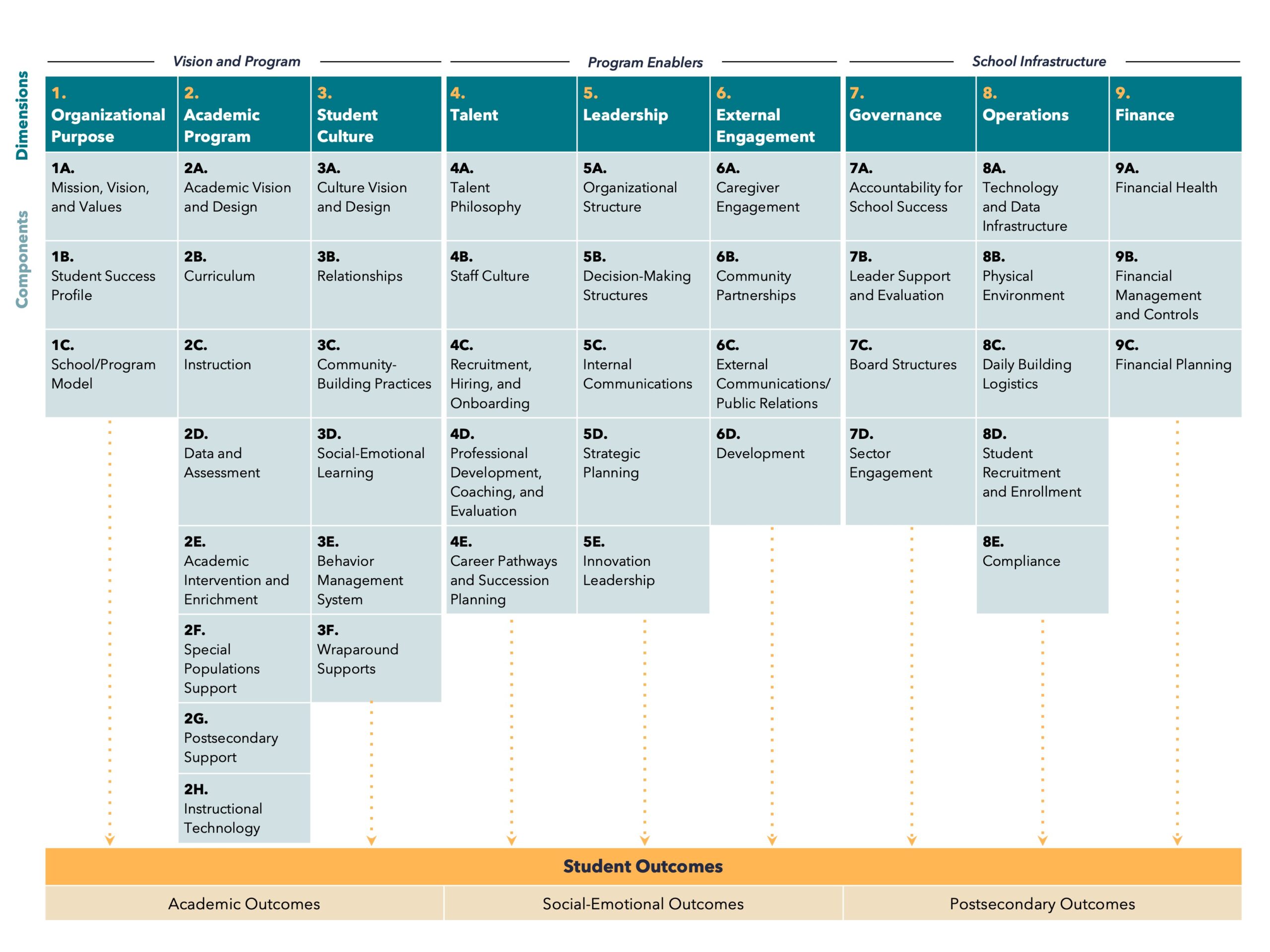
Bellwether’s School Quality Framework (SQF) defines nine dimensions of school excellence — from academics to student culture to operations — and breaks them down into clear, actionable components for schools and school leaders.
Bellwether’s School Quality Framework (click to enlarge)
Those who lead in school systems know that educator talent — especially teacher talent — is the lifeblood of a successful school. And finding, developing, retaining, and growing great teachers and leaders is perhaps more challenging than ever. Consider that:
- Fewer people choose teaching as a career, with preparation program enrollment dipping for more than a decade and many districts struggling to fill roles that once had long waiting lists across the country.
- Early-career teachers leave at rising rates, often pulled away by high workloads, stagnant pay, and growing expectations that stretch well beyond instruction.
- Those who stay in the classroom often strain under tough conditions, fueled by purpose but at times wholly reliant on school culture, strong leadership, and professional growth to anchor them in a field that increasingly asks them to do more with less.
That’s why a core Dimension of an effective SQF is a school’s, district’s, or network’s bench of talented teachers and staff. The talent and leadership in a school building shape and guide not only an environment conducive to student learning but also a staff community of high-performing educators who are committed to one another, to continuous improvement, and to the students they serve every day. Components such as staff culture, recruitment, and professional development, among others, enable a school or network to realize its organizational purpose and academic vision.
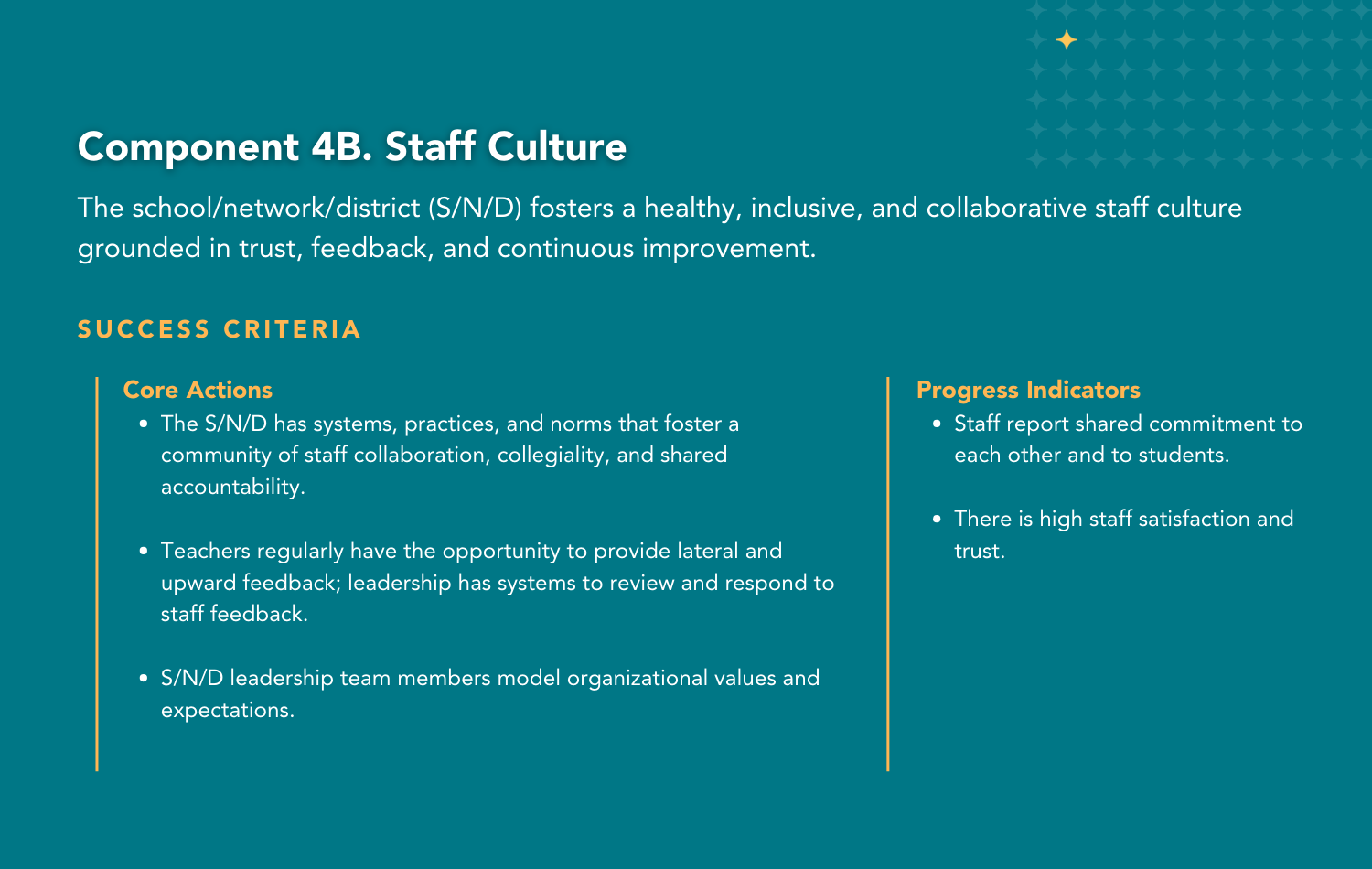
Component 4B. Staff Culture
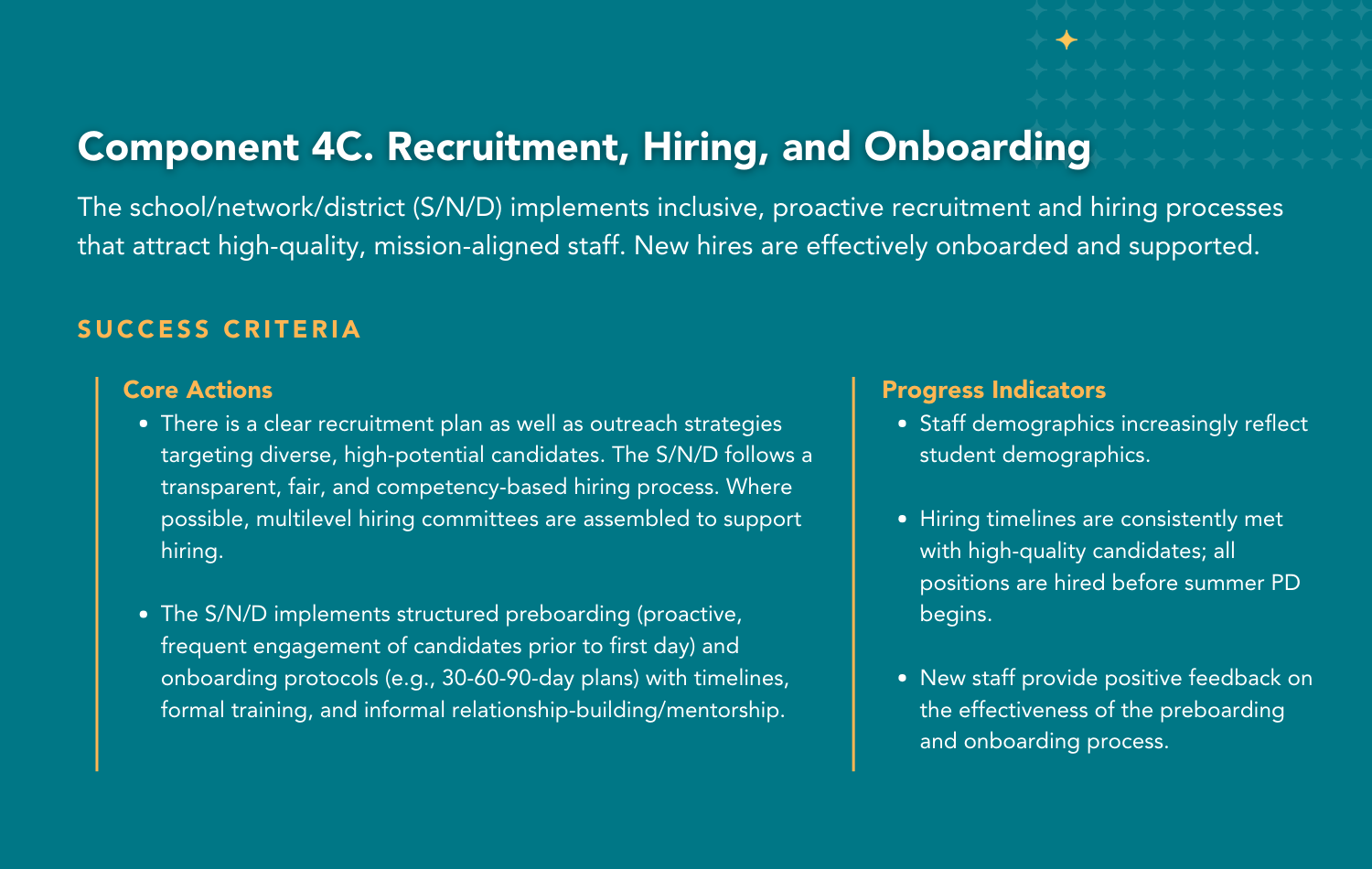
Component 4C. Recruitment, Hiring, and Onboarding
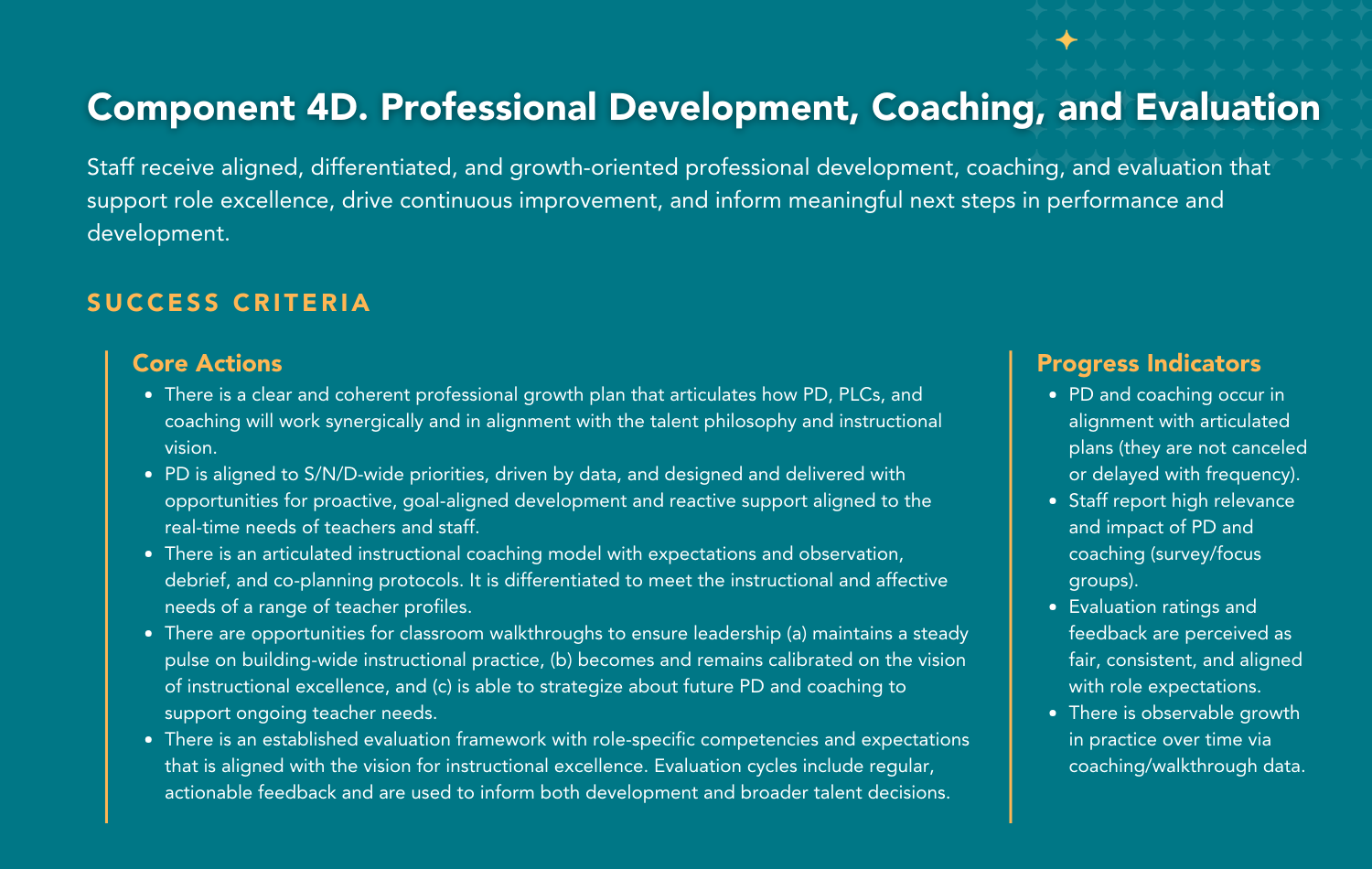
Component 4D. Professional Development, Coaching, and Evaluation
We recently met with Alex Quigley — executive director and high school principal of Durham Charter School (DCS) in Durham, North Carolina — to talk about how his approach to building, retaining, and growing talent and school leaders has contributed to student success and a culture of excellence. His answers have been edited for clarity and length.
Anson Jackson: What’s your background in K-12 and role at DCS? Set the stage for our readers about the school — the first charter in North Carolina — its founding, student and staff profile, and growth plan.
Alex Quigley: I’ve been in education now for almost 26 years and have worked in charter schools for just over 16 years. During most of my career, I’ve predominantly led school turnarounds, taking low-performing schools or networks and improving their academic offerings and, in turn, student outcomes.
Since joining DCS, we’ve moved from the lowest- to highest-performing charter school in the state over the past eight years — six of which we averaged in the Top 5 of all public schools in terms of academic growth in the state. We’re the only charter in Durham with students from low-income households with proficiency over 60%, and out of about 2,500 public schools statewide, we’re the No. 2 highest-growth charter. So, we’ve gone from “worst to first” in many ways here at DCS.
Today, we serve 1,200 K-12 students and just moved into a new 50-acre site in Durham. The Class of 2026 will be our inaugural graduating seniors in the spring.
AJ: How are students learning and achieving at DCS?
AQ: Our updated mission is to build a world-class school that empowers students to thrive in college, career, and life. We place a huge premium on 1) academics (with high-quality curriculum taught in a consistent manner by great teachers in the classroom and school leaders tracking implementation with fidelity); 2) a discipline culture (with high expectations and a culture where students are held to a high standard and encouraged to build strong relationships); 3) a comprehensive arts, athletics, and science program for students; and 4) an emphasis on early college and career readiness (our high school juniors and seniors have full dual enrollment with Durham Technical Community College [Durham Tech] — we don’t offer Advanced Placement courses for our high schoolers, it’s all driven through our partnership with Durham Tech).
AJ: How does Talent and the human capital side of DCS play a role in the student learning experience and academic growth you’ve outlined?
AQ: We have about 120 staff in total, about 90 of whom are teachers. The rest are mostly instructional leaders with a mix of operations and central office roles. Our teacher profile is a mix, but we have a large contingent of H-1B visa holders on the team, many of whom are originally from Jamaica. Most of those teachers come to us through a third-party agency and have at least five years of instructional experience in a U.S. school prior to joining our team.* They’re outstanding educators with great mindsets and attitudes, and they take teaching seriously and work really hard — but they don’t take themselves too seriously.
Due to the potentially shifting landscape, my strategy is to retain the high-performing H-1B staff I have by offering to pay for their permanent resident process as a way to diversify our recruitment pipeline. Regardless of one’s status, we put all applicants through the same rigorous interview process and have found that H-1B applicants are overwhelmingly converted to a full-time hire through the process. Most of them have master’s degrees and an average of 10-15 years of teaching experience in their home countries and about five additional years in U.S. classrooms. If selected hires are successful in Year 1 at DCS, we begin the permanent green card process for them and ask that they stay for another four years — it’s an investment we are more than willing to make in the caliber of talent we recruit.
Once teachers are hired, we put them through the same level of rigor in training as our school leaders. It’s an adjustment for all new-to-DCS teachers. We often hear in Year 1 from many that “I was a good teacher and now I feel like a beginner again.” Our school leaders anticipate that and work hard with teachers on classroom observation, coaching, and ongoing feedback. Most of our instructional coaches, academic deans, and principals are hired through our internal pipeline and “grow into” their role, often promoted at a high rate. All of our leaders are trained in the Paul Bambrick-Santoyo model via Uncommon Schools and Doug Lemov’s Teach Like a Champion.
We also have a teacher resident program with recent college graduates in a Teach For America style, where recent college graduates commit to teach at DCS for at least a year. If they stay three school years, we’ll pay for their master’s degree and state-approved education pathway. Many of our residents are now some of our highest-performing teachers at DCS — we’re confident that it will be an ongoing pipeline to tap into moving forward.
Akeshia Craven-Howell: You started to talk a bit about adult learning. How do you raise the bar with teachers who come to DCS with 10-15 years of experience and help staff progress in their career?
AQ: Two parts fit into the teacher growth trajectory at DCS. One is classroom management. As I mentioned, we use the Teach Like a Champion and Get Better Faster models of instructional practices across all grade levels. It’s definitely an adjustment for teachers who are used to going into their classrooms and being left alone. We have a lot of coaches in classrooms all the time providing real-time feedback, which can be shocking to new teachers at first. But if done the right way, they’re open to it.
Another part is intellectual preparation for teachers in the content components of the work. If you’ve never taught cognitively-guided work in math it can be a learning curve. At DCS, we expect teachers to internalize the actual curriculum and we’ll be in classrooms to talk about it and observe it with them. Coaches work with teachers to prepare a lesson, upload it, learn re-teaching methods for it, and more. So much of this is about unpacking and understanding standards and putting them into a framework that we know from experience works.
For example, our H-1B teachers are strong classroom managers, but we give them a playbook to make them better. They also get the North Carolina standards. But they have to earn their autonomy in the classroom — principals typically give them that space after about two years to ensure they know the foundational DCS system and approach.
All of this is a form of on-the-job refinement at DCS. During teacher orientation, I put up pictures of a surgeon, lawyer, and pilot to make the point that the systems and procedures they have to follow are akin to those of our teachers. Would you want a surgeon to operate without refined and focused ongoing training? Of course not. Our oversight and continuous feedback is a key ingredient of excellence and instructional success at DCS.
AJ: Leadership is a big piece of that ongoing teacher development at DCS, setting the conditions to help coaches unlock great instruction. How do you see it drive teacher retention, quality, and a growth-with-excellence mindset?
AQ: Leadership is there to enable highly-skilled teachers to teach. We break it down into general administrative support, support with student culture, and academic support. At DCS, we have deans of academic support in the schools to address student issues so that teachers can effectively do the thing they went to school for: teach. We need a leadership team to equip teachers to do just that by ensuring that if there’s a discipline problem or a student in crisis, there are other trained adults in the school building who can help support them so classroom instruction continues. We take teachers’ ability to teach and to feel like they have the right environment in which to do so very seriously.
Our leadership team has to be smart, skilled, and detail oriented. We expect principals to be instructional leaders, too. Deans take on about 80-90% for instruction out of their workload focus and we expect principals to take on about 60-70% for instructional leadership. We have a chief academic officer (CAO) to ensure this is at the forefront; arts and athletics are a priority at DCS, but academics are the cornerstone of all that we do.
ACH: How would you describe your staff culture, and what are a few of the most important drivers and sustainers of that culture?
AQ: We operate on an “assumption of good” mindset, knowing that our teachers want to teach and that our team wants results from kids. Those are the things that make us happiest and most fulfilled in our jobs. From there, we focus a lot on building community among the staff at DCS.
Our dean of students has a side hustle with a Jamaican food truck. For recent November birthdays, they brought in Jamaican food and people shared meals and deepened camaraderie. We recently had a Thanksgiving team potluck, too.
At the high school, we huddle every single morning to review schedules, coverage changes, and more together. Internal communication is a critical part of a solid teacher and leader school culture. The foundation for this lies in the talent and leadership selection processes, where we ensure philosophical alignment with DCS’ model. Once hired, we work hard to create conditions where staff can be themselves within our high-performing system.
And we invest in things like swag to build a positive and engaged culture among the team. I recently purchased cardigan sweaters for our teachers in the style of old historically Black colleges and universities fraternity sweaters that teachers wear as a form of school pride. Pride in self and school must be reinforced every day.
We measure all of this through quarterly surveys where we align questions with the North Carolina teacher working conditions survey. We also pay into state health insurance and retirement, which is rare.
AJ: Is there anything we haven’t discussed or that you’d like to put a finer point on for other schools, districts, and networks interested in Talent and Leadership?
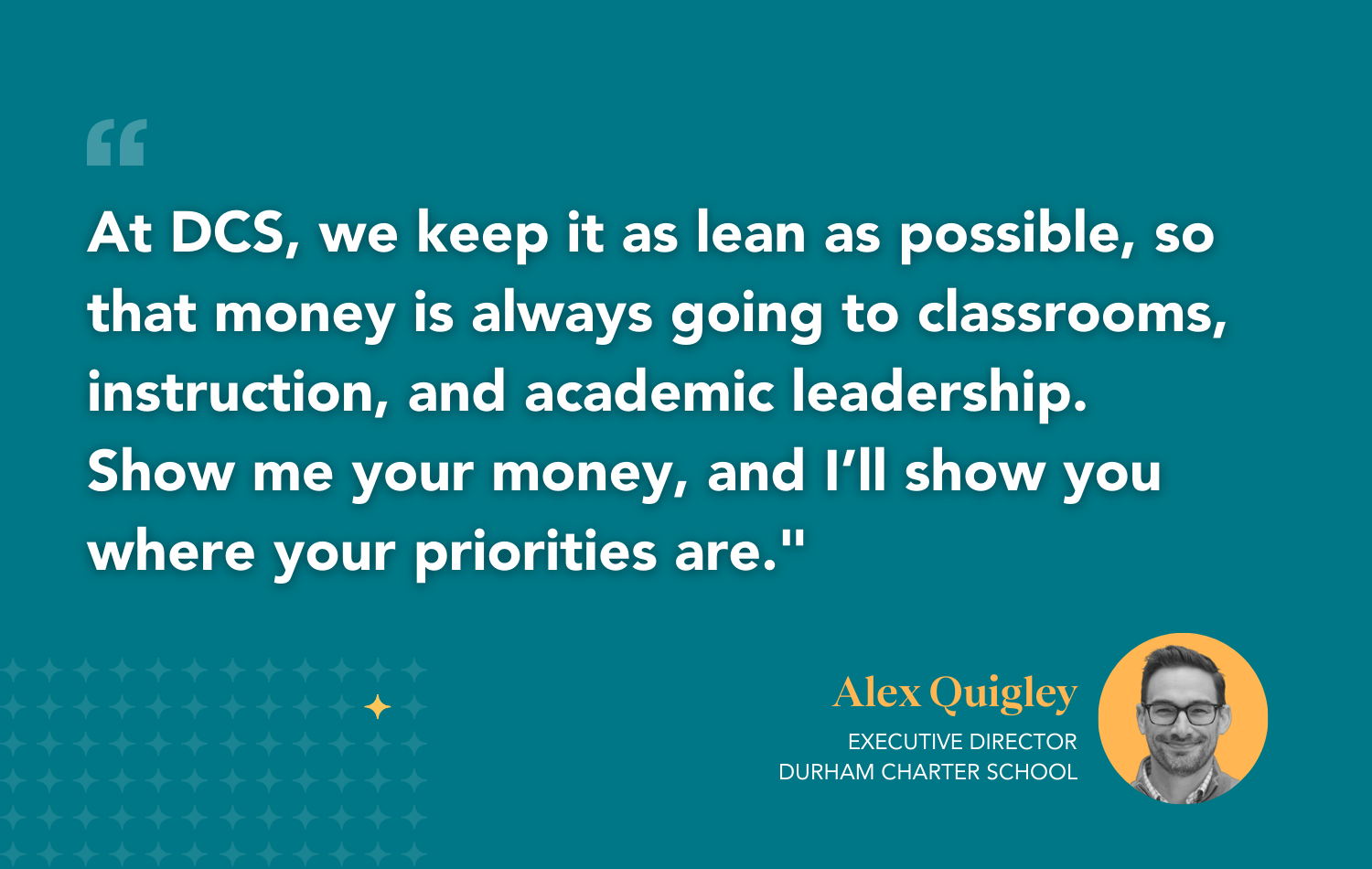
AQ: Invest in people and in classrooms. We all know it’s all about people, they’re everything in a school building in terms of supporting students academically and socially. DCS spends more on academic leaders and coaches to create consistent instruction for teachers, all for students’ benefit. During the COVID-19 pandemic, we spent all our money on staff. One thing we’re experiencing with the CAO as the school has grown is a pitfall a lot of charters face: a tendency to grow and bloat the central office staff. At DCS, we keep it as lean as possible, so that money is always going to classrooms, instruction, and academic leadership. Show me your money, and I’ll show you where your priorities are.
To learn more about Bellwether’s School Quality Framework, reach out to Anson Jackson at anson.jackson@bellwether.org.
*Note: Durham Charter School does not hire teachers directly from a foreign country; any H-1B visa holders the school hires have taught for at least five years in the U.S. under a J-1 visa.
