
SERIES OVERVIEW
This series focuses on the role of accountability systems built to meet federal and state requirements to ensure that schools and districts are meeting their obligation to graduate all students ready for college and career.
Explore the full series from Bellwether experts on the role of state accountability in K-12 education systems.
Alongside conventional school accountability structures, many states also have alternative accountability models, modifying their standard tools to account for the complexities of measuring the quality of a subset of alternative schools. Alternative schools are, for the most part, understood as the second-chance (or last-chance) school for students who have been chronically or seriously unsuccessful in a conventional setting. They may have been expelled, be significantly behind in credit accrual, be parenting themselves, or face any number of other challenges. Many of them have missed significant stretches of instructional time and are likely to have profound skill gaps. In short, these schools set out to serve the students that every other school has decided were “too hard” for them to serve well. Alternative accountability models are a state’s best effort to do what the best of these schools do: meet people where they are, give them the support that meets their needs, and then hold them to appropriately high expectations.
But this is not work that has gotten much attention or resources. Many alternative accountability models are designed in good faith, but are still too clumsy for the problem they’re trying to solve. They treat alternative schools as off-brand versions of “conventional” school counterparts, rather than accounting for the meaningfully different responsibility they have taken on — one with higher stakes and a much smaller margin of error. For many students attending these schools, it’s instructive to ask what we mean by “alternative.” Alternative to what? Most of the time they are at that school because they are out of alternatives. In that sense, these schools may be better understood as alternatives for adults who are out of ideas.
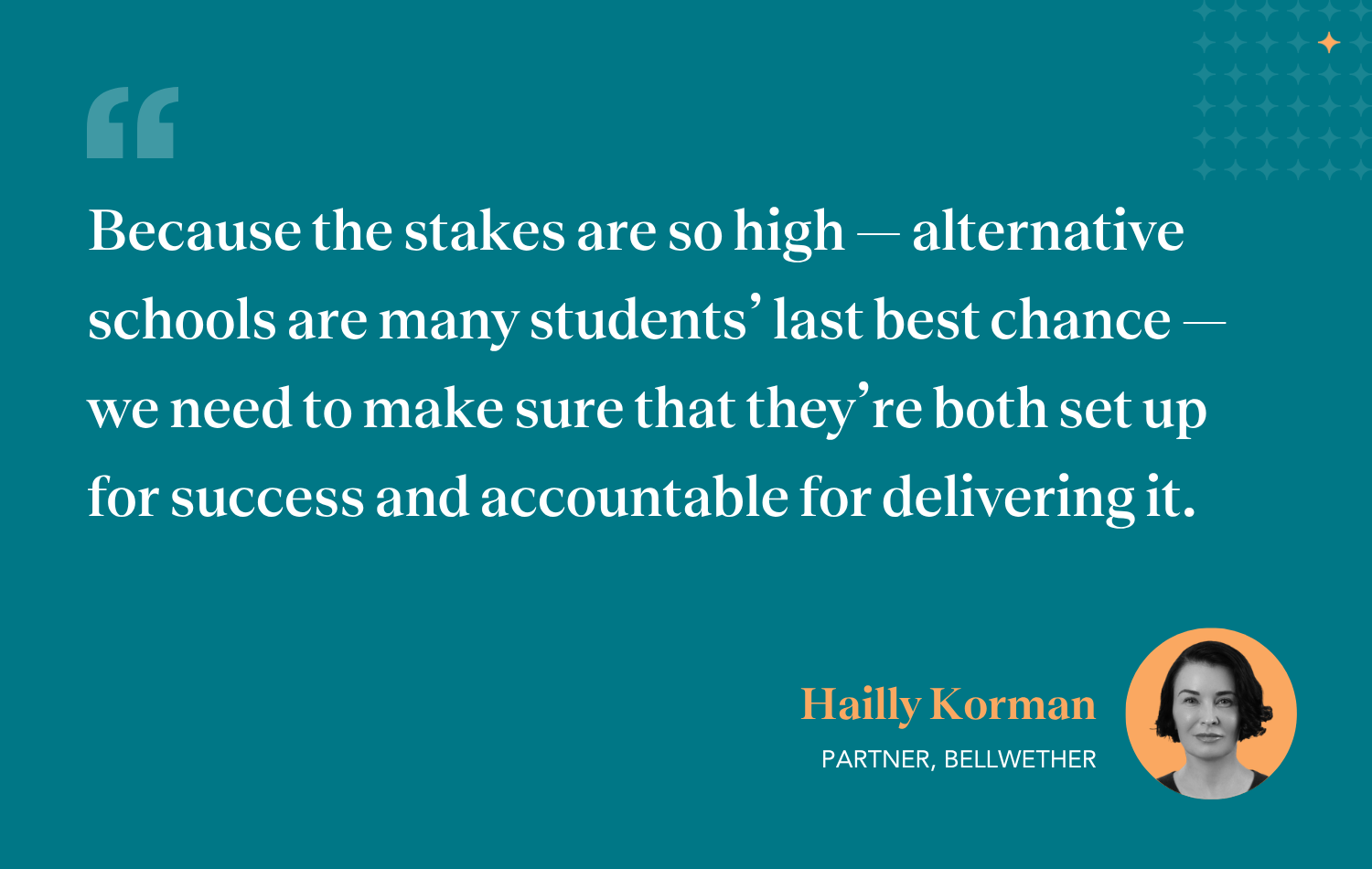
Because the stakes are so high — alternative schools are many students’ last best chance — we need to make sure that they’re both set up for success and accountable for delivering it. That’s what all schools owe to kids, to families, and to communities. Right now, many of these schools are doing things every day that other schools refuse to do (and some are doing them exceptionally well), but because they’re being assessed through a set of measures that never contemplated the challenges that they would take on, they’re classified as “failing.”
Even worse, when that happens, they’re frequently served up a set of supports and resources intended to help them get on track, but that are fundamentally mismatched to the nature of the problem. And the few supports that can meet an unmet need are insufficiently resourced to the task. It’s a circular problem: The reason that kids and schools are in this position in the first place is that very few people know how to serve them well at scale. Assessing and reporting on that is only as helpful as the tools that are used. If alternative accountability models aren’t sufficiently matched to the work that those schools are doing and the needs that they are trying to meet, they won’t produce helpful direction for improvement. And if schools can’t improve, they close. Then what? The alternative for far too many students usually turns out to be not going to school at all.
If we want a sector in which every child can be served well in an environment that suits their needs, high-quality alternative accountability models are an essential part of that.
Bellwether will be at the Reaching At-Promise Students Association (RAPSA) Forum Nov. 4-6, 2026, with some of our colleagues to talk about the realities of implementing alternative accountability structures. If you’ll be there, please consider joining us.
