

During fiscal year (FY) 2023, nearly 8 million students were identified as eligible for special education services, accounting for more than 15% of K-12 public school students nationwide. Federal law ensures every student with a disability has the right to a free public education that meets their needs, helping millions of children get the educational opportunities they deserve.
While the costs of providing special education are split among federal, state, and local revenue sources, school districts disproportionately cover a larger share of the costs. These mounting costs are a more pressing concern for districts as they grapple with an increase in the number of students identified for special education services and the financial implications of meeting federal requirements to provide them.
To support individual state stakeholders — policymakers, education leaders, families, and educators — Bellwether has developed and updated an interactive tool for special education finance equity, which includes state and federal special education funding and enrollment data breakdowns from FY16 to FY23. After updating the tool, several new takeaways emerged that can inform conversations around the relationship between K-12 special education funding and student enrollment.
Takeaway #1: National K-12 Enrollment for Students With Disabilities is Trending Upward
Since FY16, the number of students identified for special education services has increased by 13%, from 6.7 million students in FY16 to 7.5 million in FY23. While the overall trend is upward, there is considerable variation across states and in the level of need among students receiving services (Figure 1). During this time frame, every state, except for Illinois, had an increase in special education enrollment. Hawaii had the smallest growth (3.6%), while Texas had the largest growth (51.8%).
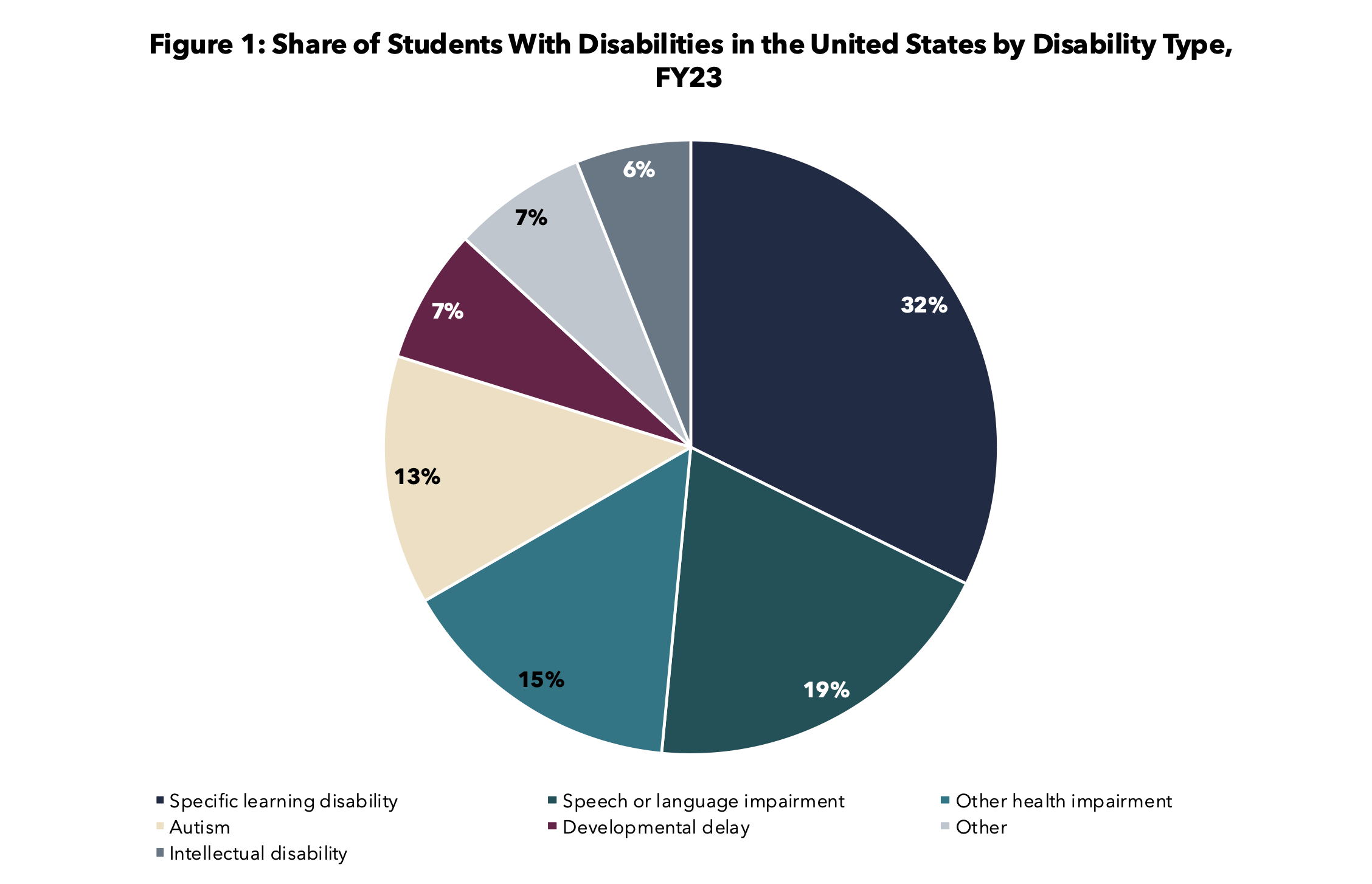
The nationwide trend in increased identification of students with disabilities, combined with the variation in their needs, reflects a rapidly expanding demand for special education services in K-12 schools This underscores a critical need for state and federal governments to provide adequate resources, staffing, and support systems to ensure that districts can effectively support students identified for special education services.
Takeaway #2: Federal Funding Isn’t Keeping Pace with Growing Special Education Enrollment
The federal government supports students with disabilities primarily through the Individual with Disabilities Education Act (IDEA) Part B, Grants to States, which represent 92% of all IDEA funding. IDEA funding is the federal government’s main mechanism for shaping the delivery of special education services; states and districts are required to follow stringent and comprehensive regulations to receive this form of funding.
However, our analysis found that federal funding has not kept up with the increase in students identified for special education services, particularly after for inflation. Total federal appropriations for IDEA Part B, Grants to States rose from $11.7 billion to $14.2 billion between FY16 and FY23, representing a 21% nominal increase. However, after adjusting for inflation, the federal funding declined by nearly $500 million, amounting to a 3% decline in real terms.
The strain becomes clearer when examining federal funding support at the per-pupil level. Despite a nominal 7% growth in per-pupil funding allocations from FY16 to FY23, this growth lags far behind the 13% increase in special education enrollment (Figure 2). When adjusted for inflation, per-pupil funding levels declined by 14%, dropping from $2,199 in FY16 to $1,886 in FY23. At the state level, after adjusting for inflation, every state also had a decline in federal per-pupil funding. In short, while the number of K-12 students requiring special education services has grown, funding from the federal government has effectively declined in real terms.

Takeaway #3: State Funding Resources Vary for Students With Disabilities
States play a critical role in providing special education funding to K-12 districts. Forty-six states and the District of Columbia provide additional funding for students with disabilities through their state funding formulas. However, while nearly every state enrolled more students with disabilities from FY16 to FY23, their funding responses have varied.
Among the 35 states with available funding data from FY16 to FY23, 10 experienced declines in per-pupil special education funding. After adjusting for inflation, the number of states with declines rose to 21, with Connecticut experiencing the largest decrease at $2,812 per individualized education program (IEP).
Conversely, 25 states increased per-pupil special education funding over this same time frame, with Nevada showing the most significant gain, at $6,506 per IEP. However, when adjusting for inflation, only 14 states maintained per-pupil special education funding increases.
This mismatch in federal and state K-12 funding means that in many states, resources are failing to keep pace with growing special education enrollment, leaving districts with the responsibility of serving more students with increasingly inadequate support. The uncertainty surrounding the future of federal IDEA funding, including the potential shift to block grants and reduced federal oversight, further compounds this challenge.
*
Moving forward, state policymakers will play an increasingly pivotal role in ensuring that K-12 districts have the necessary resources to provide students with disabilities the services that they are entitled to under federal law. Developing sustainable and equitable funding policies is not just a fiscal necessity; it is a critical investment in the educational rights and long-term success of students with disabilities and their families.
Yesterday, Krista Kaput spoke with Heather Eckner from the Autism Alliance of Michigan and Nicole Fuller of the National Center for Learning Disabilities about the actions states can take to support students with disabilities. Check out the video below.
