
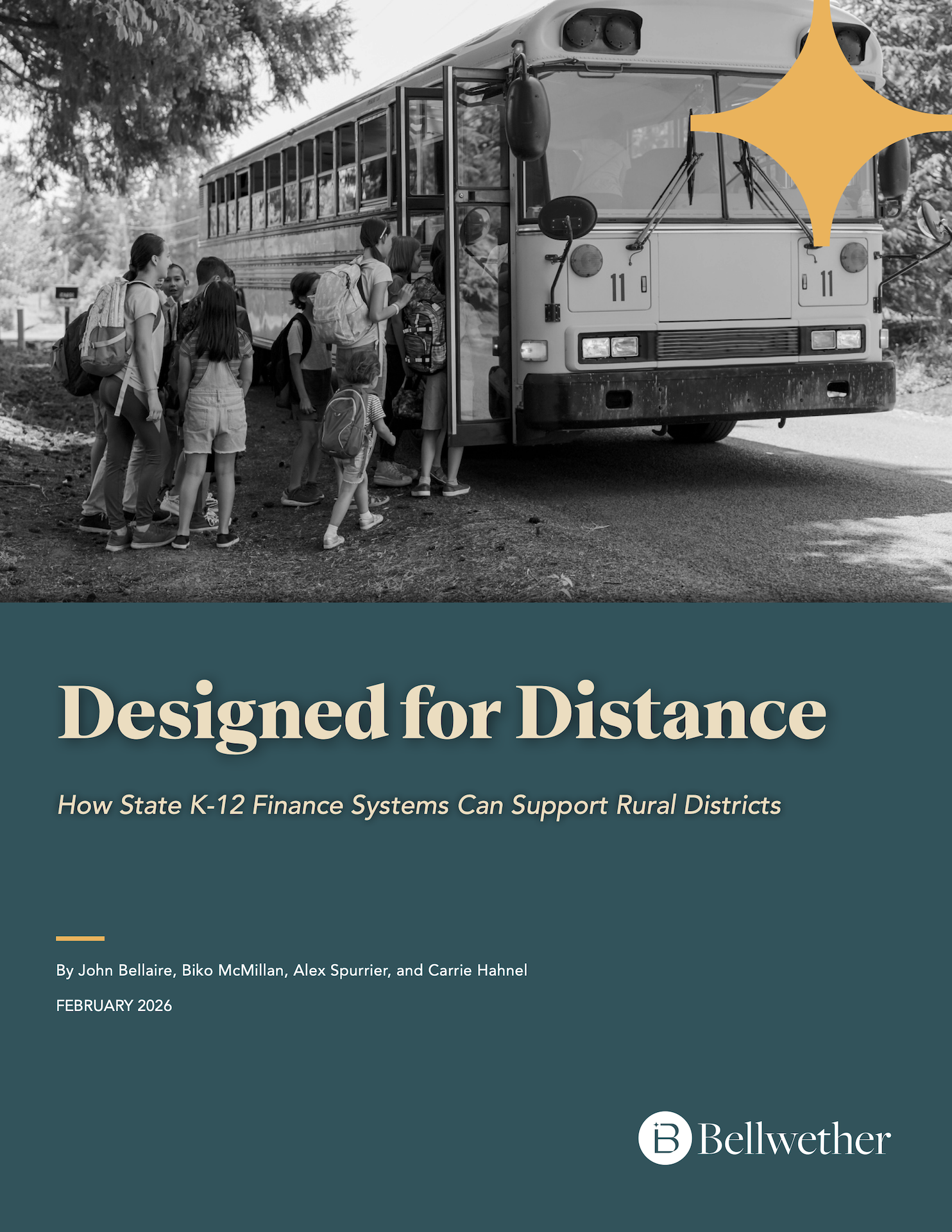
Designed for Distance
How State K-12 Finance Systems Can Support Rural Districts
Overview
In 2022, nearly 8 million U.S. public school students across nearly all states attended districts classified as rural by the National Center for Education Statistics. While rural school districts are not monolithic, they typically encounter similar fiscal pressures that increase the cost of providing public education in their communities: diseconomies of scale, transportation needs, and geographic isolation all contribute to increased costs. Meanwhile, rural districts, on average, have less capacity to generate revenue, particularly through property taxes, since they hold less property wealth. The national median property value in rural districts is only about 64% of that in nonrural districts.
Unless state education funding formulas address the unique constraints on rural districts and cross-district disparities in local wealth, rural schools will struggle to provide the high-quality K-12 education all students deserve.
This report draws on prior research and publicly available data to illustrate patterns and present options for policymakers to address operational funding and supports for rural districts.
Download and read Designed for Distance.
Why Rural Districts Need Dedicated Resources
Of the nearly 49 million K-12 students attending public schools in 2022, 7.6 million — 16% of all students nationwide — were educated in rural school districts. Yet school funding systems in many states do not fully account for the challenges associated with providing public education in rural communities. Rural school districts are more likely to face diseconomies of scale, higher transportation costs, and geographic isolation — factors that raise costs and limit their ability to provide comprehensive services. Developing support mechanisms designed to address these specific cost pressures can help rural districts provide robust educational opportunities for all students.
For many state policymakers, rural school districts represent a substantial proportion of their state’s K-12 students. Twenty-four states have more than 100,000 students enrolled in rural districts, and in 37 states, at least 10% of public school students attend a district designated as rural.

For more on how policymakers and leaders can support rural districts, read Designed for Distance.
Acknowledgments, About the Authors, About Bellwether
Acknowledgments
We would like to thank the many experts who gave their time and shared their knowledge with us to inform our work, including Dreama Gentry, Emily Gutierrez, Taylor McCabe-Juhnke, Melissa Sadorf, and Lori Taylor. Thank you also to the Walton Family Foundation for its financial support of this project.
We would also like to thank our Bellwether colleagues Kelly Robson Foster, Lauren Miller, Paul Beach, and Bonnie O’Keefe for their input and Dwan Dube for her support. Thank you to Amy Ribock, Kate Stein, Andy Jacob, McKenzie Maxson, Temim Fruchter, Julie Nguyen, and Amber Walker for shepherding and disseminating this work, and to Super Copy Editors.
The contributions of these individuals and entities significantly enhanced our work; however, any errors in fact or analysis remain the responsibility of the authors.
About the Authors

JOHN BELLAIRE
John Bellaire is a policy analyst at Bellwether. He can be reached at john.bellaire@bellwether.org.

BIKO McMILLAN

ALEX SPURRIER

CARRIE HAHNEL

Bellwether is a national nonprofit that works to transform education to ensure young people — especially those furthest from opportunity — achieve outcomes that lead to fulfilling lives and flourishing communities. Founded in 2010, we help mission-driven partners accelerate their impact, inform and influence policy and program design, and bring leaders together to drive change on education’s most pressing challenges. For more, visit bellwether.org.
© 2026 Bellwether
This report carries a Creative Commons license, which permits noncommercial reuse of content when proper attribution is provided. This means you are free to copy, display, and distribute this work, or include content from this report in derivative works, under the following conditions:
Attribution. You must clearly attribute the work to Bellwether and provide a link back to the publication at www.bellwether.org.
Noncommercial. You may not use this work for commercial purposes without explicit prior permission from Bellwether.
Share Alike. If you alter, transform, or build upon this work, you may distribute the resulting work only under a license identical to this one. For the full legal code of this Creative Commons license, please visit www.creativecommons.org.
If you have any questions about citing or reusing Bellwether content, please contact us.
