
Realizing Reimagined Teaching
A Framework for Strategic Staffing Implementation
Executive Summary
Every student deserves access to excellent teaching. Yet too often, outdated staffing models leave schools understaffed and teachers overwhelmed. Across the country, many K-12 schools and districts are trying new staffing approaches, but few have the conditions needed to sustain and scale them.
Strategic staffing is an approach to mitigate persistent and interconnected challenges in the K-12 teacher workforce. It reimagines how schools organize people, time, and resources to improve instruction and make the teaching role more sustainable. It is not a single model, but a variety of innovative approaches for reimagining the teacher role. Common strategic staffing models involve elements such as team teaching, differentiated roles, distributed leadership, extended reach for high-impact teachers, innovative pay structures, teacher pipelines, and comprehensive professional learning — often combined in the same site.
When implemented well, strategic staffing models can transform the teaching role across contexts. This report examines the current landscape of strategic staffing, explores what effective implementation requires, and identifies the conditions that support scale. It serves as a resource for policymakers, practitioners, and partners who are working to make excellent teaching sustainable and accessible to every student.
Framework for Effective Implementation
The success of any new idea in schools and districts depends not only on the design itself but also on the conditions that allow it to take hold. Bellwether’s seven-part implementation framework offers a roadmap for system leaders interested in moving strategic staffing from idea to practice.
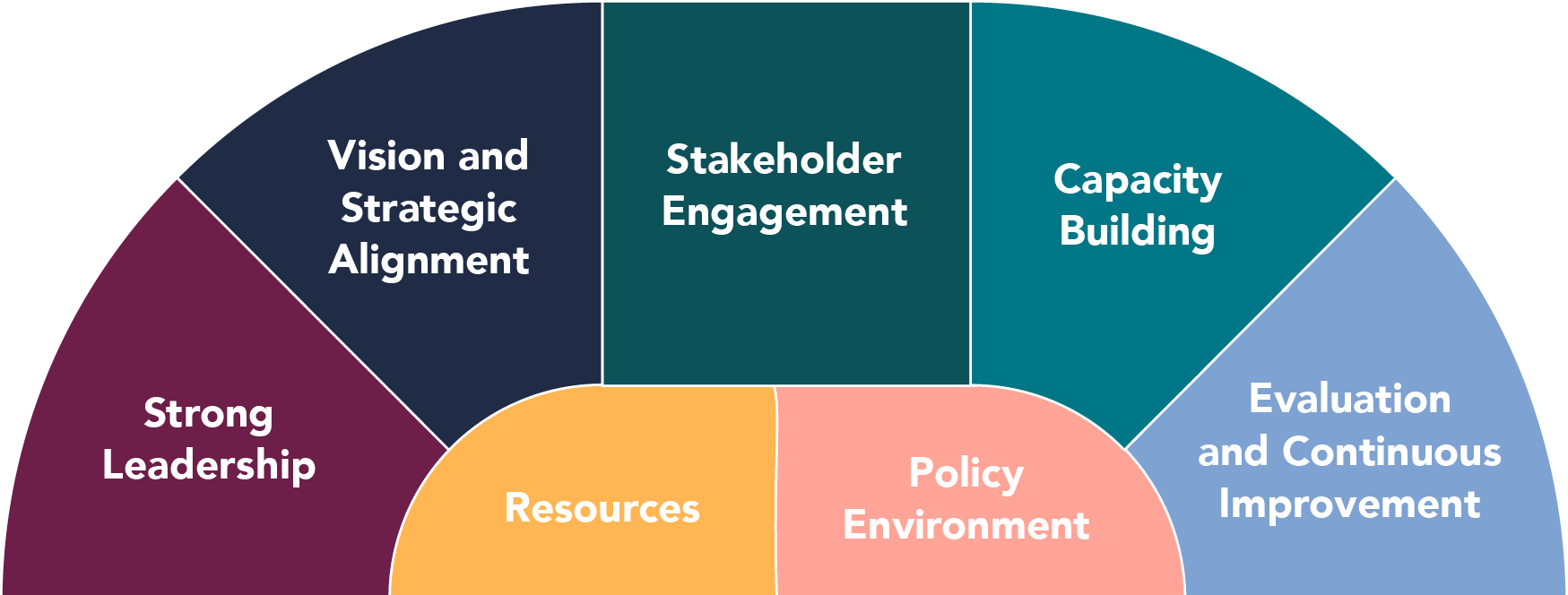
The framework and related case studies in Bellwether’s report demonstrate how implementation of strategic staffing initiatives is successful when the following components are present:
- Strong Leadership: The presence of a committed school- or district-level leader who drives change, fosters trust, ensures clear communication and alignment across all levels, and empowers educators to take ownership in sustaining long-term success.
- Vision and Strategic Alignment: The establishment of a shared, compelling, and motivating aspiration for change grounded in feasible and measurable goals related to student and educator outcomes.
- Stakeholder Engagement: The intentional, strategic process of creating buy-in, shifting mindsets, and building trust through multilateral communication with people across the system.
- Capacity Building: The systems and structures to ensure that educators and leaders have the knowledge, skills, time, and support needed to implement strategic staffing policies effectively.
- Evaluation and Continuous Improvement: The ongoing processes of using data and evidence to monitor progress, assess effectiveness, and iteratively refine implementation to strengthen impact and sustainability.
- Resources: The procurement and allocation of funding, time, technology, infrastructure, data systems, and physical space necessary to launch, sustain, and scale strategic staffing models.
- Policy Environment: The political, organizational, and institutional context that enables strategic staffing initiatives.
Acknowledgments, About the Authors, About Bellwether
Acknowledgments
We would like to thank the many experts who gave their time and shared their knowledge with us to inform our work, including Sarah Beal, Rhea Brown, Leslie Ayorkor Edwards, Pete Fishman, Kelley Gangi, Isabel Geathers, Bryan Hassel, Amy Junge, Kendall Hedding King, Dara Klein, Mary Laski, Randy Mahlerwein, Sara Marshall, Jason Midwood, Lydia Rainey, Tess Reed, David Rosenberg, and Susannah Tsien. Thank you also to the Walton Family Foundation for its financial support of this project.
We would also like to thank our Bellwether colleagues Mark Baxter, Anson Jackson, Krista Kaput, Stephanie Spangler, and Daniela Torre Gibney for their input and Alexis Richardson for her support. Thank you to Amy Ribock, Kate Stein, Andy Jacob, McKenzie Maxson, Temim Fruchter, Julie Nguyen, and Amber Walker for shepherding and disseminating this work, and to Super Copy Editors.
The contributions of these individuals and entities significantly enhanced our work; however, any errors in fact or analysis remain the responsibility of the authors.
About the Authors

SOPHIE ZAMARRIPA

DAVID CASALASPI

TITILAYO TINUBU ALI

Bellwether is a national nonprofit that works to transform education to ensure young people — especially those furthest from opportunity — achieve outcomes that lead to fulfilling lives and flourishing communities. Founded in 2010, we help mission-driven partners accelerate their impact, inform and influence policy and program design, and bring leaders together to drive change on education’s most pressing challenges. For more, visit bellwether.org.
© 2026 Bellwether
This report carries a Creative Commons license, which permits noncommercial reuse of content when proper attribution is provided. This means you are free to copy, display, and distribute this work, or include content from this report in derivative works, under the following conditions:
Attribution. You must clearly attribute the work to Bellwether and provide a link back to the publication at www.bellwether.org.
Noncommercial. You may not use this work for commercial purposes without explicit prior permission from Bellwether.
Share Alike. If you alter, transform, or build upon this work, you may distribute the resulting work only under a license identical to this one.
For the full legal code of this Creative Commons license, please visit www.creativecommons.org. If you have any questions about citing or reusing Bellwether content, please contact us.
