
Scaling What Works
Creating Career-Connected Learning Ecosystems That Support Students
Series Overview
By 2031, 85% of jobs that provide a family sustaining wage in the U.S. will require education and training beyond high school. 1 Yet today, just 44% of Americans hold a postsecondary credential. 2 This disconnect will have real consequences for learners, communities, and states. For individual learners, entering the workforce with only a high school diploma can mean a nearly $5,000 difference 3 in median annual earnings compared to those with a high-quality credential and a $20,000 difference 4 in median annual earnings, compared to those with an associate degree. For states, when credential attainment doesn’t meet labor market need, it can decrease the state’s tax base and weaken its economies. 5
States have a unique opportunity to close this gap between credential attainment and labor market expectations by expanding career-connected learning opportunities that start in high school. Evidence-based high school models — such as career academies, career and technical education (CTE) programs of study, CTE dual or concurrent enrollment, early college high schools (ECHS), pathways in technology early college high schools (P-TECHs), and youth apprenticeships — give students an early start on pursuing their postsecondary and career goals. These models blend secondary and postsecondary academic and technical learning with authentic work-based experiences, improving outcomes in academic achievement, college enrollment, persistence, employment, and earnings (for more details, see “Career-Connected Learning Models” in the lefthand menu).
Download and read Scaling What Works: Policies to Support Individual High School Career-Connected Learning Models and Scaling What Works: Lessons on Creating a Career-Connected Learning Ecosystem From Four Leading States.
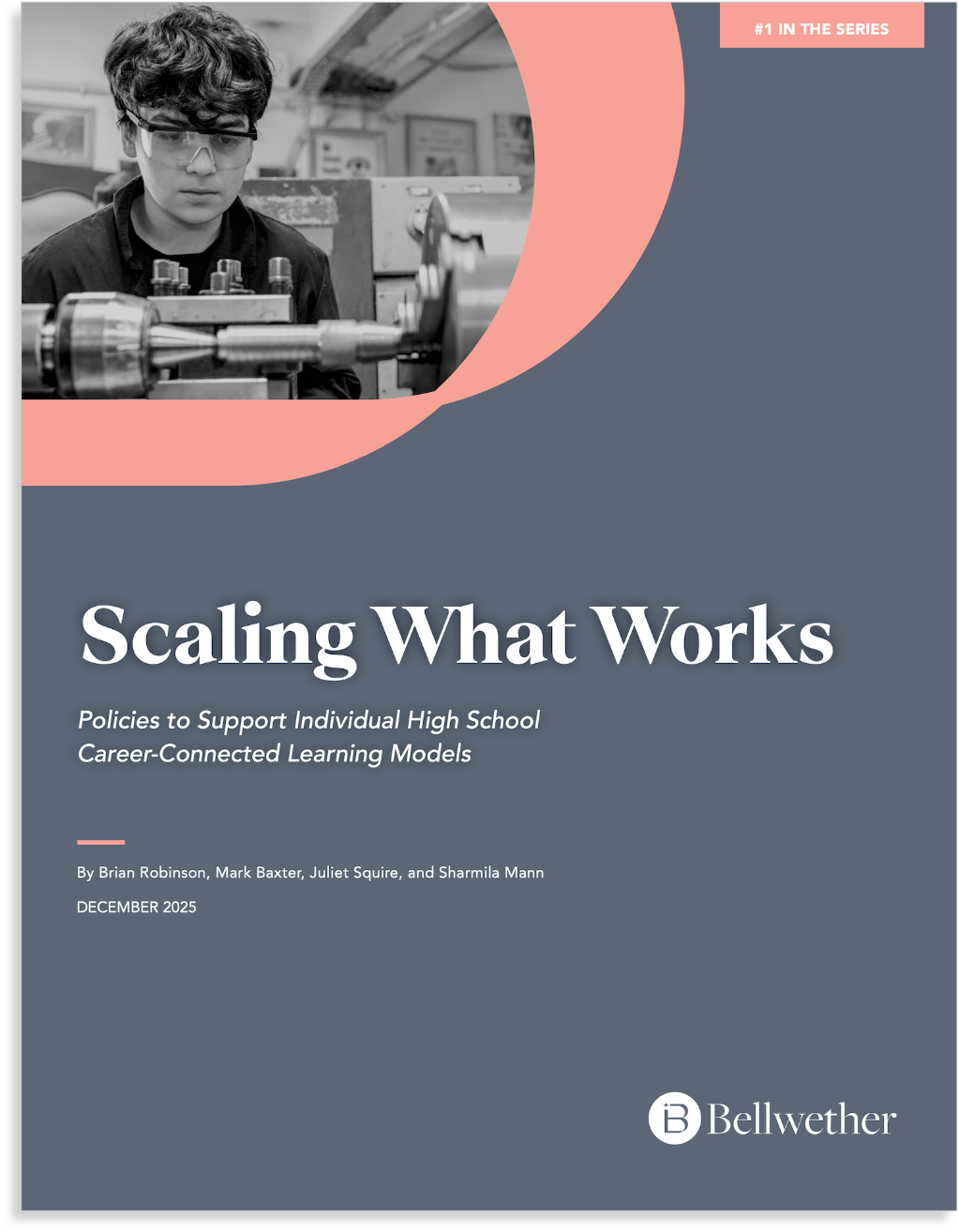
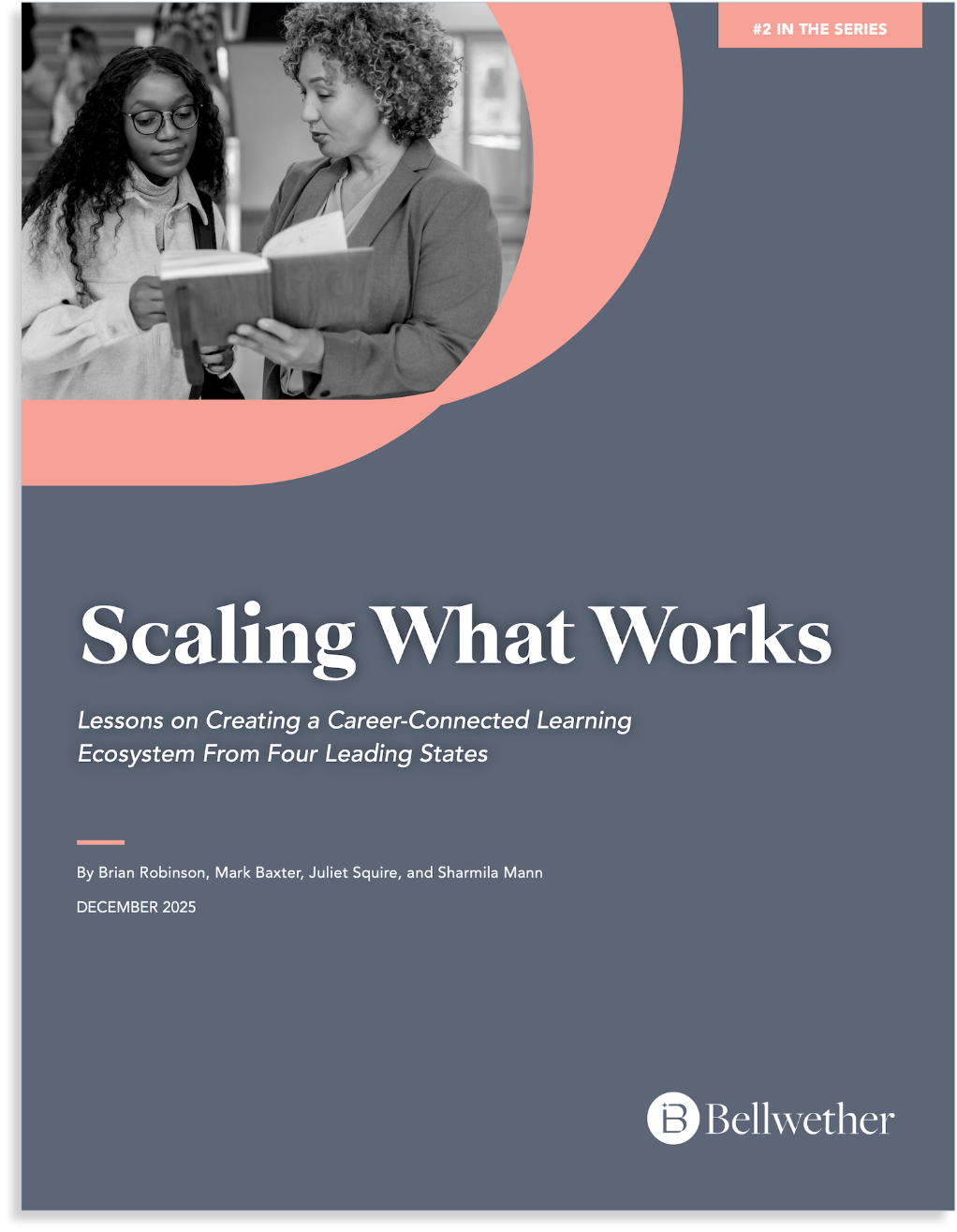
Despite the benefits of these programs, states are in different places in their career-connected learning journeys. Bellwether has created two briefs to help states advance their efforts based on local context and need.
For state policymakers interested in scaling specific, evidence-based career-connected learning models in high school, it is important to understand the policies that enable one or more models to gain traction and thrive. Our first brief, “Scaling What Works: Policies to Support Individual High School Career-Connected Learning Models,” summarizes research on the foundational policies that undergird the success of specific models.
While these foundational policies are crucial to the development of specific career-connected learning models, gaps remain that prevent multiple models from scaling in states. For state policymakers interested in building an ecosystem of evidence-based career-connected high school models, our second brief, “Scaling What Works: Lessons on Creating a Career-Connected Learning Ecosystem From Four Leading States,” summarizes lessons learned from four states that have made progress in this direction.
Career-Connected Learning Models
Evidence-based career-connected learning models give students an early start on pursuing their postsecondary and career goals. Scaling multiple evidence-based models allows more students to access programs that connect learning to meaningful careers. This is especially true for students who are furthest from opportunity, including students of color, 6 students from low-income households, 7 and students who live in rural communities, 8 who often face the biggest barriers to accessing career pathway programs. Limited opportunities for participation at the secondary level translate to detrimental consequences for these student groups as they move into adulthood, where they are more likely to be unemployed, underemployed, or working low-wage jobs. 9
Download and read Scaling What Works: Policies to Support Individual High School Career-Connected Learning Models and Scaling What Works: Lessons on Creating a Career-Connected Learning Ecosystem From Four Leading States.
| Type of Program | Description |
| Career Academies | Specialized high school programs (often called “schools within a school”) that integrate academic and technical education around a specific career theme, such as health sciences, engineering, or business. Career Academies combine rigorous academic coursework with career-focused learning and work-based learning experiences. |
| CTE Dual or Concurrent Enrollment | An educational arrangement where high school learners are enrolled simultaneously in secondary and postsecondary coursework. Like traditional academic programs, learners participating in CTE dual or concurrent enrollment can earn college credits that count towards both high school graduation and a postsecondary degree or professional certificate. These programs are designed to accelerate educational opportunities, enhance the rigor of high school education, and provide learners with a head start on career readiness. |
| CTE Programs of Study | High school programs that integrate academic and technical skills, offering practical knowledge and hands-on experience in specific career fields. Through CTE Programs of Study, students complete a sequence of related courses in a specific career pathway, culminating in industry-recognized credentials, certifications, and/or college credits. |
| ECHS | An educational model that blends high school and college in a cohesive, integrated program within a specialized school that enables learners to simultaneously earn a high school diploma and substantial college credits toward an associate or bachelor’s degree. |
| P-TECH | An educational model that integrates high school, college, and career training within a specialized school to equip students with the skills and credentials needed for the workforce. Students can complete high school and college coursework simultaneously, while earning a high school diploma and an associate degree within six years for free. P-TECH schools partner with industry leaders to provide mentorship, internships, and work-based learning opportunities, strongly emphasizing STEM fields. |
| Youth Apprenticeship | Education programs that combine academic instruction with work-based learning for high school students. These programs are designed to provide students with practical, hands-on experience in a specific trade or profession while they continue to meet their high school graduation requirements. Youth apprenticeships aim to bridge the gap between school and the workforce by providing young people with the skills, knowledge, and work experience necessary to succeed in today’s economy. |
Acknowledgments, About the Authors, About Bellwether
Acknowledgments
We would like to thank the many experts who gave their time and shared their knowledge with us to inform our work, including Kristy Brown, Charlotte Cahill, Kyle Hartung, Andrew Hodge, Deborah Knoll, Kate Kreamer, Monica Martinez, Danielle Ongart, Alex Perry, Luke Rhine, and Bryce Warden. Thank you also to the Walton Family Foundation for its financial support of this project.
We would also like to thank our Bellwether colleague Colleen Campbell for her input and former Bellwether colleague Janine Sandy for her support. Thank you to Amy Ribock, Kate Stein, Andy Jacob, McKenzie Maxson, Temim Fruchter, Julie Nguyen, and Amber Walker for shepherding and disseminating this work, and to Super Copy Editors.
The contributions of these individuals and entities significantly enhanced our work; however, any errors in fact or analysis remain the responsibility of the authors.
About the Authors

BRIAN ROBINSON

MARK BAXTER

JULIET SQUIRE

SHARMILA MANN
Bellwether is a national nonprofit that works to transform education to ensure young people — especially those furthest from opportunity — achieve outcomes that lead to fulfilling lives and flourishing communities. Founded in 2010, we help mission-driven partners accelerate their impact, inform and influence policy and program design, and bring leaders together to drive change on education’s most pressing challenges. For more, visit bellwether.org.
This report carries a Creative Commons license, which permits noncommercial reuse of content when proper attribution is provided. This means you are free to copy, display, and distribute this work, or include content from this report in derivative works, under the following conditions:
Attribution. You must clearly attribute the work to Bellwether and provide a link back to the publication at www.bellwether.org.
Noncommercial. You may not use this work for commercial purposes without explicit prior permission from Bellwether.
Share Alike. If you alter, transform, or build upon this work, you may distribute the resulting work only under a license identical to this one.
For the full legal code of this Creative Commons license, please visit www.creativecommons.org. If you have any questions about citing or reusing Bellwether content, please contact us.
Footnotes
- Jeff Strohl, Artem Gulish and Catherine Morris, The Future of Good Jobs: Projections Through 2031, (Georgetown University Center on Education and the Workforce), 2024, https://cew.georgetown.edu/wp-content/uploads/cew-the_future_of_good_jobs-fr.pdf.[↩]
- Lumina Foundation, Credentials of Value (Stronger Nation, 2025), https://strongernation.luminafoundation.org/credentials-of-value.[↩]
- Noah Berger and Peter Fisher, “A Well-Educated Workforce Is Key to State Prosperity,” Economic Policy Institute, Aug. 22, 2013, https://www.epi.org/publication/states-education-productivity-growth-foundations/.[↩]
- Andrew Hanson, “Examining the Value of Nondegree Credentials,” Strada Education Foundation, July 28, 2021, https://www.strada.org/reports/examining-the-value-of-nondegree-credentials.[↩]
- Noah Berger and Peter Fisher, “A Well-Educated Workforce Is Key to State Prosperity,” Economic Policy Institute, Aug. 22, 2013, https://files.epi.org/2013/A%20well-educated%20workforce%20is%20key%20to%20state%20prosperity.pdf.[↩]
- Rebeca Shackleford and Kristen Hengtgen, “A Vision for Equitable Pathways: Enhancing Support and Innovation in College and Career Counseling,” EdTrust and All4Ed, September 2024, https://files.eric.ed.gov/fulltext/ED670956.pdf.[↩]
- Linea Koehler, Harold Hinds and Nick Lee, “Expanding Opportunity: How States Can Accelerate the Use of Career Pathways Programs to Help Young People Access Meaningful Careers,” Bellwether, March 2023, https://bellwether.org/wp-content/uploads/2023/03/ExpandingOpportunity_Bellwether_March2023.pdf.[↩]
- Advance CTE, Council of Chief State School Officers and Education Strategy Group, “Making Good on the Promise: Expanding Access to Opportunity,” June 2019, https://careertech.org/wp-content/uploads/2023/01/Equity_Brief_4_Final_1.pdf.[↩]
- Moussa, Nano. “How Employers Can Address the Social Determinants of Work.” Jobs for the Future (JFF), May 24, 2023. https://www.jff.org/blog/how-employers-can-address-social-determinants-work/.[↩]
