
School finance is a complicated topic to understand. The available universe of school finance data doesn’t make it any easier: relevant datasets are spread across agencies, often in different formats, and require a great deal of cleaning before researchers can do any sort of useful analysis. This challenge is why Bellwether developed and released edfinr — an R package of tidy K-12 school finance data — one year ago. It’s a tool that’s been embraced by the field: edfinr has been downloaded more than 2,000 times since August 2025.
At conferences for the Association for Education Finance and Policy and Harvard University’s Strategic Data Project, and through a combination of virtual and in-person trainings, our team helped researchers explore education finance questions with edfinr. We also gathered feedback on how we could make edfinr better.
Launching a New and Improved edfinr for Education Finance Researchers
Today, we’re launching an updated version of edfinr designed to be even more useful to education finance researchers.
- New F-33 Data: The original edfinr package shipped with district-level finance data from the National Center for Education Statistics (NCES) F-33 survey that covered each school year (SY) from SY11-12 through SY21-22. Today’s update adds data from the latest NCES F-33 release, which covers SY22-23.
- Expanded Capital Spending and Debt Data: In addition to edfinr’s collection of revenue and current expenditure data, the updated edfinr now includes data on capital outlays, debt service, and fund balances.
- More Community Characteristic Data: The rerelease of edfinr adds several new variables from the U.S. Census Bureau’s American Community Survey 5-Year estimates that provide more detail on school districts, including mean household income, homeownership rates, unemployment rates, and more. We’ve also included granular data on district urbanicity and sparsity (students per square mile).
- Teacher Wage Index Data: NCES provides a Comparable Wage Index for Teachers (CWIFT) — now included in edfinr — that enables researchers to adjust K-12 finance data based on regional variations in the wages of college-educated workers. This allows researchers to more fairly compare K-12 district revenue and spending across different geographic areas.
Using the Updated edfinr in Practice
These new data fields will help researchers analyze more complex questions with greater ease. For example, you might be interested in understanding how the CWIFT wage index differs across urban, suburban, and rural districts. Creating a visualization to answer that question only takes a few lines of code with edfinr.
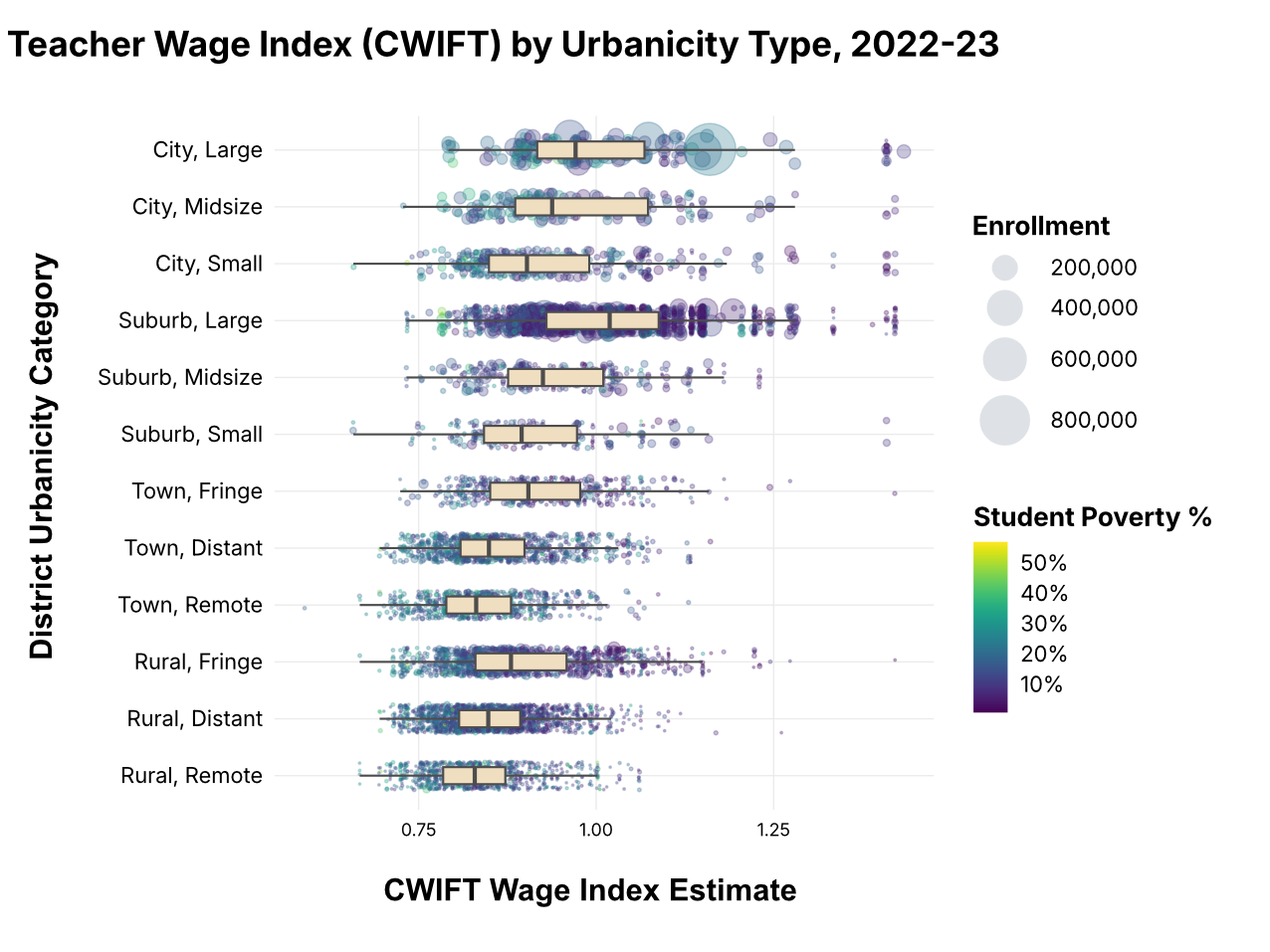
Source: edfinr; Districts with enrollment > 300 students.
The resulting edfinr plot illustrates important high-level trends:
- Large suburban districts tend to have higher CWIFT estimates and lower student poverty rates.
- Rural districts tend to have lower CWIFT estimates, but some low-poverty “rural fringe” districts can have CWIFT estimates that exceed the average of large suburban districts.
- The variation in CWIFT estimates within urbanicity categories is wider than the variation across those categories.
This example only scratches the surface of the kinds of questions researchers can examine with the updated version of this tool. As more states feel the pressure of declining enrollment alongside the end of COVID-19 pandemic relief funding, there will be greater interest in understanding how K-12 dollars are flowing through school systems to help policymakers make better decisions for students. That’s what Bellwether’s enhanced edfinr is built for.
The functionality and data-cleaning methodology in edfinr will evolve. To learn more about how to install and use the tool, visit the edfinr webpage. Questions or feedback? Contact Alex Spurrier at alex.spurrier@bellwether.org.
