
Systemic Impact
The Only Path to Scale, Success, and Sustainability
Introduction
“When we remember that no system is God-given, we remember that every system is changeable. Which means every system was already changed, more than once.” —Eric Liu1
“Power concedes nothing without a demand. It never did and it never will.” —Frederick Douglass2
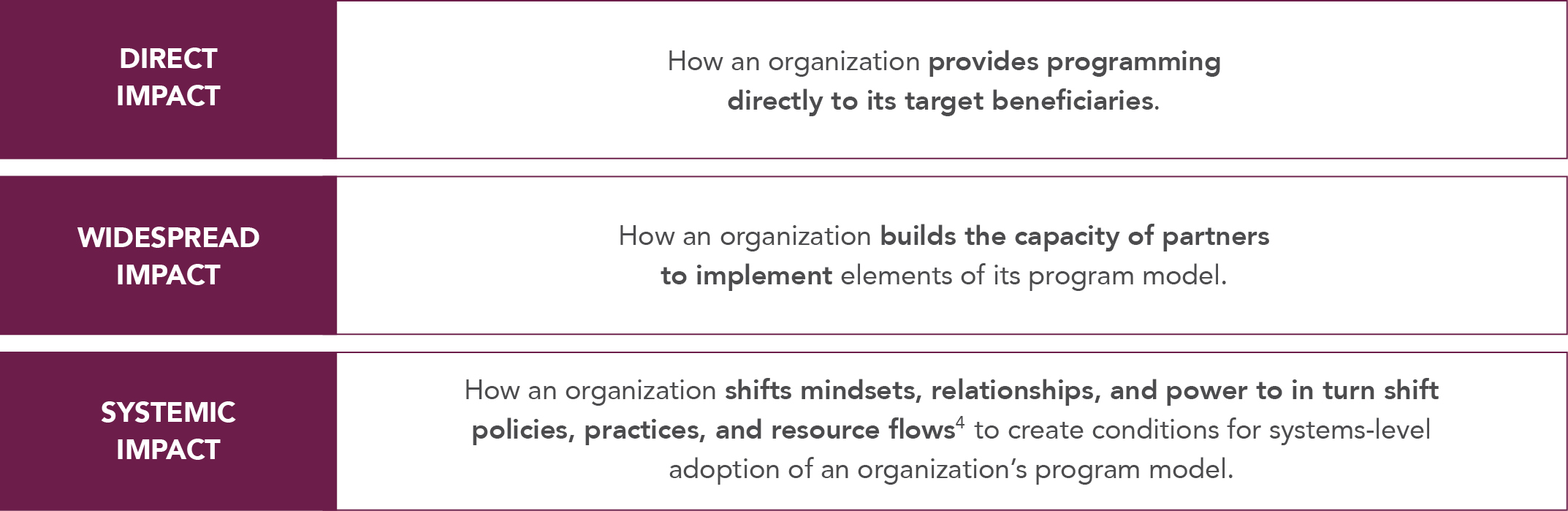
In June 2022, Bellwether published the Pragmatic Playbook3 which explored how organizations can employ three strategies to maximize their impact: Direct Impact, Widespread Impact, and Systemic Impact.4
These three strategies are not mutually exclusive and can, in fact, be mutually reinforcing (Figure 1).
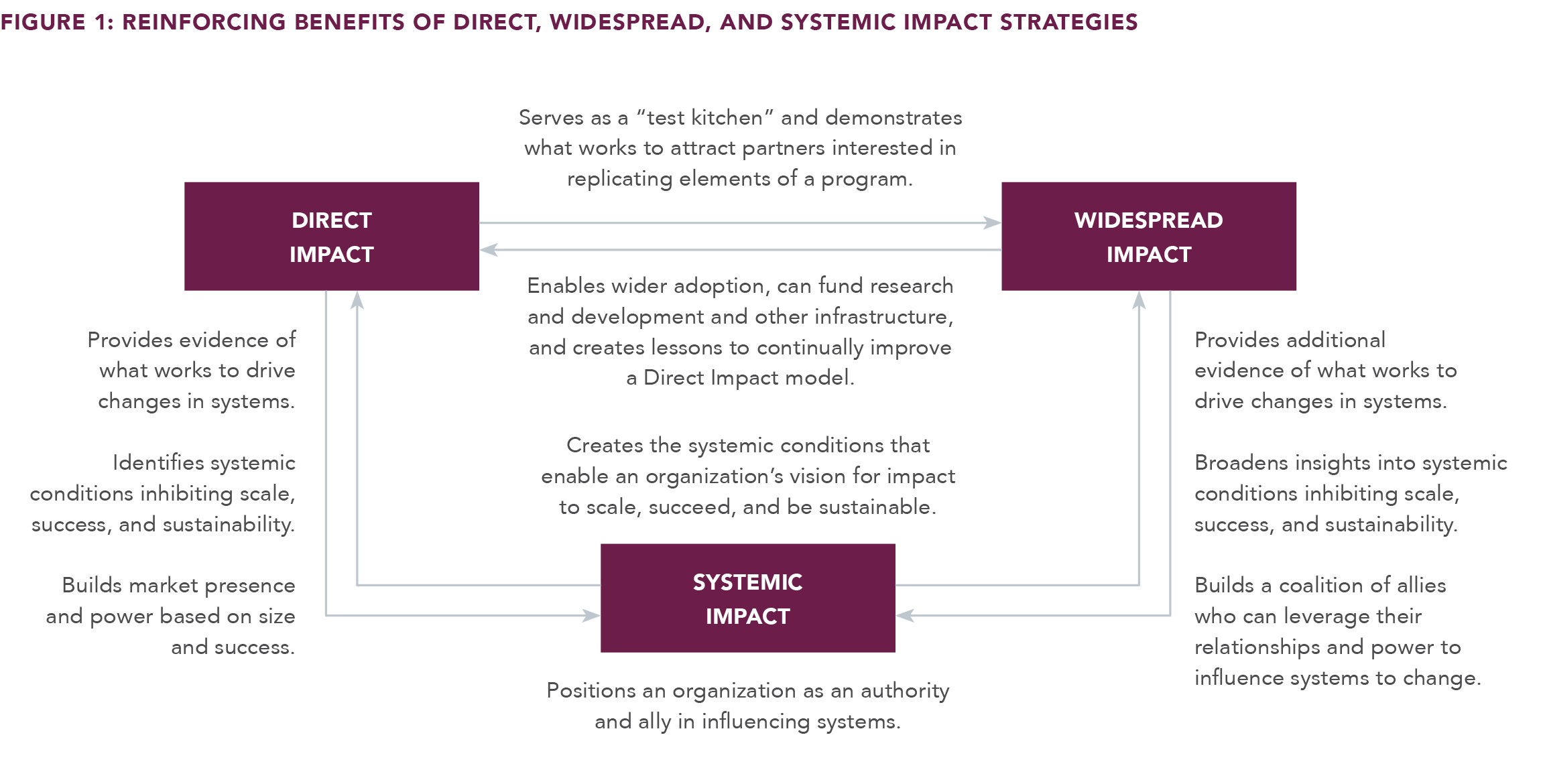
Over the past three-plus years, dozens of organizations across the country have adopted this framework for strategic decision-making and have used its key principles to communicate priorities in a clear, compelling external pitchbook to attract clients, partners, funders, and allies, and as an internal playbook to build alignment within their organization.
One of the biggest areas of need organizations frequently cite is access to more guidance and resources on how to build their ability to pursue Systemic Impact. In January 2025, Bellwether launched an initiative to explore strong practices in Systemic Impact, culminating in a June 2025 community of practice composed of 10 postsecondary persistence advising organizations across the country. The community focused on promising practices to build and/or evolve participants’ Systemic Impact strategies and to provide feedback and counsel to pressure test this content, grounded in a shared set of strategic questions (Table 1).
This first publication focuses on the “why” and “what” of Systemic Impact, with subsequent publications and resources focused on the “how” of Systemic Impact.
TABLE 1: KEY QUESTIONS GUIDING SYSTEMIC IMPACT AND ITS DESIGN AND EXECUTION
| Key Questions | |
| What Is Systemic Impact? |
|
| How Is a Systemic Impact Strategy Designed and Executed? |
|
A Note on Language: Although the sector uses the terms “Systemic Impact” and “Systems Change” interchangeably, this report anchors on “Systemic Impact” (except in direct quotes). At times, the most important Systemic Impact work is not to create a change but rather to preserve the status quo or “play defense” to preserve existing progress — to resist change that is in opposition to an organization’s agenda.
Why Is Systemic Impact Important?
Systemic Impact is a strategy all organizations must pursue (individually and/or in coalitions) to achieve their ambitions for scale, success, and sustainability.i In the education sector, a greater focus on and investment in Systemic Impact is important for three reasons:
- Many education reform efforts ignore Systemic Impact, pursuing a “field of dreams” as their theory of change (“If you build it, they will come”).
- Systemic Impact is the only way to achieve true population-level impact — it is philanthropy’s only exit strategy, and it is the ultimate in business development.
- Education systems are experiencing seismic shifts in funding and focus. An education organization does not have to be interested in systems for systems to be interested in it.
1. Many education reform efforts ignore Systemic Impact, pursuing a “field of dreams” as their theory of change (“If you build it, they will come”).
Education reform and education philanthropy have often operated under a fundamentally flawed premise, pursuing a theory of change grounded in the 1989 movie Field of Dreams, paraphrasing its iconic line: “If you build it, they will come.”5 This theory presumes that if education reformers and philanthropists are righteous in their intent about addressing inequity and they are getting promising results, then that is all it takes for others to broadly follow them into the “field” and transform systems.
Unfortunately, this theory keeps falling short of creating systems-level impact because it has two flaws:
- First, education systems are not wholly rational systems; they are also political systems. Education systems are a complex web of money, power, interests, and values. If an education innovation requires disrupting the status quo of money, power, interests, and values to get to scale, it can expect the system to push back. Systems are very good at preserving their status quo.
- Second, efforts to change education systems often neglect to be representative of and responsive to the communities they are trying to serve. Reform agendas are typically set by and reflect the values of people with “Social problems are owned by social systems, which can enact policy, direct funding, and implement and hold accountable changes in practices at scale.” Organizations can consider three types of growth: 1) growth in scale related to how many beneficiaries they reach, 2) growth in success in achieving impact for these beneficiaries, and 3) growth in sustainability to ensure there is sufficient funding to enable their programs to endure. i “ 6 Systemic Impact: The Only Path to Scale, Success, and Sustainability Bellwether.org privilege in positions of power. These efforts can marginalize and alienate the very communities that reforms are intended to benefit by imposing an agenda on them, essentially disenfranchising them in the same way that existing underperforming education systems often do.6
2. Systemic Impact is the only way to achieve true population-level impact — it is philanthropy’s only exit strategy, and it is the ultimate in business development.
Philanthropy by itself cannot support population-level impact. K-12 education philanthropy was estimated to have spent up to $7 billion in school year (SY) 2016-17,7 which is a prodigious number (and may be high). In contrast, the U.S. spent $707 billion on public K-12 education in SY16-178 from federal, state, and local sources (and this does not include private spending on education).
Philanthropy is less than 1% of total K-12 spending, and the vast majority is focused on the supply side of innovations and not the demand side of systems. As John King, the chancellor of SUNY, once shared, “We are investing something like 98% of our national philanthropy in supply, and at best 2% on demand, and we’re not seeing equityfocused systems change happen quickly enough.”9
Ultimately, unless there is a consumer-focused market for an education solution, social problems are owned by social systems, which can enact policy, direct funding, and implement and hold accountable changes in practices at scale. As such, virtually every nonprofit and/or education reform effort must engage in Systemic Impact.
For philanthropies, “Systemic Impact is philanthropy’s only exit strategy”10 in terms of achieving their ambition for scale, success, and sustainability (though to achieve this, philanthropy will need to make enduring investments in Systemic Impact). For education leaders and organizations seeking to grow innovations, “Systemic Impact is the ultimate in business development.”11
3. Education systems are experiencing seismic shifts in funding and focus. An education organization does not have to be interested in systems for systems to be interested in it.
As of fall 2025, there are fundamental changes happening to education funding:
- Federal education funding is being disrupted and reduced. Remaining federal funding for education is likely to become block grants delivered to the states.
- New K-12 funding mechanisms are transferring more of the power of spending into the hands of families and creating new school choice marketplaces.
- Federal policy changes are impacting student loans and borrowing for pursuing conventional postsecondary degree pathways, while opening new funding for nondegree pathways.
Amid a changing federal funding landscape, the education sector is facing a structural decline in K-12 and postsecondary enrollment (in aggregate; this can vary significantly based on local geography).12 There were fewer births after the Great Recession, which will lead to a decline in high school graduates, and fewer international students may pursue education in America in the foreseeable future.13
In addition, the lines continue to blur among K-12, postsecondary, and workforce. There is growing skepticism about the value and affordability of conventional postsecondary pathways (e.g., pursuing a four-year bachelor’s degree), while also growing interest in nondegree and workforce pathways (e.g., short-term credentials or apprenticeship models) — even as there continues to be critical information gaps about the performance of pathways of all types to guide individual choice and systemic accountability. There is also a rising level of directiveness shaping what is taught in some education systems, while at the same time there is a growing school choice marketplace in K-12 that enables further fragmentation.
Changes to education systems are happening all over the country, whether organizations like it or not. The old adage “You’re either at the table or on the menu” applies when it comes to rapidly transforming education systems. Navigating these evolving systems, however, is easier said than done.
Why Is Systemic Impact So Hard?
Despite these arguments in favor of Systemic Impact, there are reasons that organizations hesitate to pursue it.
Systemic Impact is unapologetically about power and who controls the agenda. As Liu observed, “If you don’t learn how to practice power, someone else will do it for you — in your name, on your turf, with your voice, and often against your interests.”14 Systemic Impact requires exercising power through partnering, persuasion, pressure … or any combination thereof.
Systemic Impact has a long (if not eternal) timeline and is nonlinear. Systemic Impact is neither a sprint nor a marathon, but rather a commitment to walk 10,000 steps every day, frequently around the same track, and sometimes walking backwards because those with competing agendas will push back.15 For example, Systemic Impact initiatives around restricting abortion or legally recognizing gay marriage were planned over decades, not in just one to three years. The wheel is always turning, and often in the direction that those with the most power want it to turn. Because of this, Systemic Impact is usually nonlinear and cyclical.
Systemic Impact frequently requires multiple campaigns to:
- Elect or ensure the hiring/appointment of people to positions of authority.
- Change a policy or preserve a policy (sometimes the most important campaigns are to preserve the status quo and play defense).
- Secure funding for a policy (if funding was not originally allocated).
- Ensure policy is implemented (“Implementation is where Systemic Impact goes to die.”).
- Promote adoption by stakeholders who can now access and benefit from an implemented policy.
Systemic Impact demands effective, well-designed, and well-executed campaigns, which requires organizations to answer the following questions:
- What is the future-state vision an organization is trying to achieve?
- What are the barriers to achieving this vision?
- How does an organization design and execute a Systemic Impact campaign to overcome one or more barriers?
- What is a specific agenda for impact an organization is trying to achieve?
- Which system or systems have the authority to advance this agenda?
- What is the map of how power flows within this system? Who has to be influenced to do what in order to achieve this campaign agenda?
- What is the set of actions an organization needs to take in a campaign to shift mindsets and relationships and then exercise power to influence authority?
- What are the resources required to undertake this Systemic Impact campaign?
- What are the risks and opportunity costs to be considered before committing to a campaign?
- How does an organization use measurement in planning a campaign, managing its execution, and demonstrating its outcomes?
- What are the challenges to implementation in Systemic Impact and how can an organization address them?
Systemic Impact requires resources. Systemic Impact requires the funding fortitude to recognize the long-term (if not perpetual) financial requirements required for enduring success. Systemic Impact is also very different work than Direct Impact or Widespread Impact and requires different skills and talent — be it in-house, via coalitions, or via vendors — to design and successfully execute Systemic Impact campaigns.
Though Systemic Impact is hard, it is also possible — and it is happening all the time. The purpose of this publication and its companion pieces is to lower the barriers to successfully planning and executing Systemic Impact strategies by offering a road map of design questions that organizations should answer along their journey, as well as examples of how various leaders and organizations have answered these questions in their own path to Systemic Impact. In approaching Systemic Impact, there are two quotes to keep in mind:
“There is nothing more difficult to take in hand, more perilous to conduct, or more uncertain in its success, than to take the lead in the introduction of a new order of things.” —Niccolò Machiavelli, The Prince16
“But the bravest are surely those who have the clearest vision of what is before them, [both opportunities and challenges] alike, and yet notwithstanding, go out to meet it.” —Thucydides (paraphrased), History of the Peloponnesian War17
What Is a System?
This seems like a simple question, but it has a complex answer. In Bellwether’s research, four common themes emerge about what defines a “system”:
1. Systems are defined by a set of stakeholders, their relationships, and their interactions with one another. This centers on who is in the system and how they engage with one another. Cynthia Rayner at the Skoll Centre for Social Entrepreneurship at the University of Oxford observed, “A system is both a system of players and the interactions between them,”18 a sentiment echoed by the Systems Change Lab, which defines a system as “an interdependent set of elements that are connected through a web of relationships,” where “the whole is greater than the sum of its parts.”19
2. Systems are a common set of processes and beliefs that guide those interactions and relationships. Human interaction is complex and inevitably gives rise to some method of organization. Rockefeller Philanthropy Advisors consider a system to be “a collection of elements, processes, or components that work together for a common purpose.”20 This can also be the definition of a civilization or nation, which “is held together by shared values, shared beliefs, shared attitudes. That is what enables people to maintain a cohesive society despite the tensions of daily life. That is what enables them to rise above the conflicts that plague any society.”21 This definition can also be construed as a warning for what happens when those shared values and beliefs break down.
3. Systems are a construct of governance where those processes and beliefs are applied and stakeholders interact. This centers on the idea that humans create and inhabit systems of governance that determine what we can and cannot do — including public systems of governance in local, state, and federal systems with executive, legislative, and judicial components, as well as private systems of governance such as a private college or university, or a company or nonprofit. The common theme is that all are “a set of structures that upholds a set of policies and practices to achieve a set of outcomes.”22
In many constructs of governance, individuals play a critical role. Former Congressman Barney Frank frequently noted that, “Government is simply the name we give to things we choose to do together.”23
4. Systems are also about power. James Madison noted that “the essence of government is power.”24 For the purposes of this publication, power is defined as “the ability to decide an agenda and make action happen to advance that agenda.”25 In systems, power is the ability to influence the interactions of people with one another.
Systems can be on a continuum between open systems and closed systems. This concept was originated by authors Landon Mascareñaz and Doannie Tran at the Open System Institute. They defined open and closed systems as follows:
“Closed systems have struggled with the communities they serve by failing to design alongside their communities, calcifying decades of institutional oppression into legacy school systems, reducing trust and limiting democratic energy. In contrast, we define ‘open systems’ as those that are designed to co-create, co-produce, and redesign public education through the voices of families and communities [Figure 2]. Open systems foster a sense of responsiveness and reciprocity with the communities in which they are embedded.”26

Source: Re-created from The Open System Institute, “Open Principles,” 2019.
An organization’s approach to Systemic Impact can look very different depending on whether a system is open or closed (Table 2).
TABLE 2: OPEN VERSUS CLOSED SYSTEMS
| System | Description |
| Open Systems | Change is led through a dialogue of co-creation between system leaders (sometimes referred to as “intrapreneurs”) and members of the community they serve working in partnership. Authority may or may not be more decentralized, but power is more broadly owned as more stakeholders co-create the agenda. |
| Closed Systems | System leadership excludes/marginalizes/disenfranchises community voice. Both authority and power are more centralized and top down in decision-making. As a result, the community is not using its power collectively with system leadership but deploying it at system leadership to persuade or pressure them to change, and to ideally “open up” the system as a consequence of changing how power flows. |
It is critical for organizations pursuing Systemic Impact to avoid the common assumption that a system is inherently closed, and that the only tools at their disposal are persuasion and pressure. Systems can also change back and forth between open and closed systems. As one of this publication’s authors noted in 2021:
“When I first started exploring how parents can exercise their power, particularly in education, I found it very easy to fall into the trap of assuming that their success only manifests when parents show up with picket signs and megaphones, using their voices in protest to influence the direction of those in positions of authority. To be fair, this is a totally legitimate and sometimes necessary way for parents to employ their innate power to change systems. However, it can also be an oversimplification. As often, parents can and will also show up with shovels to build together with those in authority towards the common good — but only if those in authority are willing to respect and recognize parents as partners who play an essential role in determining what gets built.”27
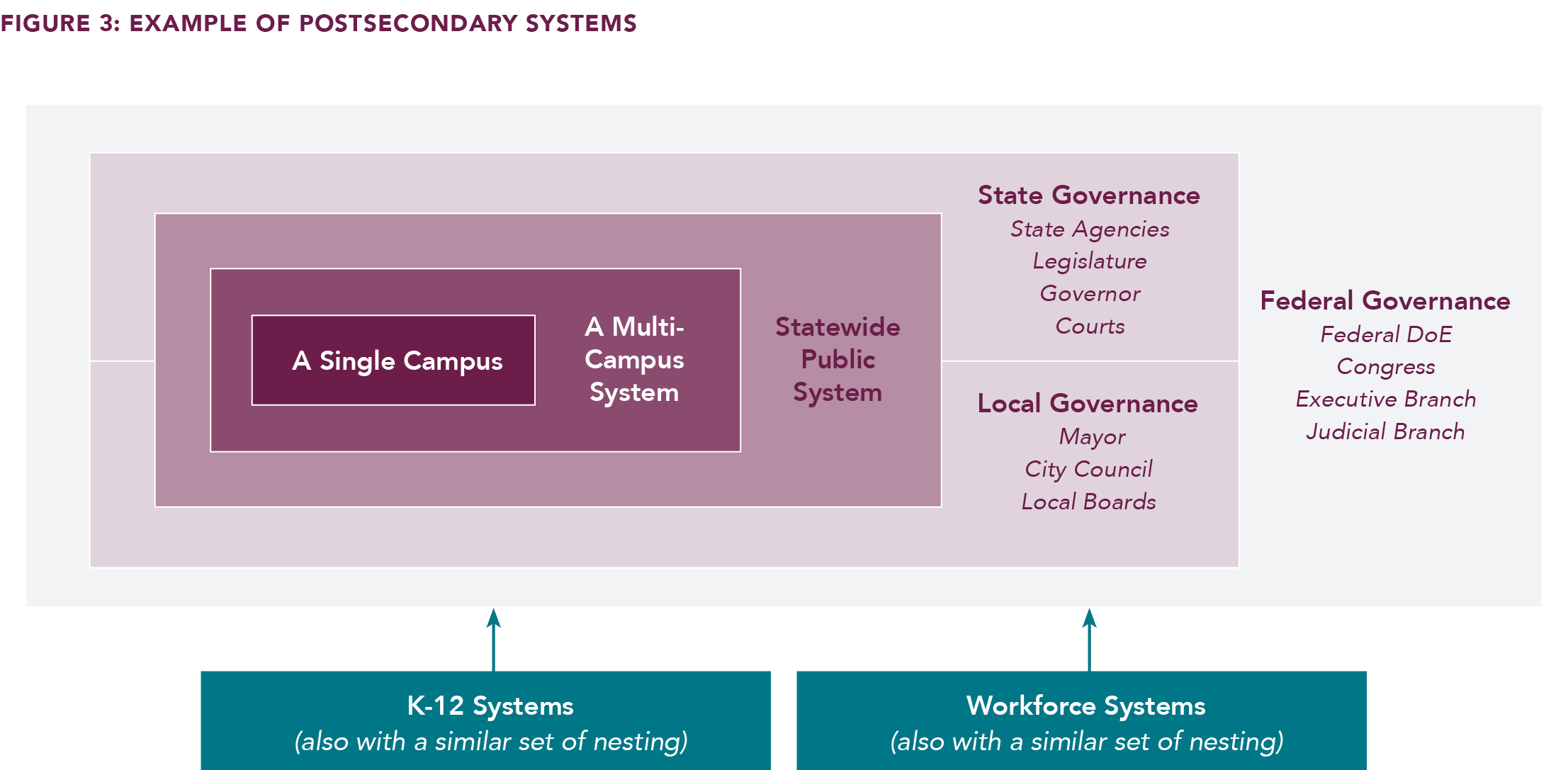
Many systems are nested within larger systems. For example, in postsecondary pathways, one can consider a range of systems that shape how postsecondary education happens (Figure 3). Further complicating matters, influence between these systems is nonlinear. Larger systems (e.g., the federal government) can influence smaller systems (e.g., state governments), and vice versa. Postsecondary systems can also interact with a range of K-12 systems and workforce systems.
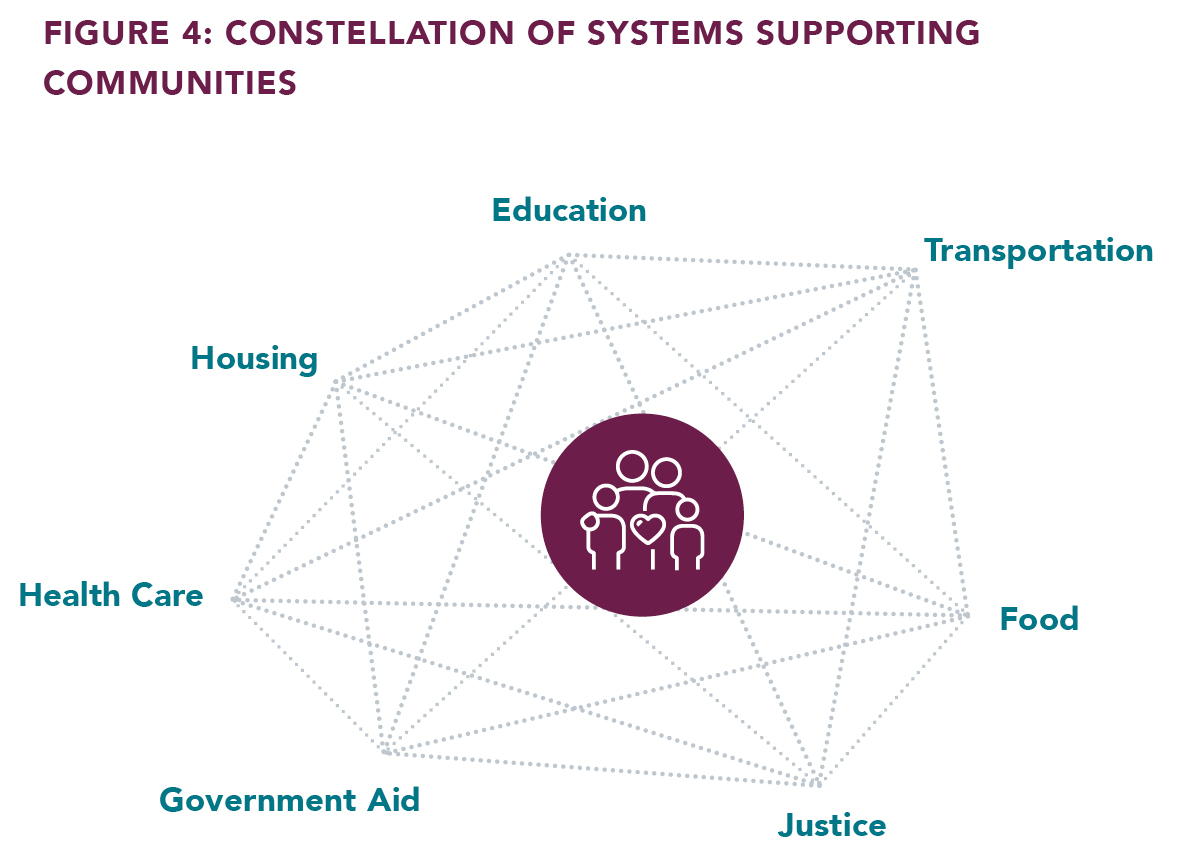
Additionally, communities do not experience systems in isolation, but as a constellation (Figure 4).
“In education reform, we have the privilege of creating our own siloed definition of systems — school systems. But that is not how communities experience systems. They experience an ecosystem of multiple — and often failing and oppressive — systems that overlap and impact each other. If we want to be in service of social justice, then we also have to be responsive to that reality and respond to a community’s agenda outside of just our narrow definition of education — be it safety, food security, housing, healthcare, immigration rights and protections, economic opportunity, and/or taking on systemic racism and oppression in our social policies and civic structures.”28
All this underscores that systems are complex; accepting and embracing the complexity of a system is a critical first step in developing a Systemic Impact strategy. John Henry Holland, a professor at the University of Michigan, compares it to board games:
“A small number of rules or laws can generate systems of surprising complexity. Board games provide an ancient and direct example: Chess is defined by fewer than two dozen rules, but the myriad patterns that result lead to perpetual novelty and emergence. It took centuries of study to recognize certain patterns of play, such as the control of pawn formations. But once recognized, these patterns greatly enhance the possibility of winning the game.”29
What Is Systemic Impact?
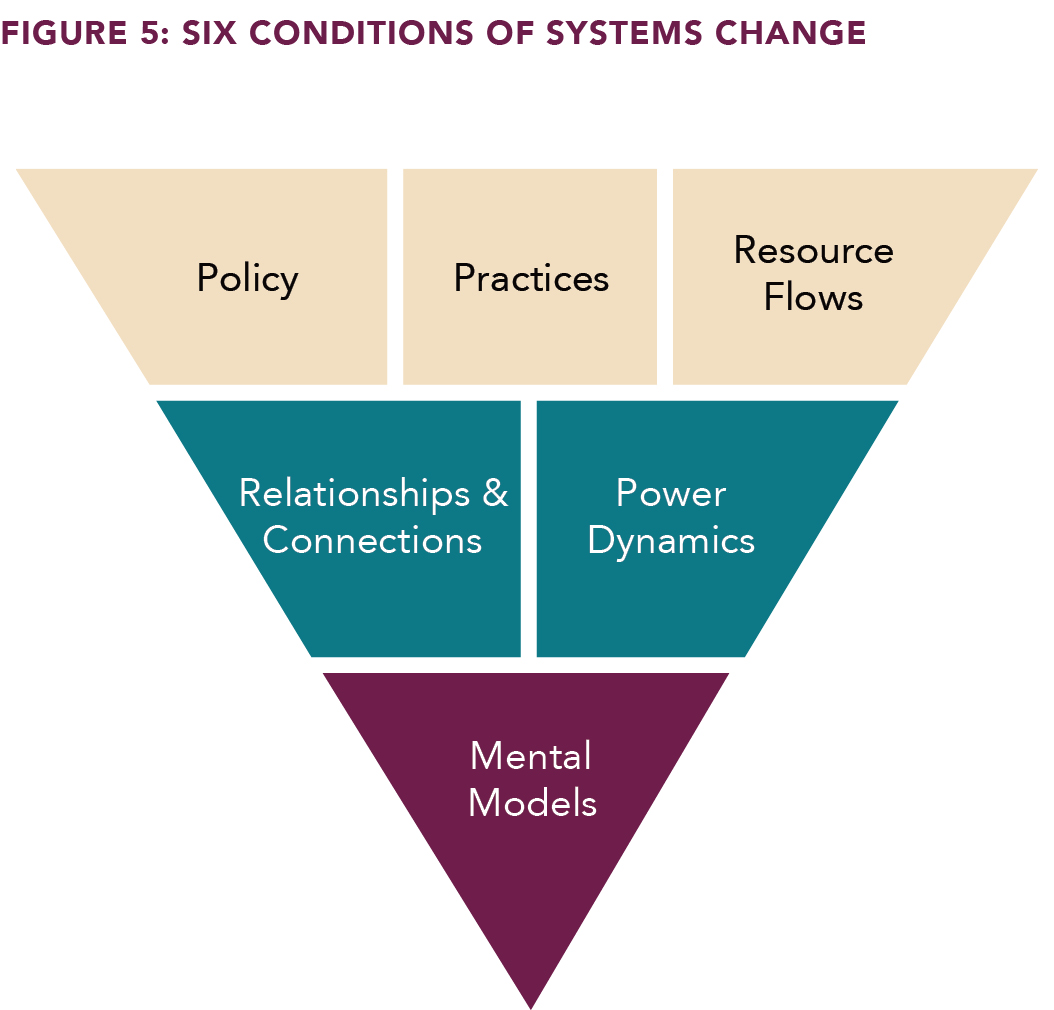 There is no single definition of Systemic Impact or Systems Change. However, one of the most accessible ways to think about the elements of Systemic Impact comes from FSG’s 2018 seminal essay, The Water of Systems Change, which frames six conditions or elements of Systems Change (Figure 5).30 The role of the six conditions is to help people “see” and understand the system they seek to change (which is a precursor to but separate from developing campaigns to change a system).
As noted in a 2024 webinar by John Kania, one of the authors of this framework who now leads the Collective Change Lab, these six conditions are interrelated and interconnected, meaning they must be considered holistically and not just “box by box.”31 Additionally, Kania observed that the vast majority of attention and activity is usually focused on the top three boxes — policy, practices, and resource flows — but true transformation comes from shifting the deeper levels of systems around mindsets, relationships, and power.
Source: John Kania, Mark Kramer, and Peter Senge, Foundation Strategy Group, “The Water of Systems Change,” May 2018.
This raises a crucial question: Is Systemic Impact about changing what a system does, or changing how a system operates? The first — what a system does — is about winning the existing game. The second — how a system operates — is about changing the rules by which the game is played.
Most experts interviewed for this publication focused on the fundamentals of changing the rules of the game. Ben Austin, a lifelong education advocate and founding director of Education Civil Rights Now, explained: “Systemic Impact isn’t about policy change, it is about power. If we shift power, the policy will follow. … It’s an irrational strategy to play by the existing rules and think you will get anything other than the outcomes you are getting now.”32
An education funder who wished to remain anonymous shared: “Systems change is about shifting the core functions of the system, not just tweaking its policies to get the current functions a little better. You have to get at the root cause of the unjust policies baked into the system. In my experience, people need an ‘aha’ moment to really get the size of the undertaking of systems change. The way we talk about it can sound like it’s just normal business to do systems change. And the reality is it’s radically disruptive.”33
Without working to change the rules of the game, wins in the existing game may prove fleeting. Kim Syman, a senior partner at New Profit, observed, “Changing a policy and going home is the thinnest of systems change because it is vulnerable to whomever comes next with power. Without changing power, changing policy is not sticky.”34
Yet power exists in service of making something specific happen, and Systemic Impact is about identifying an agenda for change at the level of policy, practice, and/or resource flows and then pursuing a campaign to achieve it. Power is necessary, but it is a means toward a specific end.
Several other common themes emerged in researching how various leaders and organizations define their approach to Systemic Impact (Table 3).
TABLE 3: COMMON THEMES IN APPROACHING SYSTEMIC IMPACT
| Themes | |
| Holistic Understanding | “Systems thinking is often contrasted with reductionist thinking, in which we break up a problem or issue into its constituent parts and analyse each one separately. Systems thinking on the other hand tries to facilitate an understanding of the ‘whole’ by focusing on the relationships, interactions and patterns that occur between the elements that make up a system.” —The Commons Social Change Library, Systems Thinking for Campaigning and Organizing35 |
| Creative Destruction | “There is a natural tendency among those who work for societal change to focus on the creative part of the task — developing the new. But change also involves destroying the old, whether it be institutions, relationships, or ways of doing things.” —Steve Waddell, Stanford Social Innovation Review36 |
| History and Place | “Systemic-level disruption must be grounded in history and place.” —Paul Beach and Hailly T.N. Korman, Bellwether37 |
| Trauma and Healing | “We’re trying to bring awareness and understanding of trauma and collective healing to the center of how systems change work gets done.” —John Kania, Collective Change Lab38 |
Is Systemic Impact always about making a system, and the society it encompasses, a better place? Yes and no.
Yes, Systemic Impact is about changing (or preserving) things for the better, but not necessarily every person’s specific definition of “better.” American society has been, is, and always will be in a competition between those who want to create more responsive systems that are inclusive of communities, and those who are seeking to (re)establish systems that can be exclusionary and prioritize the needs of some while marginalizing the needs of others.
Rev. Martin Luther King Jr. inspired us by teaching that “the arc of the moral universe is long, but it bends toward justice.”39 President Barack Obama added a qualifier: “The arc of the moral universe may bend towards justice, but it doesn’t bend on its own.”40 The pace and even the direction of that bending ultimately depends on who has the most power to bend it. This speaks to why Systemic Impact is unapologetically about power.
In the U.S., Systemic Impact happens within the context of a democracy. America as a societal system was explicitly designed to change and evolve, and to resist the aggregation of power, even as it absolutely acknowledged the role of power and how people with competing agendas will compete. This country’s system was not designed for Abraham Lincoln’s “better angels of our nature”41 but rather for the bitter demons of our ambition. America’s system of laws was designed to place limits on the competition that arises from these ambitions, including political ambitions. As Aristotle observed, humans are a naturally “political animal.”42 When it comes to human interactions and human systems, “there is no such thing as an apolitical process.”43
Finally, the most important thing to understand about Systemic Impact is that change is the only constant. The wheel is always turning in systems, which can be a source of both frustration and hope.
Authority and Power: What Are Their Roles in Systemic Impact?
For some education leaders, one of the most challenging aspects of Systemic Impact is that it is unapologetically about power — the ability to decide an agenda and make action happen to advance that agenda. Systemic Impact also requires differentiating those who have authority from those who have power.
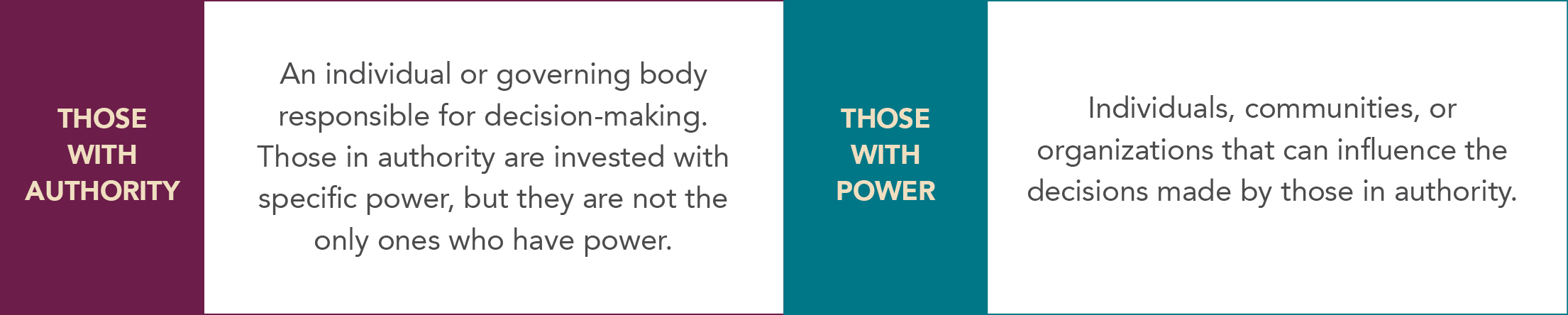
Emily Cherniack, the founder and CEO of New Politics, observed: “Authority is formal, titles, positions. You could have a lot of authority but not a lot of power. … Some community leaders have a lot of power. Power isn’t always where you think it is. Some power comes from people who don’t have authority.”44
Power, like systems and Systemic Impact, is complicated:
- Power is about relationships. Maya Martin Cadogan, the founder and CEO of Washington, D.C.-based Parents Amplifying Voices in Education, shared, “When you are focused on power, you’re focused on building relationships.”45 In Systemic Impact, “relationships are not the cost of doing business; they are the business.”46
- Power tends to want to grow itself. As Liu explained, “Power concentrates — that is, it feeds on itself and compounds (as does powerlessness).”47
- Power also tends to sustain itself. Rayner warned, “Power is the ultimate positive feedback loop: simply put, people in positions of power use their positions of privilege to stay there,” a sentiment echoed by George Orwell, who cautioned, “We know that no one ever seizes power with the intention of relinquishing it.”48
- Because of this, power can change people and priorities. It is perhaps too simplistic to always assume the cliché “power corrupts”49 or Frank Herbert’s admonishment that “power attracts the corruptible.”50 However, gaining power risks shifting priorities in service of sustaining power, raising the timeless question “How do you use institutional power without being institutionalized?”51
- Power can be about perception, with perception then creating reality. If people do not believe they have power, they do not have power. Conversely, if people can convince others they have power, then they have power. Saul Alinsky observed, “Power is not only what you have but what the enemy thinks you have.”52
- Power can therefore be a competition to shape people’s perceptions, including their perception of their own power. Sometimes power is also applied to make people feel and therefore act powerless. Daniel Anello, CEO of Kids First Chicago, observed that “sometimes we let these hierarchies of power take up residence in our head.”53Systemic Impact campaigns often require changing people’s mindsets and/or beliefs about their own power. Systemic Impact does not itself “empower” people. Rather, Systemic Impact involves “informing and organizing people so they can find and exercise their innate power — individually and collectively — to drive and sustain change.”54 Alinsky warned, “If people don’t think they have the power to solve their problems, they won’t even think about how to solve them.”55 Conversely, people can be inspired to find and exercise their power. As King once preached in his seminal 1963 speech on the steps of the Lincoln Memorial, “I have a dream … .”56
- Money is power. Money is a resource that can be deployed to drive change: It can hire people, and it can be spent on research, media, and outreach. Money can buy access and influence. Money enables organizing. Money is a tool that enables participation in the political process.
Systemic Impact often involves exercising power in any combination of the following (Figure 6).
- Partnership is about working with stakeholders to support an organization’s agenda that they already agree should be advanced. For example, a nonprofit works with a state education agency to co-design and implement a statewide longitudinal data platform linking K-12, postsecondary, and workforce data. It then conducts an awareness campaign promoting the platform and conducting a series of trainings to help individuals and those who advise them to use this data to support choice in selecting postsecondary pathways.
- Persuasion is about influencing stakeholders that an organization’s agenda is one that they want to take action to support. For example, an organization conducts research and then shares compelling data and individual stories about the impact of food insecurity on K-12 students to persuade district and/or state leaders to fund food banks and universal free meals.
- Pressure is about influencing stakeholders to take action to advance an organization’s agenda that they would not otherwise support. For example, an organization plans large public events where students protest a policy, conducts a social media campaign criticizing those with the authority to change that policy, organizes a walkout (or sit-in), and organizes a strong presence at and testifying at an open governance meeting with those in authority to demonstrate their power to influence their decision-making. Those in authority support an organization’s agenda because they are experiencing or can see what they will experience if they do not support that agenda.
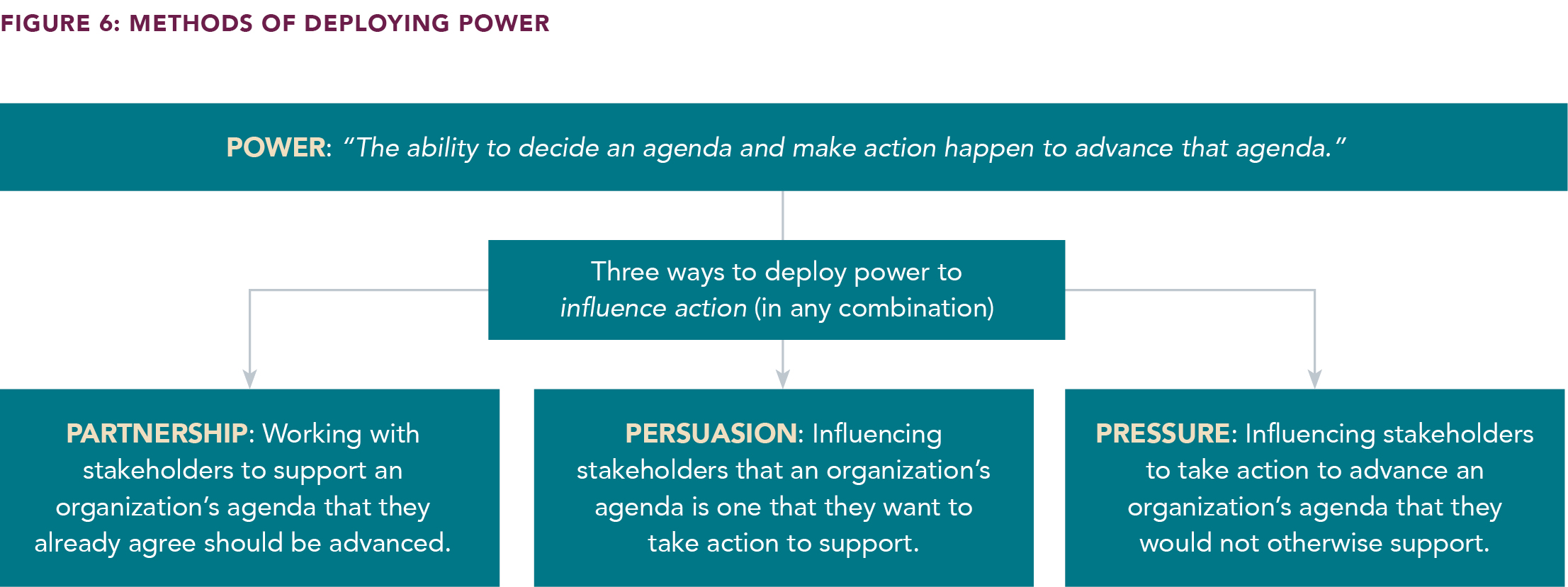
These three levers can be pulled in any order or combination. Anello observed: “You can move in and out of these [levers] pretty quickly — it will always be dynamic.”57
As discussed earlier, it is easy to assume that power is only about pressure and/or persuasion. When a system is closed, these two approaches are usually necessary. But sometimes in closed systems there are open leaders who are seeking partners to advance an agenda. These leaders may lack the authority (or perceive they lack the authority) to advance an agenda on their own. They may not fully understand the problem or the potential solution without the support of outside partners. These leaders may need support to make progress within the system where they reside, needing their partners to in turn deploy persuasion and/or pressure on other parts of the system.
For example, Anello counseled that, even when using persuasion and pressure, ideally these are steps toward creating the conditions for partnership wherever possible: “If leaders come around to wanting to authentically partner, it’s folly to miss that opportunity; and if they are a partner when the next campaign comes around, you’re more likely to be successful.”58
Next Steps: Going From the “Why” and “What” to the “How”
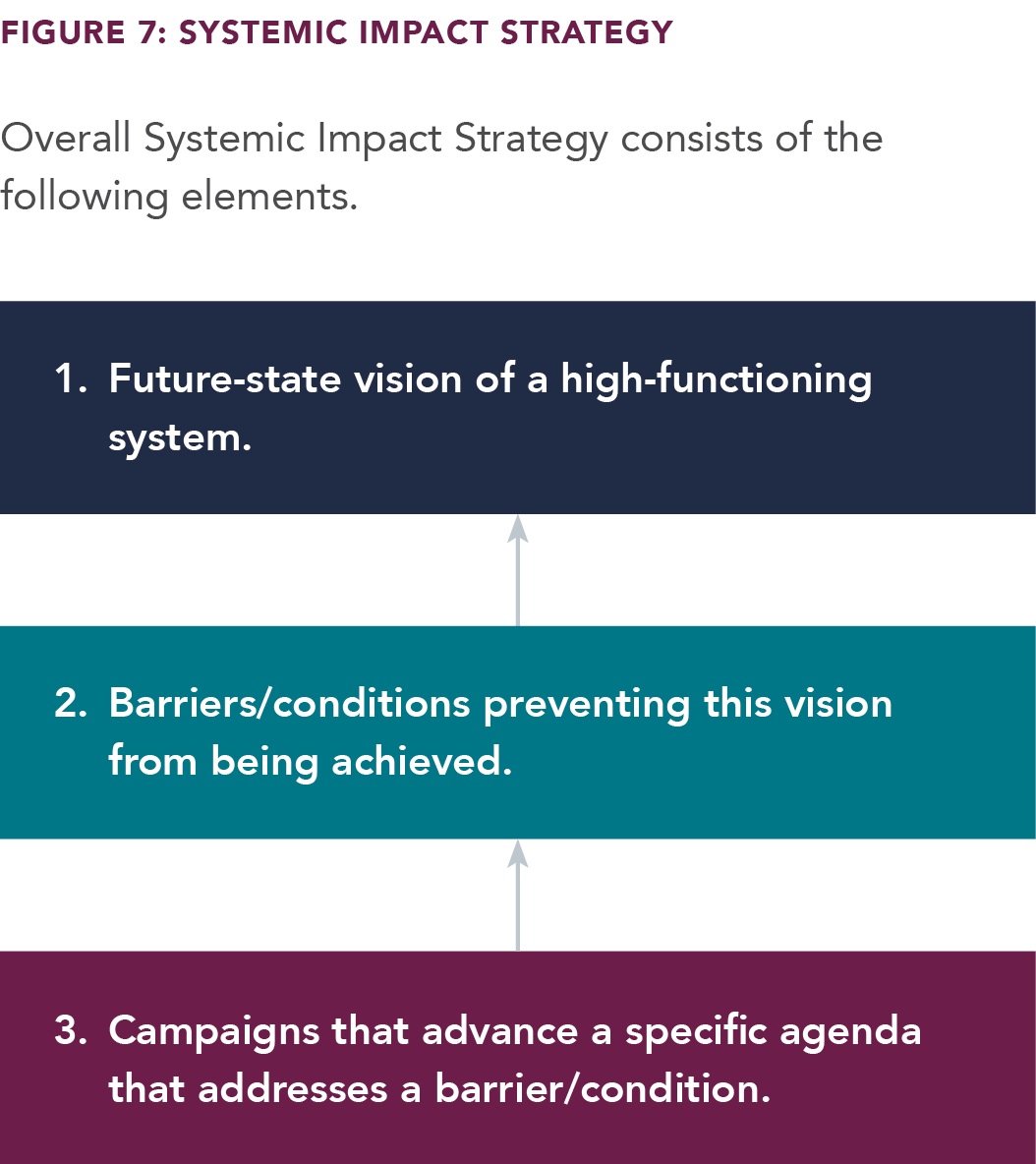
To pursue Systemic Impact, education organizations must have a strong understanding of the “why” and “what” behind Systemic Impact, including the role of authority and power. This understanding equips education organizations to address the far more challenging set of questions regarding how to design and execute a Systemic Impact strategy, which requires articulating a future-state vision; identifying the barriers to achieving that vision; formulating a campaign with a specific agenda and a clear conception of who has authority and then how to build power to influence those in authority; and prioritizing, resourcing, and executing a set of actions to build and deploy power to influence those in authority (Figure 7).
 Systemic Impact is a difficult and daunting strategy to pursue for most organizations in the education sector. It requires sustained effort, a specific set of skills, access to ongoing funding, and a high degree of comfort building and unapologetically employing power. Yet, it is ultimately the only way to ensure social solutions to social needs reach an entire society.
For Systemic Impact skeptics, perhaps the most compelling evidence is what is happening every day as others seek to affect changes in systems — some of which those skeptics may agree with and others they may vehemently oppose.
Within K-12 systems, stakeholders are waging Systemic Impact campaigns about school choice, funding, accountability, and what can and cannot be taught in schools. Within postsecondary pathways, there are similar campaigns to shape admissions, funding and financial aid, what courses are or are not taught, what services are provided to students (and which students), institutional closures, new innovations (e.g., three-year degrees), and changes to accreditation.
Some of these Systemic Impact campaigns may feel sudden; other campaigns have been in process for a long time to create and/or rapidly respond to the right moment.
Americans live in systems; if people want to see systems act the way they believe systems should, then they have to be willing to act. Education leaders facing both headwinds and tailwinds in the sector are no exception. Systemic Impact is about exercising power to determine where the wind blows.
- 1. Eric Liu, You're More Powerful Than You Think: A Citizen's Guide to Making Change Happen (PublicAffairs, 2017). ↩
- 2. Frederick Douglass, "The Significance of Emancipation in the West Indies: An Address Delivered in Canandaigua, New York, on August 3, 1857," in The Frederick Douglass Papers: Speeches, Debates, and Interviews Volume 3: 1855-1863, https://frederickdouglasspapersproject.com/s/digitaledition/item/10509. ↩
- 3. Alex Cortez and Christine Wade, A Pragmatic Playbook for Impact: Direct, Widespread, and Systemic, (Bellwether, 2022), https://bellwether.org/publications/pragmatic-playbook-for-impact/. ↩
- 4. Alex Cortez and Christine Wade, A Pragmatic Playbook for Impact: Direct, Widespread, and Systemic (Bellwether, 2022), https://bellwether.org/publications/pragmatic-playbook-for-impact/. ↩
- 5. Field of Dreams, directed by Phil Alden Robinson (Universal Pictures, 1989). ↩
- 6. Alex Cortez, Systems Change & Parent Power (New Profit, 2020), https://newprofit.org/wp-content/uploads/2021/06/Parent-Power-and-Systems-Change-in-Education-VF-New-Profit-2020.pdf. ↩
- 7. IP Staff, "What's Going on with Philanthropy for K-12 Education?," Inside Philanthropy, March 8, 2022, https://www.insidephilanthropy.com/home/2022-3-8-whats-going-on-with-philanthropy-for-k-12-education. ↩
- 8. "Table 236.10. Expenditures for Public Elementary and Secondary Education and Other Related Programs, by Function: Selected School Years, 1919-20 Through 2020-21," Digest of Education Statistics, 2023 Tables and Figures, National Center for Education Statistics, https://nces.ed.gov/programs/digest/d23/tables/dt23_236.10.asp. ↩
- 9. Alex Cortez and Yordanos Eyoel, "Notes from the Field: If You Want Great Schools, First Work with Parents to Create 'Actionable Demand,'" The 74, May 10, 2017, https://www.the74million.org/article/notes-from-the-field-if-you-want-great-schools-first-work-with-parents-to-create-actionable-demand/. ↩
- 10. Cortez, Systems Change. ↩
- 11. Cortez and Wade, Pragmatic Playbook. ↩
- 12. Christine Dickason, Paul Beach, Carrie Hahnel, and Andy Jacob, Systems Under Strain: Warning Signs Pointing Toward a Rise in School Closures (Bellwether, 2025), https://bellwether.org/publications/systems-under-strain/?activeTab=1. ↩
- 13. On October 6, 2025, the New York Times published an analysis indicating that there was a 19% decline in the number of international students arriving in the United States in August (international students cannot enter the country more than 30 days before the start of their semester). Aatish Bhatia and Amy Fan, "Nearly 20 Percent Fewer International Students Traveled to the U.S. in August," The Upshot, New York Times, October 6, 2025, https://www.nytimes.com/interactive/2025/10/06/upshot/us-international-student-travel.html. ↩
- 14. Liu, More Powerful. ↩
- 15. Cortez and Wade, Pragmatic Playbook. ↩
- 16. Niccolò Machiavelli, The Prince, trans. W. K. Marriott (1908; Project Gutenberg, October 29, 2024), chap. VI, https://www.gutenberg.org/files/1232/1232-h/1232-h.htm. ↩
- 17. From The History of the Peloponnesian War by Thucydides, excerpted and translated by Alfred E. Zimmern, in The Greek Commonwealth: Politics and Economics in Fifth-Century Athens (Oxford at the Clarendon Press, 1911), "Chapter VIII: The Ideal of Citizenship: Happiness, or the Rule of Love," 200, https://www.google.com/books/edition/The_Greek_Commonwealth/BHMKAAAAIAAJ?hl=en&gbpv=0. ↩
- 18. Interview with Cynthia Rayner, visiting fellow at the Skoll Centre for Social Entrepreneurship at the University of Oxford, April 15, 2025. ↩
- 19. "What Is Systems Change?," Systems Change Lab, https://systemschangelab.org/what-is-systems-change. ↩
- 20. Facilitating Equitable Systems Change: A Guide to Help Foundation Board Members and Executive Leadership Lead the Way (Shifting Systems Initiative, 2023), https://www.rockpa.org/wp-content/uploads/2023/09/Facilitating_Equitable_Systems_Change.pdf. ↩
- 21. John Gardner, The Recovery of Confidence (Pocket Books, 1971). ↩
- 22. Interview with Hannah Gravette, PICO California, January 15, 2025. ↩
- 23. Quotation attributed to Barney Frank in Jennifer Pahlka, Recoding America: Why Government Is Failing in the Digital Age and How We Can Do Better (Metropolitan Books, 2023), 280. ↩
- 24. James Madison, "Speech in the Virginia Constitutional Convention, Richmond, Virginia," December 2, 1829, in The Writings of James Madison, ed. Gaillard Hunt, vol. 9 (G. P. Putnam's Sons, 1910), 361. ↩
- 25. Cortez, Systems Change. ↩
- 26. "What Is the Open System?," The Open System Institute, https://www.theopensystem.org/the-idea. ↩
- 27. Alex Cortez, Picket Signs & Shovels: Lessons on Parent Power and Systems Change from Umm Al-Fahm, Israel (New Profit, 2021), https://newprofit.org/wp-content/uploads/2021/04/New-Profit-Picket-Signs-and-Shovels-Whitepaper-5.pdf. ↩
- 28. Cortez, Systems Change. ↩
- 29. John H. Holland, Emergence: From Chaos to Order (Basic Books, 1998), 225. ↩
- 30. Kania, Kramer, and Senge, "The Water of Systems Change. ↩
- 31. "Introduction to Systems Change," online workshop hosted by the Collective Impact Forum and Collective Change Lab, November 21, 2024. ↩
- 32. Interview with Ben Austin, Education Civil Rights Now, March 18, 2025. ↩
- 33. Interview, March 4, 2025. ↩
- 34. Interview with Kim Syman, New Profit, March 20, 2025. ↩
- 35. Blueprints for Change, Systems Thinking for Campaigning and Organizing (The Commons Social Change Library, 2020), https://commonslibrary.org/systems-thinking-for-campaigning-and-organizing/ (actual document link: https://docs.google.com/document/d/1QoyD8kDaNaavhpTlFDjTEZ6ytVkl-JvJBgV-Mx72RhU/edit?tab=t.0#heading=h.wiw5olqsx1pm). ↩
- 36. Steve Waddell, “Four Strategies for Large Systems Change,” Stanford Social Innovation Review 16, no. 2 (2018): 40–45, https://doi.org/10.48558/GNE5-BS86. ↩
- 37. Paul Beach and Hailly T.N. Korman, The Seeding Disruption Fellowship: How One Organization Builds Cross-Sector Relationships in Pursuit of Racial Equity (Bellwether, 2025), https://bellwether.org/publications/the-seeding-disruption-fellowship/. ↩
- 38. Interview with John Kania, Collective Change Lab, January 27, 2025. ↩
- 39. Rev. Martin Luther King, Jr., "Remaining Awake Through a Great Revolution," commencement address for Oberlin College, June 14, 1965, https://www2.oberlin.edu/external/EOG/BlackHistoryMonth/MLK/CommAddress.html. ↩
- 40. Barack Obama, "Remarks by the President at the 'Let Freedom Ring' Ceremony Commemorating the 50th Anniversary of the March on Washington," The White House, August 28, 2013, https://obamawhitehouse.archives.gov/the-press-office/2013/08/28/remarks-president-let-freedom-ring-ceremony-commemorating-50th-anniversa. ↩
- 41. Abraham Lincoln, "March 4, 1861: First Inaugural Address," UVA Miller Center, https://millercenter.org/the-presidency/presidential-speeches/march-4-1861-first-inaugural-address. ↩
- 42. Aristotle, Politics, trans. William Ellis (1928; Project Gutenberg, December 8, 2012), bk. 1, chap. 2, https://www.gutenberg.org/cache/epub/6762/pg6762.txt. ↩
- 43. Liu, More Powerful. ↩
- 44. Interview with Emily Cherniack, founder and CEO of New Politics, March 3, 2025. ↩
- 45. Interview with Maya Martin Cadogan, Parents Amplifying Voices in Education, February 12, 2025. ↩
- 46. Cortez, Systems Change. ↩
- 47. Liu, More Powerful. ↩
- 48. Cynthia Rayner and François Bonnici, The Systems Work of Social Change (Oxford University Press, 2021); George Orwell, 1984 (Penguin, 1959). ↩
- 49. John Emerich Edward Dalbberg, Lord Acton, correspondence with Archbishop Mandell Creighton, April 5, 1887, https://oll.libertyfund.org/titles/acton-acton-creighton-correspondence. ↩
- 50. Frank Herbert, Chapterhouse: Dune (Putnam, 1985). ↩
- 51. Jeremy Heimans and Henry Timms, New Power: How Power Works in Our Hyperconnected World—and How to Make It Work for You (Doubleday, 2018). ↩
- 52. Saul Alinsky, Rules for Radicals: A Pragmatic Primer for Realistic Radicals (Random House, 1971). ↩
- 53. Interview with Daniel Anello, Kids First Chicago, August 8, 2025. ↩
- 54. "Parent Power in Education: Measuring What Matters," New Profit, https://www.parentpowerined.org/. ↩
- 55. Alinsky, Rules for Radicals. ↩
- 56. Rev. Martin Luther King, Jr. "I Have a Dream." Speech, Washington, DC, August 28, 1963. American Rhetoric, http://www.americanrhetoric.com/speeches/mlkihaveadream.htm. ↩
- 57. Interview with Daniel Anello, Kids First Chicago, August 8, 2025. ↩
- 58. Ibid. ↩
Acknowledgments
We would like to thank the many experts who shared their knowledge with us to inform our work, including interviewees for their time, insights, and expertise as well as the community of practice participants who contributed to this publication.
We would also like to thank our Bellwether colleagues Mark Baxter, Nick Lee, and Jennifer O’Neal Schiess for their input. Thank you to Amy Ribock, Kate Stein, Andy Jacob, McKenzie Maxson, Temim Fruchter, Julie Nguyen, and Amber Walker for shepherding and disseminating this work, and to Super Copy Editors.
The contributions of these individuals and entities significantly enhanced our work; however, any errors in fact or analysis remain the responsibility of the authors.
About the Authors

ALEX CORTEZ
Alex Cortez is a partner at Bellwether. He can be reached at alex.cortez@bellwether.org.

CHRISTINE WADE
Christine Wade is a senior associate partner at Bellwether. She can be reached at christine.wade@bellwether.org.

KATELAND BEALS
Kateland Beals is a senior consultant at Bellwether. She can be reached at kateland.beals@bellwether.org.

Bellwether is a national nonprofit that works to transform education to ensure young people — especially those furthest from opportunity — achieve outcomes that lead to fulfilling lives and flourishing communities. Founded in 2010, we help mission-driven partners accelerate their impact, inform and influence policy and program design, and bring leaders together to drive change on education’s most pressing challenges. For more, visit bellwether.org.
© 2026 Bellwether
This report carries a Creative Commons license, which permits noncommercial reuse of content when proper attribution is provided. This means you are free to copy, display, and distribute this work, or include content from this report in derivative works, under the following conditions:
Attribution. You must clearly attribute the work to Bellwether and provide a link back to the publication at www.bellwether.org.
Noncommercial. You may not use this work for commercial purposes without explicit prior permission from Bellwether.
Share Alike. If you alter, transform, or build upon this work, you may distribute the resulting work only under a license identical to this one. For the full legal code of this Creative Commons license, please visit www.creativecommons.org.
If you have any questions about citing or reusing Bellwether content, please contact us.
