
Navigating School Reorganization
A Playbook for Charter School Leaders and Boards in the District of Columbia
ADDITIONAL RESOURCES
- Navigating School Reorganization: A Condensed Playbook for Charter School Leaders and Boards in the District of Columbia (PDF) — A resource featuring select content from the playbook’s web version.
- Navigating School Reorganization: An Overview (PDF) — High-level guidance on whether and how to pursue a school merger, acquisition, or other form of reorganization that fits your community.
1. Introduction to School Reorganization
Local and national trends — including declining K-12 enrollment, fiscal pressures, and talent pipeline challenges — are leading more charter school leaders and boards to consider mergers, acquisitions, and other forms of reorganization as strategies for strengthening and sustaining their schools. Leaders and boards deciding whether to pursue these strategies should weigh an organization’s circumstances and available alternatives and center what will best serve students, honor the mission, and strengthen school quality. When thoughtfully pursued, reorganization can preserve access to diverse school models, improve student outcomes, and strengthen the long-term sustainability of the organization that carries those models forward.
In June 2026, the DC Public Charter School Board (DC PCSB) adopted its School Reorganization Policy,1 establishing a formal process for District of Columbia charter local education agencies (LEAs) to pursue mergers and acquisitions. This playbook offers charter leaders and board members in the District of Columbia practical guidance on whether and how to pursue this type of reorganization. The guidance is grounded in national lessons from leaders who have navigated these transitions and is tailored to the local policy, governance, and community context in the District of Columbia. Leaders exploring other forms of reorganization, such as changes to grades served, management company transitions, or campus closures, may still find much of the guidance useful.
How To Use This Playbook
The playbook is organized in sequential sections, each focused on a key question leaders and boards should ask and answer while moving through the process. It can be used sequentially, or you can go directly to the sections most relevant to the questions or topics you are facing at present.
Although much of this playbook focuses on the technical aspects of reorganization, the work typically requires a great deal of adaptive change.2 Leaders and boards should expect to spend significant time and energy navigating these adaptive aspects of the process, even though these aspects receive less attention in the sections that follow. Reorganization involves far more than an organizational transaction — the process often requires leaders and board members to sit with uncertainty, to be vulnerable with a potential partner and with their own community, and, in some cases, to confront the possibility that the organization they built or lead may not continue in its current form.
This playbook is a decision-support resource, not a push or mandate to reorganize. At every stage of the process described, leaders and boards retain full discretion over whether to continue, pause, or step back. Board members and leaders should feel assured that choosing not to move forward at any point is a sign that the process worked as intended. The playbook is designed as a starting point for internal discussions and conversations with the DC PCSB, potential partners, and external advisers. In addition, this playbook is intentionally nonexhaustive. It is meant to complement, not replace, the professional judgment and local expertise of LEA leaders and boards. As a static resource, it also lacks the depth and specificity of advice from legal, financial, and management professionals (Appendix).
The body focuses on core information, decision-making considerations, common trade-offs, and practical guidance, while hyperlinked content includes resources, examples, and templates for readers who want to go deeper. Throughout the playbook, where relevant, specific considerations are highlighted for:
-
- Complementary LEAs exploring a merger of equals.
- LEAs seeking greater stability and scale by joining another LEA.
- LEAs seeking to add new partners to their portfolio of schools.
- Single-site versus network (multisite) LEAs.
Education Forward DC
Education Forward DC (Ed Forward DC) is a nonprofit that combines strategic grantmaking, hands-on partnerships, and citywide coordination to ensure a great public school for every student in the District of Columbia. Working across both traditional public and public charter schools, Ed Forward DC invests in school quality, develops outstanding leaders and teachers, and advances the conditions that make progress possible. Ed Forward DC supported the development of this playbook and helped connect Bellwether with the school leaders and board members whose experience shaped it.
Ed Forward DC’s guidance to readers is straightforward: Engage early. Reorganization works best as a proactive strategy, not a response to a crisis, and Ed Forward DC’s own support is structured the same way. As Rashida Young, Ed Forward DC’s partner for schools and talent, said, “Ed Forward DC’s resources are most effective supporting leaders making informed decisions before they reach a crisis point, when there is still time to plan, engage families, and provide stability for students.” Schools that reach out while they still have options, rather than waiting until circumstances are dire, get the most out of what Ed Forward DC and other sector partners can offer (Disclosure).
When and Why Should We Consider School Reorganization?
Reorganization is one of several strategic options available to charter school leaders and boards. It is most effective when considered proactively rather than in response to a crisis or an isolated partnership inquiry. Boards should periodically assess whether their current organizational model remains the best way to advance their mission and revisit that assessment as circumstances change.
This section helps leaders and boards understand when reorganization may be appropriate, what it can realistically accomplish, and how to determine whether it is the right strategy for their school or network.
The Human Impacts of Reorganization
For a school leader or board member, even raising the question of reorganization can feel like an admission that something is not working or a threat to a legacy they have built. That discomfort is a healthy and normal part of stewardship, not a sign that something has gone wrong. Naming this tension early and giving yourself and your board members room to sit with it tend to produce clearer thinking than treating reorganization as a purely strategic or technical exercise.
Consider reorganization at key strategic decision points.
Leaders and boards should consider reorganization at several natural decision points:
-
- As part of periodic strategic planning. Evaluate whether the current organizational model remains the best way to achieve your mission, considering reorganization alongside expansion, replication, program changes, and other strategic options.
- As part of annual planning. Revisit key assumptions about the school’s or network’s performance, financial outlook, leadership, and capacity to determine whether reorganization or another strategic path warrants consideration.
- In response to external changes or opportunities. Consider whether shifts in funding, policy, facilities, community needs, or interest from a potential partner create new opportunities or challenges that warrant exploring reorganization.
- Before beginning a search for a new leader. Determine whether the organization should continue in its current form before committing to a successor. The leader profile depends on that answer, and a transition is one of the few moments when reorganization does not require displacing a sitting leader.
You should also consider how the timing of these conversations intersects with key external milestones, including when performance results become available and where the organization is in its charter review or renewal cycle. These factors may affect eligibility for reorganization under DC PCSB policy and how much certainty an LEA has before investing significant time and resources in exploration (Section 2). For example, the third year of a five-year charter review cycle is a useful checkpoint: By then you can see whether you are on track to remain eligible for reorganization and still have enough runway to act.3
Guide reorganization discussions with a clear strategic rationale.
Reorganization can advance a range of strategic objectives, but it also involves meaningful risks and trade-offs. Many costs, including legal fees and consulting support, are incurred up front, while potential benefits are neither immediate nor guaranteed. Financial efficiencies may take time to realize, and successful implementation requires sustained leadership attention, investment, and change management. Leaders and boards should weigh costs and benefits when defining what they hope to achieve and determining whether reorganization is the strongest strategic response. Organizations may pursue reorganization to:
-
- Expand or improve educational opportunities for students.
- Preserve high-quality schools or programs.
- Increase organizational impact or reach.
- Strengthen long-term organizational sustainability through economies of scale (e.g., by optimizing facility or other resource utilization).
- Support intentional leadership succession or organizational continuity.
- Combine complementary strengths, expertise, or resources.
Given these trade-offs, leaders and boards should discuss and agree on their strategic rationale for reorganization before moving into active exploration.
First, define the objectives the organization is trying to achieve, what opportunity it is seeking to pursue or what challenge it is trying to address, and how those objectives connect to its mission and long-term strategy. Then, consider the range of potential pathways for achieving those objectives. In addition to a merger or acquisition, options can include internal improvement or restructuring, expansion or replication, shared services or other strategic partnerships, or continued independence (Sections 2, 8). Compare the potential benefits and trade-offs of each, including:
-
- Strategic alignment.
- Resource requirements.
- Fit with leadership interest, capabilities, and capacity.
- Expected impact on students and communities.
- Time frame and level of risk and certainty.
- Implications for school accessibility, transportation, continuity of educational programming, specialized services, family choice, and students’ sense of belonging.
Leaders and boards should move forward with reorganization as the preferred strategy only when their pathway comparison suggests it is the best fit for their school’s or network’s objectives.
Assess readiness before beginning active exploration.
Once leaders and boards determine that reorganization may be a strong strategic option, they should assess whether their organization is ready to move from consideration to active exploration. They do not need to have every question answered at this stage, but they should have sufficient alignment and capacity to invest meaningfully in the process. This assessment could produce a “not yet” or “not in this way” answer, which is a legitimate outcome; no one outside the organization can obligate you to proceed past this point. Assess organizational readiness, including:
-
- Leadership and board alignment around the strategic rationale.
- Internal skill sets, energy, and bandwidth to undertake a complex, multiyear effort.
- Financial resources and external expertise needed to support exploration.
Leaders and boards should also begin considering what they most want to prioritize or preserve through a potential reorganization. These initial priorities and nonnegotiables will inform the partner criteria developed later in the process (Section 5).
Start the conversation internally.
There is no single “right way” to start a conversation about reorganization at a school or network. The topic may come up as part of annual or strategic planning, be prompted by an inbound request from an interested partner, or be suggested by a funder or advocate. If you think a conversation is needed and serendipity has not yet worked its magic, consider applying one or more of the following conversation starters:
-
- Start with the strategic challenge. Ask: What pressures or opportunities could materially affect our ability to serve students well over the next three to five years? Then explore whether partnership is one possible response.
- Flip the question by asking what it would take to “stay independent.” Ask leadership and the board to articulate what would need to be true for the LEA to thrive independently and where they have concerns about achieving that.
- Imagine you get a call. Ask: If a strong, mission-aligned LEA approached us tomorrow about a merger or acquisition, what questions would we want answered before deciding whether to explore further? Who would we want to involve in answering those questions?
- Run a future-state exercise. Ask: What would we want students, families, staff, and the organization to experience five years from now? What structures might best support that future?
- Discuss what would make a merger worth exploring. Rather than debating a specific partner, identify the conditions under which a merger could advance the LEA’s mission.
- Begin with fiduciary stewardship. For boards especially, ask: What are our obligations to students and the public if another organizational structure could produce stronger or more sustainable outcomes?
- Compare strategic pathways side by side. Put a merger alongside other options: remain independent, share services, enter a programmatic partnership, grow, scale back, or pursue another form of reorganization. Discuss the benefits, risks, and feasibility of each.
- Use a trigger-based discussion. Review objective indicators (e.g., enrollment, finances, academic performance, leadership succession, facilities, talent capacity) and ask what thresholds should prompt consideration of a strategic partnership.
TOOLS, TEMPLATES, AND RESOURCES
- Reasons To Consider a Merger — A summary of common strategic rationales for nonprofit mergers to help leaders and boards build their own before exploring a reorganization.
- Strategic Rationale Template — A template to clarify what an organization is trying to achieve, why reorganization may be relevant, and how it compares with other potential pathways.
- Reorganization Readiness Assessment — A set of guiding questions about an organization, to be answered honestly and out loud before any conversation with a prospective partner begins.
2. What Implications Does the New DC PCSB Policy Have for Charter Schools Considering Reorganization?
The DC PCSB adopted its School Reorganization Policy4 in June 2026 as one of three policies governing how the charter sector evolves over time, alongside the School Expansion Policy5 and Charter Application Guidelines.6 Per its definition, “school reorganization restructures an LEA’s program, governance, or operations.”7 However, the current DC PCSB policy does not govern all types of reorganization; it focuses on three pathways:
-
- Merger: Two or more independent LEAs operating under separate charters combine into one LEA under a single charter, while maintaining elements of each LEA’s program.
- Standard Acquisition: One LEA or campus closes8 and transfers its assets to another LEA, which agrees to enroll the closing LEA’s students. (Available only when the closing LEA is not at imminent risk of revocation, nonrenewal, or relinquishment.)
- Emergency Acquisition: The same transfer, initiated when closure is already imminent or decided. (Runs on a compressed timeline with no planning year.)
As of November 2026, the School Reorganization Policy includes four sections:
-
- Purpose (Connections to Other Policies, Definitions, Guiding Principles)
- School Merger Policy (Minimum Eligibility Criteria, Notice of Exploration, Letter of Intent, Standard for Approval, Application and Evaluation, After the Board Vote)
- Standard School Acquisition Policy (same subsections as the School Merger Policy)
- Emergency School Acquisition Policy (excludes Notice of Exploration)
The School Reorganization Policy applies only to transactions between LEAs and campuses already authorized by the DC PCSB. It does not cover proposals involving parties outside the DC PCSB’s oversight, such as an out-of-state charter management organization or provider seeking to acquire a charter school in the District of Columbia without an existing DC PCSB authorization. Such proposals fall outside the scope of the School Reorganization Policy and would likely need to be pursued through a different process (e.g., a new charter application), similar to how the policy treats new charter applicants generally.
The Human Impacts of Reorganization
This section is the most procedural in the playbook, but the procedure exists because real people (students, families, and staff) are affected by these decisions. Treat the deadlines and criteria that follow as guardrails for a process that is ultimately about people, not as a checklist to move through as quickly as possible.
Plan backward from the DC PCSB timeline.
The timeline for a merger or standard acquisition is long, but now more clearly defined. LEAs looking to reorganize must begin the formal DC PCSB process 18-24 months before a merger or standard acquisition takes effect. For mergers and standard acquisitions, the formal DC PCSB process begins the school year before a required planning year, with a letter of intent (LOI) due no later than February 1 and the formal application due no later than June 1. The DC PCSB will then schedule a hearing and decide after a required 30-business-day Advisory Neighborhood Commission (ANC) comment period. The DC PCSB expects the process from application submission to decision to last about four months. Emergency acquisitions follow an accelerated process and do not require a planning year (Figure 1).
FIGURE 1: OVERVIEW TIMELINE FOR A STANDARD CHARTER ACQUISITION, DISTRICT OF COLUMBIA
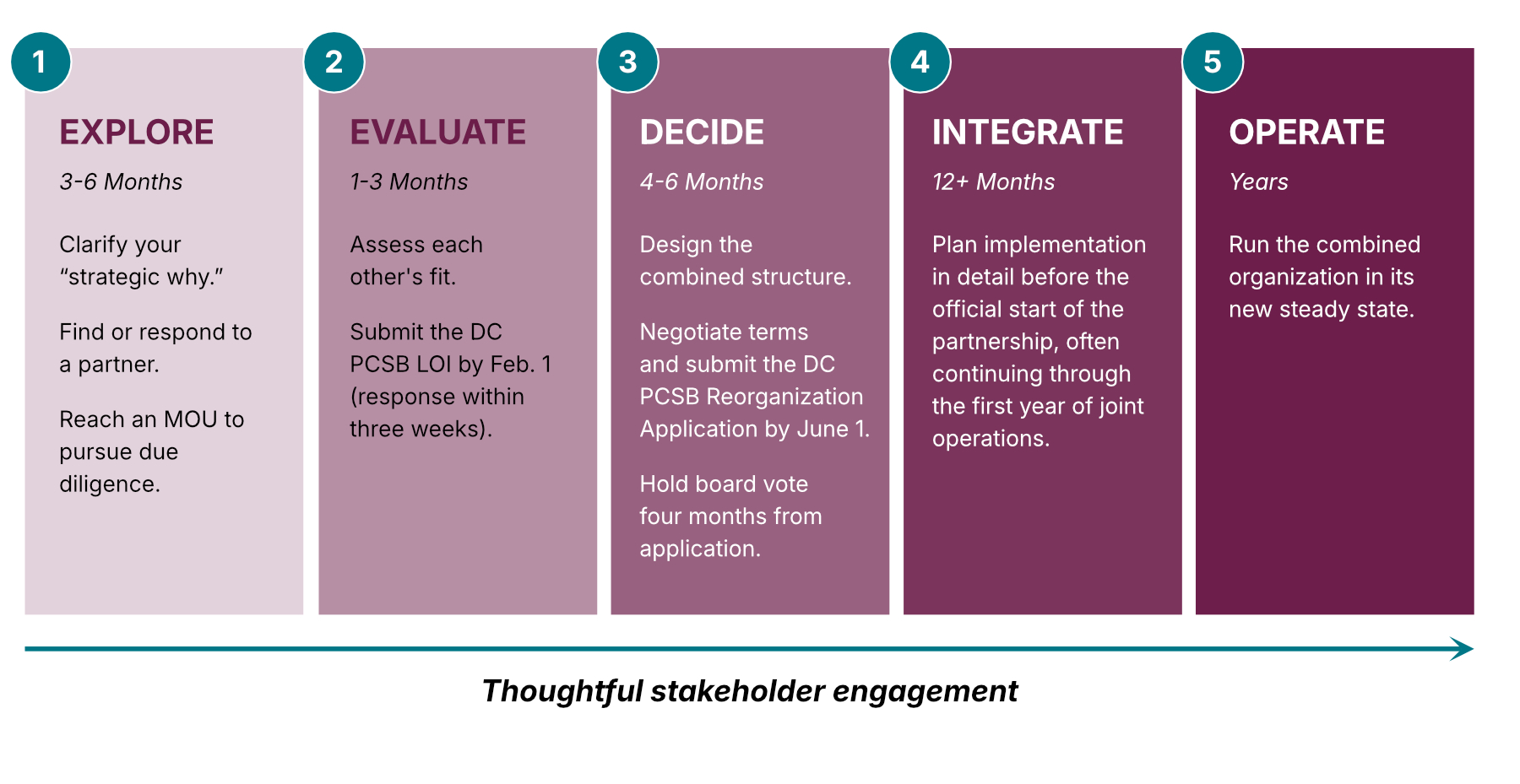
These deadlines should be treated as milestones to work toward, not starting points. By the time an LEA submits an LOI, its board and leadership team should already have done substantial work to understand why reorganization may make sense, identify and assess a potential partner, and confirm that both partners are prepared to move forward in tandem. The sections that follow provide guidance on how to do that work.
Confirm that the proposed reorganization is eligible.
LEAs considering reorganization should first understand whether they meet the DC PCSB’s minimum eligibility requirements. Eligibility differs by pathway and, in some cases, by the role an LEA would play in the transaction (Table 1).
TABLE 1: SUMMARY OF DC PCSB REORGANIZATION ELIGIBILITY REQUIREMENTS FOR A CHARTER SCHOOL OR NETWORK
| Criterion | Merger | Standard Acquisition | Emergency Acquisition |
| Charter Review and Standing |
All LEAs:
|
LEA being acquired:
|
LEA being acquired:
|
|
Acquiring LEA:
|
|||
|
Performance (Must meet eligibility criteria in at least two of the previous three school years.) |
If all LEAs evaluated under the DC PCSB’s Annual School Performance Index Report and Evaluation (ASPIRE):
If one evaluated under the Alternative Accountability Framework (AAF):
If all evaluated under AAF:
|
Acquiring LEA:
LEA being acquired:
|
|
| Finance |
All LEAs:
At least one LEA:
|
Acquiring LEA:
LEA being acquired:
|
|
Consider whether to submit a notice of exploration.
At any time before submitting an LOI to the DC PCSB, LEAs may notify the authorizer that they are exploring a potential reorganization. The notice has no specific requirements and does not commit the LEAs to moving forward.
Leaders and boards should be thoughtful about when they submit a notice of exploration and how they communicate about a potential reorganization. Materials submitted to the DC PCSB may be subject to public records requests, so LEAs should assume their exploration could become public once they submit information to the authorizer. As an alternative to written communication, the DC PCSB welcomes phone calls and in-person conversations with board chairs and school leaders to allow for greater confidentiality.
Submit an LOI to the DC PCSB.
For mergers and standard acquisitions, eligible LEAs must submit a joint LOI by February 1 of the school year before the proposed planning year. For emergency acquisitions, the LEA seeking to be acquired must submit an LOI within two weeks of a triggering event.9 The DC PCSB will use a school’s most recent school performance data (from ASPIRE) in evaluating proposals, so schools may choose to wait until that data is released in January before submitting.10
The LOI gives the DC PCSB an early opportunity to assess the proposed reorganization before a charter school or network develops a full application. Three guiding principles anchor the DC PCSB’s approach to school reorganization:
-
- Driving Toward Excellence: Does the reorganization create a credible path to stronger educational opportunities and outcomes for students, not simply preserve an organization or solve an operational problem?
- Need and Demand: Does the proposal respond to demonstrated student and community needs and show that families are likely to choose and sustain the reorganized school?
- Organizational Capacity: Do the organizations involved demonstrate that they have the leadership, governance, financial, and operational capacity to successfully carry out the reorganization?
Consistent with these principles, the LOI asks charter schools and networks to explain the rationale and supporting evidence for the reorganization. The LOI must be signed by the school leader and board chair of each submitting LEA, and specific requirements vary by pathway (Table 2).
TABLE 2: OVERVIEW OF DC PCSB REORGANIZATION RATIONALE AND SUPPORTING EVIDENCE REQUIREMENTS
| Required LOI Component | Required For | ||
| Merger? | Standard Acquisition? | Emergency Acquisition? | |
| Rationale for how reorganization better meets student and community needs, including (if relevant) how it will improve student outcomes on ASPIRE. | Yes | Yes — in reference to students in the LEA being acquired.* | Yes — in reference to students in the LEA being acquired. |
| Identification of academic, financial, or operational challenges to date; previous strategies or methods to mitigate them; and how reorganization will address them. | Yes | Only for LEA being acquired. | Only for LEA being acquired. |
| Evidence of how the reorganization is responsive to need and demand demonstrated by sector planning data and market analysis. | Yes | Yes | Yes |
| Attestation that minimum eligibility criteria are met. | Yes | Only for acquiring LEA. | Only for acquiring LEA. |
| Attestation that acquiring LEA will assume responsibility for completing application in collaboration with LEA being acquired. | No | Yes | No |
| Evidence of sufficient capacity, including financial and administrative, to complete reorganization. | Yes | Only for acquiring LEA. | Only for acquiring LEA. |
| Approach to securing an acquiring LEA partner. | No | No | Yes |
| Who submits the LOI? | Joint | Joint | LEA seeking to be acquired. |
Note: *Adult students if the LEA provides adult education.
Across all three pathways, the DC PCSB has committed to respond within three weeks with either “No Objections to Proceeding” or “Objections to Proceeding.” LEAs may continue toward an application in either case, but an objection indicates that the DC PCSB believes the proposed reorganization is unlikely to meet the standards for approval. A “No Objections to Proceeding” response does not guarantee that the eventual application will be approved.
Submit an application.
For mergers and standard acquisitions, an application is due June 1 of the school year before the proposed planning year. For emergency acquisitions, the application is due within three months of the DC PCSB’s response to the LOI. The application asks LEAs to demonstrate that the proposed reorganization meets the DC PCSB’s five standards for approval (Table 3).11
TABLE 3: DC PCSB’S FIVE STANDARDS FOR REORGANIZATION APPROVAL
| Standard | What DC PCSB Looks For | Pathway-Specific Additions |
|
Need and Demand (Must be met for approval.) |
Reorganization better meets community need for a relevant model and strong outcomes; enrollment targets likely met; evidence of family or adult-student demand that responds to the DC PCSB’s latest demand analysis. | None |
| Sufficient Progress in Developing the Plan | Realistic view of challenges and a plan to address them; engaged families, staff, community, and officials; viable, legally compliant education, operations, and finance plans; preliminary asset acquisition agreement covering the relinquishing LEA’s 10 largest assets and liabilities, plus any item over $100,000. |
Merger: Also cover challenges the applicants have faced before. Acquisition: Engage stakeholders of the acquired LEA or campus. |
| Consistency of Mission | Mission, vision, and design are a consistent throughline, responsive to communities served, and evidence based. |
Acquisition: Explain how the acquiring LEA will support students, families, and staff if the model differs. Emergency: Track record with the closing school’s model. |
| Inclusiveness | Designed for all students, including students with disabilities, multilingual learners, and economically disadvantaged students; strong past outcomes for all groups (via accountability data, special education compliance, and observations). | Emergency: Focus on students reflecting the closing school’s demographics. If past results were below sector or city rates, provide a detailed improvement plan. |
| Leadership Capacity | Stable LEA and campus leadership; board engaged in planning; leaders and staff with the capacity and track record to execute. | Emergency: Preference for applicants with prior acquisition experience. |
After reviewing the application, DC PCSB staff may invite applicants to a capacity interview of up to 90 minutes to assess their readiness to carry out the proposed reorganization. Applicants should expect questions from DC PCSB staff and board members and may be asked to respond to a challenge scenario. Applicants’ interview teams should include the staff and board members who collectively have the expertise needed to address the areas covered in the application.
The DC PCSB holds a public hearing on the application. Following the hearing, DC PCSB staff evaluate the application and make a recommendation to the DC PCSB board, which votes on whether to approve the reorganization at a subsequent public meeting (Table 4).
For mergers and standard acquisitions, applicants can expect the process (from application submission to a DC PCSB vote) to take about four months. For emergency acquisitions, the timeline may be shorter so the DC PCSB can vote before the start of the upcoming school year.
TABLE 4: DC PCSB RECOMMENDATION CRITERIA FOR MERGERS AND STANDARD ACQUISITIONS
| Recommendation | Evaluation |
| Approval | Both applicants meet each of the standards for approval. |
| Approval With Conditions |
Both applicants meet, at a minimum, the standard “Need and Demand,” and they miss no more than one additional standard for approval. Factors staff will consider include, but are not limited to:
|
| Denial | The applicants do not meet, at a minimum, the standard “Need and Demand,” or they meet this standard but miss one or more additional standards. After considering the preceding factors, staff determines the missed standard cannot be resolved at this time. |
Use the planning year to prepare for implementation.
Approved mergers and standard acquisitions must have at least one planning year before the reorganization takes effect. During this time, LEAs finalize the agreements and plans needed to implement the reorganization. For mergers, this includes negotiating a revised charter agreement with the DC PCSB for the merged entity and refining transition plans; for standard acquisitions, it includes finalizing asset acquisition agreements and transition plans, as well as negotiating a revised charter agreement. LEAs approved with conditions must also address the missed standard as specified in the charter amendment.12 Emergency acquisitions do not have a required planning year. The planning year provides dedicated time to translate the approved reorganization into an executable transition and integration plan.
TOOLS, TEMPLATES, AND RESOURCES
- Reorganization Evidence Readiness Tracker — A resource listing every piece of evidence the DC PCSB’s Standard for Approval calls for under its School Reorganization Policy, with Bellwether’s recommendation for what would satisfy each requirement.
3. How Should We Engage Key Stakeholders Through the Process?
Schools are more than the organizations that operate them. For students, families, educators, alumni, and communities, they are places of growth, belonging, identity, history, and connection. A school can be where generations of a family have learned, where educators have built careers, and where students have found the adults and peers who know them best.
Reorganization can disrupt that sense of permanence. Even when the change is intended to strengthen a school, preserve opportunities for students, or create a more sustainable future, the prospect that a familiar school may close, combine with another organization, change leadership, or simply become something different can shake stakeholders to the core. That makes the when, where, how, and (especially) why of engagement far more than a communications matter. Done well, engagement can build trust, surface concerns while there is still time to address them, and create the understanding needed to move through difficult decisions together. Done poorly, it can dismantle trust, harden opposition, accelerate staff or family departures, and complicate nearly every step required to complete a successful reorganization.
And yet, leaders cannot simply begin by telling everyone everything.
Leaders often believe confidentiality and engagement are competing values when they are not. They are sequential responsibilities. Explore a reorganization or merger too publicly and you destabilize a school before you know whether a partnership is viable. Wait too long and families conclude that decisions were made without them. Effective leaders do not choose between confidentiality and engagement; they know when one gives way to the other.
One of the first questions leaders ask when considering reorganization is, “When should we tell people?” A better question is: “When does sharing information advance the interests of students and the organization, and when does it create uncertainty before there is enough certainty to justify it?”
Confidentiality is not secrecy. During early exploration, leaders and boards must prioritize testing assumptions, assessing strategic fit, and determining whether a partnership is viable. Public discussion before those questions have been answered creates uncertainty before there is anything concrete to communicate.13
But confidentiality has a shelf life. As confidence in a potential reorganization grows, so does the responsibility to widen the circle. Staff, families, and other stakeholders deserve to hear significant news directly from school leadership — not through rumors, social media, or a public filing. More importantly, they deserve to know not just the what but also the why behind any decisions being made about their school.
The progression also matters in the District of Columbia because stakeholder engagement in any reorganization effort is part of the approval process, not simply a communications preference. Under the DC PCSB’s “Sufficient Progress in Developing the Plan” standard,14 applicants must demonstrate engagement with families, staff, community members, elected officials, and, where applicable, adult students. The practical challenge is that meaningful engagement cannot begin at the start of confidential exploration. Leaders therefore need to plan backward from the dates that make a proposed reorganization increasingly public.
Successful engagement is rarely about saying more. It is about saying the right thing, to the right people, at the right time, in service of the students whose lives will be affected by the decisions ahead. The guidance that follows helps leaders navigate that progression deliberately: when to preserve confidentiality, when and how to widen the circle, how engagement differs depending on the stakeholder and each school’s role in the reorganization, and how to use engagement not simply to explain a plan but to strengthen it.
The Human Impacts of Reorganization
More than any other section, this one is about the people a reorganization affects, as well as your own vulnerability in leading. What follows is guidance on when and how to engage, but the harder work is often doing so with integrity and value alignment even when it is personally hard for people you know well and care deeply about.
Approach engagement as a sequence that widens as confidence grows, rather than a single conversation.
Stakeholder engagement should be treated as a sequence of conversations rather than a single announcement. The early objective is learning: Is the partnership strategically, financially, operationally, and culturally viable? As confidence grows, the objective shifts toward preparation: What will people need to understand, decide, and do if the reorganization moves forward?
By the planning year, stakeholders should not be hearing the basic idea for the first time. They should be preparing to live through it. That means leaders should work backward from the formal DC PCSB milestones rather than treating the public hearing as the starting point.
For mergers and standard acquisitions, the February 1 LOI is an important public-facing milestone because it requires the signature of each LEA’s school leader and board chair and follows board action. The June 1 application brings a more developed plan into the formal approval process and precedes ANC notification, public comment, and a public hearing. Emergency acquisitions compress this entire sequence: There is no required planning year, and the LOI is due within two weeks of the triggering event. Engagement remains essential, but the cadence is necessarily different.
Widening the circle to include key leaders and stakeholders is not the same as widening it to the public. The circle can and should expand deliberately, by role and under clear confidentiality expectations. But in a reorganization involving two organizations, that expansion also has to be coordinated (Sidebar 1). The parties should agree on who comes into the circle next, what they will be told, and what they may communicate to others. The goal is to build shared understanding early enough that the people who may later be responsible for implementation are not asked to begin that work as strangers — without moving so quickly that one organization gets ahead of the other’s readiness to engage.
SIDEBAR 1
Reorganization Engagement in Practice at Friendship Public Charter School, District of Columbia
Practice Insight: In one potential reorganization, Friendship Public Charter School (Friendship), a preschool through Grade 12 charter network with 15 campuses (including online) serving more than 4,000 students in the District of Columbia, reached a preliminary handshake agreement with another LEA and was excited about what they might build together. Friendship team members jumped right in: visiting the partner’s school, engaging funders about transition support, and beginning to plan with an ever-widening group of people.
The problem was that Friendship had moved well ahead of its potential partner. While Friendship’s leaders were behaving as though the reorganization were moving toward implementation, the other LEA had not yet engaged its key stakeholders or built the internal alignment needed to move forward. Friendship’s widening circle created pressure and exposure before the other LEA was ready for either. The mismatch in timing and lack of coordination ultimately derailed the reorganization.
Lesson: Two organizations do not need to move at exactly the same pace internally, but they do need to agree on when and how the circle widens. A handshake between leaders is not yet organizational alignment.
Practical Rule: Before either organization widens the circle, the parties should agree on who comes in next, what they will hear, and what they may communicate to others.
Tailor engagement messaging, timing, and sequencing to the audience and school context.
Leaders must consider every audience a reorganization may affect, because each enters the process with a different question. Families want to know what changes for their children. Staff want to know what changes for their jobs, programs, and professional lives. Boards need confidence that the decision is sound and consistent with the mission. Community partners and funders may be focused on continuity, stability, and stewardship. The DC PCSB needs evidence that a reorganization plan is viable and that strong engagement shaped its development.
The role each LEA plays in the transaction also changes the conversation. If an LEA is likely to relinquish its charter, its community may be absorbing a sense of loss, while staff may be asking whether they will have jobs in the fall. If an LEA will retain the charter, its community is more likely to be absorbing change: new students, new colleagues, new programs, and potentially new operating responsibilities. These are not the same conversations and often should not occur in the same room.
Assess your stakeholder culture before designing engagement.
Not every school community expects the same relationship to a reorganization decision. Some stakeholders (particularly in schools with a strong tradition of parent councils, active PTAs, or organized staff voice) will expect to shape the decision, not simply hear about it once it is made. Others are more accustomed to a top-down communication style and will accept being informed once plans firm up. Neither culture is right or wrong, but conflating the two, or misjudging which one describes your community, will erode trust and buy-in.
Before building an engagement plan, leaders and boards should honestly assess their own stakeholder culture. Consider the following:
-
- Historical engagement patterns. Has your community organized around past decisions (e.g., leadership transition, program change, facilities move)? Do parents and educators have established channels, such as a family council or staff committee, through which they expect to be consulted?
- Degree of investment. Is current parent and educator engagement strong, moderate, or already thin? (Note: A community with low historical engagement is not automatically low risk. Disinvestment can mean stakeholders will not organize a response until a decision feels irreversible, at which point opposition can surface later and be harder to manage than if it had surfaced early.)
- Expectation gap. Where your community’s expectation of voice exceeds what leaders intend to offer, explicitly name that gap (and decide whether to close it), rather than discovering it midprocess.
- Collective bargaining status. Where educators are represented by a collective bargaining unit, leaders should also identify early which provisions of the collective bargaining agreement govern notice, consultation, or the timing of information sharing with staff. These obligations can operate on a different timeline from the engagement sequencing described elsewhere in this section, and unlike general stakeholder expectations, they may carry legal consequences if overlooked.15
This assessment should directly shape whether your engagement plan is built primarily to inform (communicate decisions and rationale as they firm up) or to seek input (create structured opportunities for stakeholders to shape the plan before it is finalized). Most reorganizations require some blend of both, calibrated by audience and by stage and grounded in your actual stakeholder culture.
Ensure internal communication comes before public communication.
Whenever timing allows, staff should hear directly from their own leaders before families, community partners, funders, or the news media. Teachers who hear about a merger from a parent rarely forget it. Internal communication is not a courtesy; it is the foundation of trust through the planning year. A practical internal communication cascade is:
-
- Board and executive leadership
- Senior leaders and principals
- Staff
- Families and students
- Key external stakeholders (e.g., partners, funders, elected officials, and community members)
- Broader public and news media
The exact order may shift based on circumstances, but the key principle should not: People inside the organization who are expected to carry the change should not learn about it from anyone outside their own organization.
Prioritize listening over announcing and prepare for the hardest questions.
A communication plan tells people what leaders want them to know. An engagement plan also creates a disciplined way to hear what leaders may not yet know. Town halls, listening sessions, office hours, surveys, small-group meetings, and one-on-one conversations serve different purposes; leaders should match the method to the question they need answered.
The DC PCSB public hearing is a chance for any member of the public to speak on a reorganization. Providing structured listening space specifically for your school’s stakeholders before that hearing has two benefits: 1) it may surface concerns early enough to improve the plan, and 2) it reduces the chance that leaders first hear a significant objection while sitting at a public hearing. Engagement should shape the plan, not merely document that communication occurred.
The questions leaders least want to answer are often the ones they most need to answer. In typical reorganizations, stakeholders’ first questions are practical and personal: “Is my job safe? Is my child’s school closing? Who will be in charge?” Leaders should prepare direct answers where answers exist and be equally direct when they do not.
Avoid common engagement mistakes.
Most engagement mistakes are not the result of leaders failing to communicate. More often, leaders communicate at the wrong time, to the wrong audience, without enough specificity, or without sufficient coordination between the organizations involved. The risks are particularly high during reorganization because leaders are managing two legitimate needs at once. They need enough confidentiality to determine whether a viable transaction exists, and they need enough engagement to ensure that the people affected by the decision are not simply presented with a finished plan. The transition between those responsibilities requires judgment.
Once engagement begins, communication should be honest, regular, and grounded in what leaders know. Stakeholders generally respond better to clearly stated uncertainty than to reassurance that feels incomplete or overly polished. Leaders should distinguish among what has been decided, what is likely, what remains genuinely unresolved, and when additional answers can be expected. They should resist the temptation to speculate, minimize difficult information, or “fluff up” the message. Credibility is difficult to rebuild once stakeholders believe leaders are withholding, stretching, or obscuring the truth.
Mistakes also compound. An announcement made before leaders can answer predictable questions may generate rumors. Failing to address those rumors allows misinformation to fill the gaps. Waiting until a public filing forces disclosure may cause families and staff to conclude that their input was never wanted. Allowing one organization to widen its circle before the other is ready can create pressure that destabilizes the partnership itself. And once stakeholders lose confidence in the process, even good decisions can become harder to implement.
Strong engagement therefore requires more than an announcement. Leaders should communicate through multiple channels, make relevant information easy to find, share increasingly concrete plans as they develop, and create meaningful opportunities for questions and feedback. Communication should remain two-way: Leaders are not simply explaining a transaction; they are learning what stakeholders need, fear, value, and understand. Early signs of progress and quick wins can also help stakeholders see how the larger vision is becoming real.
The cadence matters as much as the content (Table 5). Leaders should anticipate the questions stakeholders are likely to ask and prepare for challenges rather than be surprised by them. They should continue communicating throughout planning and implementation, including when there is little new to report. In periods of uncertainty, silence is itself interpreted as information.
TABLE 5: TYPICAL COMMUNICATION CASCADE
| Recommendation | Audience | Action |
| Align | Board and executive team | Confirm alignment and approve the core message. |
| Prepare | Leaders who will be asked questions first | Brief them before anyone else is told. |
| Staff | Staff | Communicate directly, with an immediate FAQ and a clear place to ask follow-up questions. |
| Families and Students | Families and students | Use language tailored to what changes for them. |
| Key External Stakeholders | Partners, funders, elected officials, community stakeholders | Brief them before the matter reaches a public hearing. |
| Public | General public | Release public messaging only after the rest of the cascade is complete. |
The goal is not perfect communication or unlimited disclosure. It is a disciplined engagement process in which leaders continually ask: “Who needs to know now? What do they need to know? What is still genuinely undecided? What do we need to hear from them? What information should be readily available? And are both organizations ready for this circle to widen?”
TOOLS, TEMPLATES, AND RESOURCES
- Stakeholder Culture and Engagement-Risk Diagnostic — A tool to help leaders and boards make an honest, evidence-based assessment of their stakeholder culture before designing an engagement plan.
- Initial Staff and Family Communications Template — A set of starting points to structure staff and family messages, to be adapted once leaders know what has been decided and what remains open.
- Manager Talking Points Template — A set of core talking points for school site leaders, division heads, and functional leads to share essential information about a potential school reorganization.
- Board Resolution Template — An overview and template for a board resolution authorizing management to explore a potential reorganization without approving the transaction itself.
- Engagement Methods Comparison — An overview of common engagement formats, with key considerations for each, to help leaders and boards plan engagement for a potential school reorganization.
- FAQ Starter Template — A set of commonly asked questions to help leaders and boards prepare for a potential school reorganization.
- Stakeholder Engagement Risk Check — A guide that sets out core strategic questions for stakeholder outreach and maps associated risk factors for leaders and boards to consider in a potential school reorganization.
4. How Do We Secure the Right Expertise?
The goal is not simply to secure expertise. It is to assemble the right advisory team — with both external and internal members — and to know which decisions you cannot afford to get wrong.
Most school leaders will navigate a merger or acquisition once, if ever. They should not be expected to possess deep expertise in nonprofit corporate law, charter regulation, employment transitions, real estate, financial diligence, communications, and integration management. But bringing in advisers, and deploying your own internal experts, does not transfer accountability. Boards remain responsible for the decision. School leaders remain responsible for leading the process.
The useful question is not “Whom do we hire?” It is: “Which decisions here are irreversible, and are we covered on each?” Reorganization concentrates a small number of high-stakes commitments, such as asset transfer, employment, facilities, debt, and governance, into a compressed timeline. That is where leaders should spend both attention and money.
Some responsibilities should never be outsourced: the strategic rationale, the assessment of the potential partner, the decision to proceed, and the relationship with the school community. The DC PCSB’s “Leadership Capacity” standard evaluates the people who will govern and lead the reorganized school, not the quality of their consultants. This scrutiny covers not only whether the team can navigate the transaction itself but also whether it can serve a new and larger community spanning both legacy schools.
Every adviser also widens the circle of people who know about a potential reorganization. Advisory-team building requires the same discipline as stakeholder engagement: Bring people in when their expertise is needed, clarify confidentiality, and expand the team as the work becomes more defined.
The Human Impacts of Reorganization
Asking for help can feel like admitting you do not know what you are doing, especially for a first-time leader navigating unfamiliar terrain. Most leaders in your position have never done this before, and needing an advisory team is the norm, not the exception. Wisely complementing your team’s expertise with that of third-party specialists is a sign of strength, not weakness.
This section covers a lot of ground and may feel like too much to take in at once. Do not feel the need to internalize everything — you are likely some way off from needing to assemble an advisory team. When the time does come, this playbook can serve as a helpful point of reference.
Start with the expertise you already have.
Before retaining outside advisers, inventory the capacity already available inside the organization and around the board table. Leadership teams, board members, existing professional partners, and peer operators may already bring legal, financial, real estate, human resources (HR), governance, communications, or transaction experience.
This initial inventory is not an argument for using board members as free consultants. A board member who has relevant expertise still has fiduciary and voting responsibilities, and potential conflicts should be addressed explicitly. The purpose of the inventory is to distinguish among expertise the organization can rely on internally, expertise that can supplement an outside adviser, and areas that require independent professional representation.
Build around four kinds of expertise.
A strong advisory team combines four kinds of expertise (Table 6). Not every role must be external, and one person may bring more than one type, but each category should be intentionally covered:
-
- Technical expertise helps organizations complete transactions.
- Lived or practical experience helps leaders navigate them. The most valuable person at the table is not always the attorney or the accountant; sometimes it is the leader who has already walked the path you are beginning.
- Governance expertise helps ensure decisions are wisely and efficiently made.
- Operational expertise helps bridge the gap between vision and reality.
TABLE 6: ADVISORY TEAM BUILDER
| Area | Primary Contribution | Examples |
| Technical Expertise | Specialized legal, financial, employment, facilities, and regulatory knowledge | Attorneys, certified public accountant or financial adviser, real estate specialist |
| Lived or Practical Experience | Pattern recognition from having navigated reorganization before | Peer CEO, former board chair, experienced funder or adviser |
| Governance Expertise | Decision rights, fiduciary judgment, board-to-board alignment | Board chair, governance counsel, experienced board member |
| Operational Expertise | Ability to translate decisions into executable plans | COO; HR, IT, and facilities leaders; project manager; communications lead |
Before or during formal exploration, identify two or three leaders who have navigated a comparable reorganization and ask:
-
- What do you wish you had known before beginning?
- What was the first issue that surprised you after the organizations committed to move forward?
- Which adviser or capability mattered most — and which did you bring in too late?
- Where did board or leadership alignment break down or require the most work?
- What would you investigate earlier in due diligence if you did it again?
- Which integration decisions could wait, and which could not?
- What nearly stopped the transaction or created the greatest implementation risk?
Consider eight adviser roles, but engage them as needed.
The advisory team should expand over time. Bringing everyone into the room on day one is no more effective than waiting until the end. The need for outside support typically grows from exploration through diligence, peaks around major legal and financial decisions, and then shifts toward implementation during the planning year.
The roster below outlines eight typical adviser roles that LEAs rely on during reorganization:
-
- Nonprofit corporate counsel
- Charter regulatory counsel
- Employment counsel
- Real estate counsel
- Financial or audit adviser
- Neutral facilitator
- Integration project manager
- Communications adviser
Identify different adviser needs for each party and prioritize independent counsel for the party with less capacity.
The two organizations do not enter a reorganization with identical responsibilities or risks. In an acquisition, the acquiring LEA is evaluating the liabilities and future obligations it may absorb; the LEA relinquishing its charter is evaluating what happens to its assets, obligations, staff, students, and legacy. Those perspectives are related but not interchangeable.
The LEA relinquishing its charter is also often the party with less money, capacity, and leverage, which can make it the more likely party to forgo independent counsel. That is precisely when independent representation matters most. Each board needs advice that is accountable to its own fiduciary obligations. A shared facilitator can support joint conversations, but the parties should not rely on a single attorney for interests that may diverge. When resources are constrained, leaders can ask funders or, where appropriate, the acquiring party to help cover transaction costs without compromising the independence of the advice.
Address three often-overlooked items early to avoid late-stage deal failures, delays, and costs.
Certain issues are easy to treat as details until they become deal constraints. Three deserve early attention in reorganizations: tax-exempt bond covenants and change-of-control provisions; facility condition, lease assignment, and consent; and retirement plan and benefits continuity across two employers. If one of these remains materially unresolved while the parties are drafting the application, neither the application itself nor its approval will resolve it (Sidebar 2).
SIDEBAR 2
Reorganization Expertise in Practice
Facilities Practice Insight: In a highly compressed takeover, the acquiring organization learned late that the modular buildings it expected to continue using did not meet its facility standards or then-current compliance requirements. The issue was discovered too late to preserve the planned grade-level configuration.
Lesson: Approval to operate a facility is not the same thing as a condition assessment. Facilities diligence must test the physical reality, not just the paperwork.
Benefits Practice Insight: In one transition, the acquiring organization’s HR team executed the hiring process well and arranged for benefits to begin on employees’ first day with the new employer. What no one had confirmed was the exact date the closing organization’s coverage ended. It lapsed over a weekend, leaving a transferring employee with no coverage from either organization.
Lesson: Continuity of coverage is a different question from quality of coverage.
Clarify roles and build the working relationship early.
Leading a reorganization advisory team has been compared to conducting an orchestra: The leader is not the one playing every instrument, but they are responsible for timing, balance, and making sure each section knows when to come in.
Advisers work best when everyone knows who owns which decisions. The advisory team should establish decision rights, confidentiality expectations, meeting cadence, escalation paths, and documentation practices before disagreements emerge.
Confusion about who owns a decision is among the fastest ways to slow a reorganization. Advisers should inform decisions and translate them into legal, financial, or operational work. They should not become substitutes for board governance or executive leadership. Nor should managing advisers distract leaders from their core responsibilities — stakeholders will lose confidence in the process if leaders lose the plot.
Avoid common advisory mistakes.
Most adviser mistakes are timing mistakes, not selection mistakes. Organizations can assemble highly capable attorneys, financial advisers, consultants, and project managers and still find themselves poorly advised if those people enter the process too late, are asked to solve the wrong problem, or work without a clear understanding of who owns the decision.
Some expertise becomes less valuable when it arrives at the wrong time. Counsel brought in after leaders have already settled on a transaction structure may be able to document that structure but have little opportunity to help leaders identify a better one. A facilities expert brought in after assumptions about grade-level configuration or occupancy have shaped the deal may discover problems that can no longer be solved easily. An integration consultant engaged before leaders have decided what they are trying to preserve, change, or build may create an excellent implementation plan for a strategy that has not yet been determined.
Other mistakes come from coverage gaps. Leaders may have excellent corporate counsel but no one examining employment or benefits continuity. They may rely on an existing auditor without asking whether independence requirements limit the work that firm can perform. Or they may assemble advisers individually without determining whether, collectively, the team covers the decisions the organizations cannot afford to get wrong.
There is also a less visible capacity problem. External advisers do not eliminate the internal work of a reorganization. They often create more of it. Someone still has to provide documents, answer questions, reconcile conflicting recommendations, prepare the board, coordinate across organizations, and make decisions. The real capacity cost may be measured as much in the time of the CEO, CFO, COO, school leaders, and board members as in professional fees. If no one owns the whole process internally, even an excellent advisory team can become a collection of parallel workstreams rather than a source of coordinated support.
Finally, technical expertise should not crowd out practical experience. A leader who has navigated a reorganization may recognize a pattern — a stakeholder problem, transition risk, governance dynamic, or sequencing mistake — that is not visible in a legal memorandum or financial model. Peer experience does not substitute for technical advice, but treating it as optional can mean paying for lessons another leader has already learned.
TOOLS, TEMPLATES, AND RESOURCES
- Internal Expertise Inventory — A template to track who has the expertise a reorganization requires, where external support is likely needed, and which questions remain open.
- Adviser Roster and Timeline — A template outlining advisory roles and responsibilities for a potential school reorganization, along with the typical timing of engagement.
- Adviser Needs by Role — A tool to help leaders and boards identify adviser needs and areas of expertise across key legal, operational, and governance issues based on their organization’s role in a school reorganization.
- Charter School or Network Advisory Team Practical Rules — A set of guiding principles for structuring advisory teams in a potential school reorganization.
- RAPID Matrix for Decision Rights — A template to map a common set of decisions for leaders and boards in a potential school reorganization against the RAPID decision-making model.
- Common Pitfalls Checklist — An overview of common advisory and decision-making challenges, associated risks, and readiness indicators to help leaders and board members decide whether to advance to the next phase of a potential school reorganization.
5. How Do We Identify, Connect With, and Assess Potential Strategic Partners?
By definition, mergers and acquisitions require a willing partner; for most organizations, finding one is the least scripted (and least predictable) part of the reorganization process. Partners may emerge in many ways: via a deliberate search, a chance conversation at a convening, an introduction from a funder, or an unsolicited approach from another school. Schools less concerned about confidentiality might also choose to issue a request for proposals (RFP), as some have done in the past.
Regardless of the means of connection, vetting should follow a fairly standard sequence: Confirm partnership objectives and partner criteria, identify other schools that meet those criteria, evaluate and narrow the list, make (or accept) contact, gauge mutual fit and interest, and, where warranted, proceed to deeper exploration and diligence.
Boards and leaders should keep two principles in mind during this phase:
-
- Do not overinvest early. Most exploratory conversations will not lead to a transaction, and that is a healthy outcome.
- Stay curious. The schools that find strong partners tend to be the ones that start looking and asking questions before circumstances force them to.
The Human Impacts of Reorganization
Early partner conversations may require leaders to be candid (and potentially vulnerable) in front of a peer who may be a near-stranger. You will need to honestly describe your school’s real challenges (not just its strengths) to a peer who may become either a close partner or, if things do not proceed, someone you still see at every sector convening. That discomfort is worth acknowledging for yourself and your board before conversations start.
Develop criteria based on your strategic rationale.
Before talking with any potential partner, return to the strategic rationale you developed earlier in this process and confirm your answers to two questions: Why are you looking for a partner? And what do you hope will be true about that partner (Section 1)? This step applies especially to schools that receive an inbound approach. Another school reaching out first does not mean the partnership is a good fit. Run an inbound opportunity through the same criteria you would use in a proactive search and select the best proposal (not necessarily the first).
Convert your qualitative answers into a set of objective criteria you can use to quickly identify and assess potential partners. Factors often considered include:
-
- Size (total enrollment, staff, budget)
- Location and geography
- Mission alignment
- Program features (grade levels, instructional model, specialized programs)
- Academic performance
- Financial health
Together, these criteria form a partnership “strike zone”: a shared, written definition of which opportunities or “pitches” you will seek out or “swing at,” and which you will let pass. A clear strike zone saves boards and leaders precious time, keeps the search grounded in strategy rather than opportunism, and gives LEAs a principled way to decline opportunities that are not a strong fit.
For board members and school leaders: The board owns this step. The school leader will typically draft the strike zone and scan the market, but the board should debate, refine, and formally endorse the criteria before any outreach begins. A board that has approved the strike-zone criteria in advance can respond to opportunities quickly and consistently, rather than having to revisit fundamental questions each time a prospect surfaces.
For acquiring LEAs and those seeking to be acquired: Your position shapes your criteria. A school positioned to acquire (whether due to stability or ambition) should weigh its own capacity to absorb another organization: leadership bandwidth, operational systems, academic stability, and balance-sheet strength. If your school is seeking to be acquired, weigh the partner’s stability and track record (including governance, academics, and finances), its respect for your school’s community and culture, and the commitments it is willing to make to your students and staff.
Treat the strike zone as a living document. Revisit it as conversations teach you what really matters, and update it as needed.
Cast a wide net and then narrow (but not too much).
Under the District of Columbia School Reform Act, boards hold a consistent fiduciary role for the school regardless of how a potential partnership arises.16 As a matter of good governance, and to honor that duty, boards should ideally consider multiple potential partners rather than settling on the first name that surfaces, whether that name comes from their own search or an inbound approach. Some boards have gone further and issued a formal RFP to solicit interest from several potential partners at once. With few exceptions, your partner will be another District of Columbia charter operator, though the city’s charter landscape is broader and more diverse than many leaders and boards realize.17
Use your strike-zone criteria to filter quickly from the full set of schools to a smaller group worth considering more deeply. Resist the urge to narrow to one or two names at this stage; a short list of several schools preserves options and improves your negotiating position later.
Once you have narrowed to an initial short list, conduct desk research to learn more about each school’s history, leadership, community reputation, financial and academic health, and culture. Much of this information is publicly available.
For single-site and multisite LEAs: Multisite operators often have strategy staff and existing sector relationships to draw on for this scan. Single-site leaders typically do not. They should lean on board members, peer leaders, and trusted third parties to extend their reach rather than treating the scan as a solo project for a leader or board member.
For schools seeking to be acquired: Casting a wide net can also mean signaling availability broadly rather than approaching one prospect at a time. Some charter LEAs seeking to be acquired have issued a formal RFP to invite interest from multiple potential partners simultaneously. This approach can surface options a single school leader or board might not otherwise identify and can clarify competitive terms early in the process. It also raises confidentiality and reputational considerations, since an RFP is inherently more visible than a private approach, and boards should weigh those trade-offs carefully before pursuing this approach.
Make contact and stay curious.
Publicly available information can only get you so far. At some point, the initiating school must reach out to make direct contact; it is hard to definitively assess fit and compatibility without meeting the other school’s leader and board. If you lack a natural connection to a school on your list, several channels can broker an introduction. These first conversations can take many forms, but they work best when they remain:
-
- Small. Likely just the two executive directors and/or two board members at first.
- Confidential. These conversations are exploratory and preliminary; given uncertainty on all sides, premature disclosure could cause undue disruption and distraction to staff and families in both organizations.
- Exploratory. This is the time for gauging interest and beginning to assess board and leadership compatibility, not for detailed planning or negotiation.18
Questions worth exploring early include:
-
- Have you ever thought about or pursued a partnership?
- How could a partnership benefit both schools?
- What would you be looking for in a partner? Anything that feels like a red flag?
Get to know the leader and their board.
If the first conversation goes well, deepen the relationship deliberately. Meet additional board members and consider visiting each other’s schools; culture is easier to observe than to describe.
At minimum, hold a “2×2” meeting during the early exploration phase, in which the two executive directors meet together with the chair of each board, perhaps more than once. The purpose is to build rapport, ask and answer questions about each school and its model, and test whether and how a partnership might make sense.
If these conversations reveal mutual interest and meaningful potential benefit, the schools may choose to sign a nonbinding memorandum of understanding (MOU) to move into deeper (often exclusive) conversations and a structured exchange of documentation, typically under a nondisclosure agreement (NDA). Note that this MOU between the two schools is distinct from the LOI that the DC PCSB requires ahead of a proposed merger or standard acquisition (Section 2).
Before drafting or signing an MOU or NDA, each school should engage its own legal counsel. Even a nonbinding agreement shapes expectations, confidentiality obligations, and each party’s ability to exit, and each board deserves independent advice on those terms.
TOOLS, TEMPLATES, AND RESOURCES
- Example Partnership Strike-Zone Criteria — A framework to help leaders and boards map potential partnership screening criteria, programmatic nonnegotiables, and other desired elements for a potential school reorganization.
- Partnership Screening Strike Zone Template — A simplified resource to help leaders and boards efficiently screen potential reorganization partners against their strategic rationale.
- Snapshot of the District of Columbia Charter Landscape — A point-in-time overview of the charter school sector in the District of Columbia, including Ward-specific school breakdowns and a snapshot of grade levels served.
- How To Filter Down by Key Criteria — A decision-making framework for developing a short list of high-potential partners for a school reorganization.
- Resources on Charter LEAs in the District of Columbia — A set of reference resources to help leaders and boards learn about the charter sector in the District of Columbia, including a snapshot of LEAs and campuses by Ward and grade levels served.
- Organizations and Venues To Facilitate Partner Identification — An overview of established organizations, individuals, and convenings that can help leaders and boards identify potential school reorganization partners in the District of Columbia’s charter sector.
- Example Pre-Diligence MOU Between Schools — A guide for a pre-diligence MOU for two charter organizations exploring a merger or acquisition.
- Typical Pre-Diligence MOU Clauses — An overview of common components of a pre-diligence MOU, organized by binding status, to help two District of Columbia LEAs align on a contemplated transaction and the rules of engagement before investing in deeper due diligence and negotiation.
6. How Do We Decide Whether To Move Forward?
Organizations typically take anywhere from three to 12 months to decide whether to move forward with a reorganization. Conversations start informally, proceed to formal exploration, then to due diligence, before reaching formal board decisions on whether to move forward. Given the DC PCSB policy’s fixed deadlines, that arc must be planned backward from February 1 (the LOI) and June 1 (the formal application). (Note that both documents may be submitted earlier than these dates.) Most of what follows in this section describes the “standard” merger or acquisition process, with additional detail about how LEAs facing an emergency might proceed.
The Human Impacts of Reorganization
This section is where abstract exploration turns into a real decision with real consequences for real people. It is normal for the weight of leadership to feel heavier as the process advances. But by this point you have invested significant time and energy (and probably money) in the process, so there is often a sunk-cost bias that makes leaders and boards feel compelled to move forward. Remember that a “no” at any point — even amid significant investments of time and money — is a valid outcome that you can be proud of, not a failure. The decision to stop always remains the board’s to make, and leaders should be OK with that decision.
Map the merger exploration process and timeline.
A high-level, “typical” (nonemergency) sequence for a merger, from early informal conversations through day one of joint operations, distinguishes steps the DC PCSB requires from the legal and board steps and the steps that are not required but likely (Figure 2). Note that this timeline is meant to illustrate when various steps are most likely to happen, not to prescribe specific time or duration of each step.
FIGURE 2: OVERVIEW OF A TYPICAL DC PCSB MERGER EXPLORATION AND APPROVAL PROCESS TIMELINE
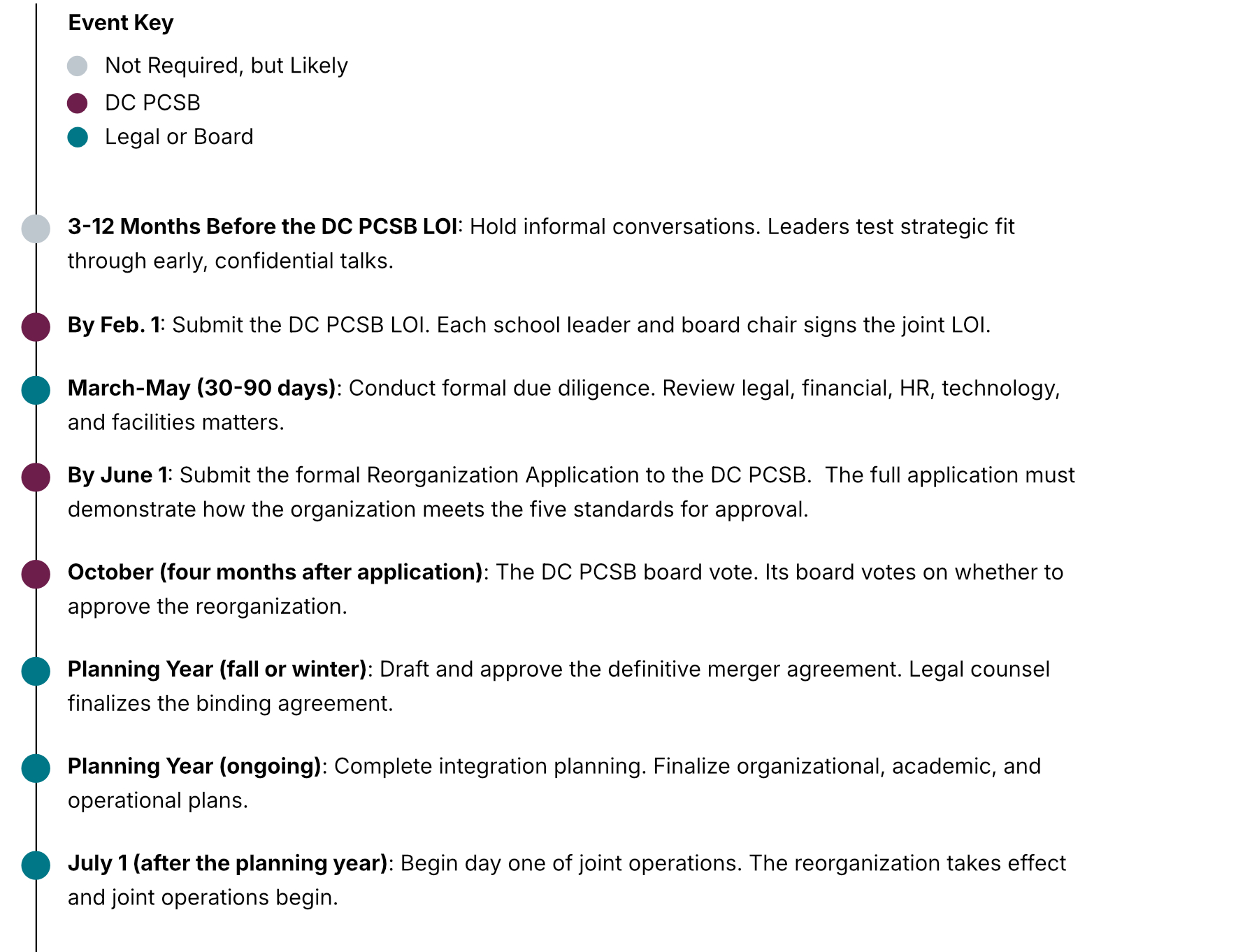
Note: Feb. 1 and June 1 are fixed DC PCSB deadlines; other dates are illustrative and vary. Source: DC PCSB, “School Reorganization Policy,” adopted June 2026.
As the relationship formalizes, the parties will use several distinct documents, and these should not be conflated:
-
- An NDA governs confidentiality and the permissible use of information and should precede any exchange of sensitive material.
- A preliminary, nonbinding MOU between the two schools (sometimes referred to as an exploration agreement, or LOI) confirms mutual interest, defines the scope and timetable for diligence, establishes roles and decision-making, sets confidentiality and communications expectations, preserves each party’s ability to stop, and allocates any joint costs.
- The DC PCSB LOI, required by February 1 for a proposed standard merger or acquisition, is a separate regulatory filing. Because it has the potential to make the exploration public, the parties should have stakeholder and external communications ready before filing (Section 3).
- The definitive merger agreement comes much later and is addressed at the end of this section.
Legal counsel should advise on the sequence, language, and dependencies among these documents. Additionally, board approval requirements for MOUs will vary depending on bylaws.
Establish clear decision points throughout the exploration process.
Deciding whether to pursue a merger is not a single yes-or-no decision. Boards and leaders must establish a series of decision points at which they will decide whether to continue to the next phase, continue subject to specific conditions, pause while information is gathered or conditions change, end the process, or pivot to a different form of partnership.
BELLWETHER TIP: Set the decision points, decision-makers, evidence requirements, and anticipated decision dates early. Doing so counteracts momentum and sunk-cost bias.
Each successive decision point should require clearer evidence, greater alignment between the organizations, more specific agreement about the future organization, greater confidence that risks can be managed, and more formal board authorization. At every decision point, return to the original strategic rationale: Does this partnership still address the problem that prompted the exploration? Is this still the right partner? Would the combined organization create meaningful benefits for students, families, and the community? Are the risks acceptable? Do we have the capacity to complete the transaction and integration?
For board members and school leaders: The decision points are where the division of labor is clearest. The leader and staff assemble the evidence; the board decides at each one. A board that votes only at the end has not governed the process, only ratified it. Single-site schools may need to lean more on advisers to assemble this evidence, while multisite LEAs have more staff bandwidth to collect, analyze, and communicate the relevant information (Section 4).
Define go-forward criteria before intensive diligence and the DC PCSB LOI.
Translate your strategic rationale and initial partnership criteria into explicit due diligence criteria, distinguishing among minimum requirements (must be satisfied to continue), strong preferences (attractive but not required), open questions (need investigation), and deal breakers (would stop or pause the process).
The criteria build on the same domains used in partner identification, at increasing depth: strategic rationale; cost versus benefit; compatibility of mission, culture, and leadership (where compatibility does not mean sameness, but major differences must be resolvable); academic and programmatic strength; financial health and sustainability; legal and regulatory feasibility under the DC PCSB policy; and integration feasibility and organizational capacity, including willingness to make hard decisions about leadership, staffing, programs, and facilities.
Determine whether there is sufficient evidence to submit the DC PCSB LOI.
The parties do not need to resolve every integration question before submitting the DC PCSB LOI. They do need enough evidence to conclude that the transaction is:
-
- Strategically compelling
- Mutually supported
- Legally and regulatorily plausible
- Financially credible at a preliminary level
- Consistent with DC PCSB requirements
- Worth the substantial effort of intensive diligence and application development
In practice, that means the parties should have at minimum:
-
- Confirmed their mutual rationales.
- Established preliminary leadership and board alignment.
- Reviewed publicly available academic, financial, enrollment, and compliance information.
- Identified known legal or regulatory barriers.
- Discussed the likely transaction structure.
- Developed an initial hypothesis for leadership, governance, and organizational design.
- Established a diligence process and timeline.
- Authorized submission through board processes.
- Prepared stakeholder communications.
Each organization’s board should understand that the LOI submission to the DC PCSB represents a meaningful commitment to continued exploration, but not an irreversible decision to complete the merger. Under the policy, once the LOI is submitted, the DC PCSB has three weeks to notify the school of its assessment.
Conduct intensive due diligence after the DC PCSB states “No Objections to Proceeding.”
Once the DC PCSB has given the green light to proceed based on the initial LOI submission (i.e., stating it has “No Objections to Proceeding”), the two parties should conduct a structured, intensive diligence process serving two purposes:
-
- To decide whether to merge: Determine whether either organization has risks, liabilities, or performance concerns that change the case for proceeding.
- To inform how to merge: Build a concrete understanding of what the integrated organization should look like and what the merger agreement and integration plan must address.
Establish a diligence work plan with a defined timeline — a dedicated project that will likely require a point person from either side (could be board or staff), and potentially a third-party facilitator. At minimum, diligence coordinators should set up a secure data room; confirm and coordinate fulfillment of the document request list; name authorized reviewers; set clear rules for privileged, confidential, and personnel information; and establish a process for reviewing findings on each side in partnership with outside legal counsel.
For acquiring and acquired schools: Diligence runs in both directions, but the burdens differ. The school relinquishing its charter must prepare the accounting of major assets and liabilities that the DC PCSB requires, and its board needs independent counsel to evaluate what the acquirer offers. The acquiring LEA bears the heavier analytical load: It is underwriting the combined entity’s future.
For single-site and multisite LEAs: Multisite operators often have finance and legal capacity in-house. A single-site LEA rarely does. It should budget for external diligence support early; this is also the moment to ask funders about transaction cost support rather than assuming costs need to be shouldered independently (Section 4).
Convert findings into a structured risk assessment. Diligence should not end as a pile of documents. For each material finding, leads should assess the risk (and potential mitigants), determine the extent to which it undermines the strategic case, and spell out implications for the potential merger agreement and/or integration plan. Findings can be tiered or categorized as follows:
-
- Acceptable without action
- Manageable through integration planning
- Requiring a contractual protection or condition
- Requiring further investigation
- Significant enough to pause or stop
Remember: The goal of due diligence is not to eliminate risk; it is to ensure boards and leaders understand the risks they are accepting and have a credible strategy for managing or mitigating them.
Evaluate future viability, including finances.
A merger can involve two individually viable organizations and still produce an incoherent or unsustainable combined entity. Before the final go-forward decision, use diligence findings to develop a preliminary integration hypothesis covering mission and strategic priorities, academic and program model, school and grade configuration, leadership structure, board composition and governance, the brand, and the economic model. A complete integration plan is not required, but the parties should understand the major decisions, level of effort, and likely sources of disruption.
Financial analysis deserves particular rigor. Build an integrated financial model that goes beyond adding the two legacy budgets together: The model should include standalone projections for each organization, a combined baseline, one-time transaction and integration costs (including those required for the planning year), recurring savings and new costs, staffing and facilities assumptions, and cash flow and reserves. Then test downside scenarios (e.g., lower-than-expected enrollment, delayed savings, higher integration costs, staff attrition, reduced philanthropic support). The model must demonstrate that the combined entity can financially sustain itself without relying on speculative savings or overly optimistic revenue or enrollment assumptions.
Submit the formal DC PCSB application.
Note: The sequencing of the agreement, DC PCSB approval, board votes, and closing depends on the legal structure and applicable requirements; legal counsel should advise on the appropriate order.
The formal DC PCSB application (due by June 1) is a far more consequential external decision point than the LOI. By this point, the parties should have high confidence that the rationale remains compelling, the transaction satisfies DC PCSB requirements, and the financial and programmatic model is viable. The application itself needs to address the DC PCSB’s five standards for approval: Need and Demand, Sufficient Progress in Developing the Plan, Consistency of Mission, Inclusiveness, and Leadership Capacity (Section 2).
Before submitting the application, each organization should prepare a go-forward recommendation for its board. The recommendation should summarize the case for the merger, the diligence conducted, and the design of the future organization. Each board should deliberate and formally authorize submission through its own governance process.
Not every integration decision must be finalized before submission, but each unresolved issue should be explicitly identified, assigned to a decision-maker, given a process and deadline for resolution, and reflected in the risk assessment and integration plan.
Agree on a term sheet.
Before attorneys invest substantial time drafting a definitive agreement, the parties should align on the major business and governance terms in a term sheet or agreed issues list. Parties should resolve differences directly rather than asking attorneys to negotiate unresolved strategic questions through competing drafts, an approach that is both time consuming and expensive. Terms vary widely, but often include:
-
- Transaction structure
- The surviving legal entity and charter treatment
- Name and mission
- Board composition and executive leadership
- Treatment of assets and liabilities (including facilities and debt)
- Employee transition principles
- Restricted funds and major contracts
- Cost responsibility during the planning year
- Required approvals
- Closing conditions
- Termination rights
One term deserves special attention: The DC PCSB requires a preliminary asset acquisition agreement that accounts for the 10 largest assets and 10 largest liabilities of the LEA relinquishing its charter, plus any assets or liabilities exceeding $100,000, along with their intended disposition.19 Two other items are worth building into this agreement, even though they arise from different parts of the policy:
-
- A provision and mechanism for enrolling transferring students. The policy separately requires the acquiring LEA to agree to enroll the students of the closing LEA or campus as a condition of the acquisition. Parties should spell out how and when that enrollment happens rather than leaving it implicit.
- Consideration of existing employees for positions at the acquiring LEA. This is not a guarantee of employment, but the DC PCSB’s standard for approval looks for evidence that the acquiring LEA engaged existing staff in the planning process and has a credible plan for supporting them through the transition. Building an explicit consideration provision into the agreement is one way to demonstrate a good-faith effort on that front.
Develop and negotiate the definitive merger agreement.
The definitive merger agreement translates the parties’ decisions and negotiated terms into an enforceable legal framework. Qualified legal counsel should draft and negotiate it; the full range of provisions it may address appears in the relevant tool included at the end of this section.
Diligence findings will help determine where specific protections, commitments, or closing conditions are needed. The parties should not attempt to place every integration decision in the legal agreement: Include only terms that are fundamental to the transaction or necessary to allocate risk. Other issues can be assigned to the integration plan (which should be developed in parallel), with the plan clearly identifying which issues must be resolved before closing and which can wait until the planning year.
Accelerate the decision process for emergency acquisitions.
This section describes the exploration-to-decision arc for a merger or standard acquisition, where LEAs typically have three to 12 months to plan backward from application deadlines (February 1 for the LOI and June 1 for the full application). An emergency acquisition compresses the decision to submit an LOI into two weeks (Section 2). It begins on the date of a triggering event (e.g., receipt of a review or renewal report, a board vote to relinquish, or other emergency circumstances that will result in closure), and is thus not entirely within the board’s control.
The LEA seeking to be acquired has to submit an LOI within two weeks of the triggering event, likely without a partner yet secured. Once the DC PCSB responds (within three weeks), the LEA must identify an acquiring partner, and that partner must submit a full application within three months. In that same period, most of the diligence and transition planning described above and below also has to happen (Section 7). There is also no planning year to fall back on, so integration planning must be highly compressed as well. Finally, emergency acquisitions do not allow for approval with conditions or the opportunity to reapply, so schools should be prepared for closure if the emergency acquisition is not approved.
BELLWETHER TIP: Compress diligence, risk, decision-making, and integration planning without cutting corners.
In a standard acquisition or merger, diligence, risk assessment, board decision-making, and integration planning happen in a rough sequence spread across many months. An emergency acquisition compresses all four into the same window, roughly the three months between the DC PCSB’s response to the LOI and the application deadline, so they have to run in parallel rather than in sequence.
Recommendation for Board Members and School Leaders
Given the time pressure during an emergency acquisition, some leaders’ instincts may be to skip board deliberation to save time. Resist that instinct. Instead, adjust the format and cadence of board involvement (not board ownership of and engagement in decision-making). A board that has not seen the risk register and the day-one plan before a vote has not independently decided to proceed, but rather only ratified a decision made by others.
Due Diligence: Focus on the same minimum requirements and deal breakers used to define go-forward criteria above, rather than the fuller set of strong preferences and open questions a standard timeline allows. Assign a small team to run diligence alongside the partner search and application drafting, setting an internal deadline well ahead of the application date so the boards have sufficient time to review findings. A standard acquisition can pause diligence to investigate a concern further. An emergency acquisition rarely has that option. Treat a finding that would normally warrant further investigation as one the board must decide on with incomplete information, not one it can defer.
Risk Assessment: The risk assessment described earlier in this section still applies, but less significant risks carry more weight here. Anything labeled “manageable through integration planning” needs an actual plan attached before the application is submitted, since there is no planning year afterward to work it out. Anything landing in “requiring further investigation” should be treated as a known, accepted risk if the LEA proceeds, since there is little runway to resolve it before the vote. Document these explicitly. The go-forward recommendation described above is the right vehicle: It should name every material unresolved risk, who accepted it, and why, rather than presenting the application as risk-free.
Decision-Making: The structure above assumes time between decision points for evidence to accumulate and boards to deliberate. This pathway does not allow for that cadence. For the acquiring LEA, this is the substantive go or no-go decision, since it is the party taking on new risk. For the LEA seeking to be acquired, the major decision was largely made earlier, when its board chose to pursue an emergency acquisition rather than closure at the LOI stage. Even so, it should still review and weigh in on the final application, since the acquiring LEA develops it in collaboration with the LEA being acquired. Rather than convening the full board repeatedly, designate a small group (typically two or three board members plus the school leader) to oversee diligence and partner selection between meetings. Reserve the formal vote on submitting the application for the full board — that vote cannot be delegated to a committee or task force.
Integration Planning: Because the application also serves as the strategic transition plan, integration planning cannot wait until after approval the way it does for a standard acquisition (Section 2). Limit it to what must be true on day one: staffing, enrollment, facilities, and the immediate family and student experience. Everything else can be sequenced into the first operating year. Emergency acquisitions compress the integration timeline and drop the planning year; that guidance still applies (Section 7). What differs for emergency acquisitions is that this compressed integration work happens at the same time as diligence and the go-forward decision, so the same small team above will need to balance both processes.
TOOLS, TEMPLATES, AND RESOURCES
- Framework for Key Decision Points — A tool that breaks down the go/no-go school decision-making process for boards in a school reorganization.
- Due Diligence Question Bank — A set of considerations, specific to the District of Columbia, for leaders and boards in the intensive due diligence phase of a charter school merger, standard acquisition, or emergency acquisition.
- Diligence Criteria and Deal Breaker Scorecard — A tracker to help leaders and boards turn their strategic rationale and partnership priorities into explicit due diligence criteria, including minimum requirements and deal breakers, for a specific partner: minimum requirements, strong preferences, open questions, and deal breakers.
- DC PCSB Letter of Intent Readiness Checklist — A resource to help leaders and boards confirm readiness to submit an LOI to the DC PCSB under its School Reorganization Policy adopted in June 2026.
- Due Diligence Findings and Risk Register — A starter list of materials to request from a prospective partner during due diligence, to be tailored to your organization’s context and prioritized around potential deal breakers.
- Board Go-Forward Decision Recommendation — A template for the go-forward recommendation a District of Columbia LEA brings to its board before submitting a formal application to the DC PCSB.
- Key Decisions Tracker Template — A decision tracker to help leaders and boards of two District of Columbia charter schools align on the key decisions in a merger or acquisition.
- Typical Merger Agreement Components — An overview of the components a definitive merger agreement typically addresses, serving as a planning and review aid for leaders and boards (not a substitute for legal drafting).
7. How Do We Prepare for and Implement a Successful Integration?
For mergers and standard acquisitions (excluding emergency acquisitions), DC PCSB approval is followed by at least one planning year before the reorganization takes effect. That year provides schools with enough runway to plan deliberately, make early decisions, and prepare people for change. This section describes how to make the most of that runway.
The Human Impacts of Reorganization
Integration is where the reorganization stops being a plan held by a few key leaders and their boards and starts becoming other people’s daily reality. Trusted team members will need to confront the prospect of having a new boss, a new set of colleagues, and sometimes a new job (or no job). Even a well-designed integration involves real loss alongside real gain. The workstream and stakeholder engagement plans described in this section will get more mileage if leaders acknowledge that loss while also celebrating what lies ahead.
Begin with a clear integration vision.
Integration planning should begin with clarity about what the combined organization is trying to become, not simply how to combine two existing organizations operationally. This vision can and should build on the strategic rationale for the merger. Additional elements of the integration vision will have been defined during exploration and diligence, but leaders and boards will often need further conversations to resolve the strategic purpose of the combined organization, including the intended student and community benefits; which organizational capabilities should be preserved, expanded, redesigned, or discontinued; the desired degree of integration across schools, programs, and central functions; and what should be true by day one (the first day of joint operation) and by the end of the first operating year.
This shared vision gives functional teams a common reference point and helps them prioritize and make trade-offs. Without it, workstreams tend to optimize individual functions rather than advancing the broader rationale for the merger.
Consider launching the work with a leadership off-site that brings together key leaders from both legacy organizations — and from multiple levels of each, not only the executive directors. The people responsible for executing the integration should understand both the process and their role within it. A well-designed off-site reconfirms the vision, builds trust and working norms across the two teams, introduces the integration governance structure, and begins to name major milestones and dependencies.
Establish integration management and governance.
Successful integration requires clear structures for direction-setting, coordination, execution, and escalation. A common structure includes three levels (all below the board):
-
- An integration leadership team (ILT), typically the two executive directors, is the ultimate decider for integration questions below the board level. It sets direction, approves major organizational design and policy decisions, resolves issues that workstreams cannot settle, monitors major risks and milestones, and maintains alignment with the governing board or boards.
- An integration project management office (IPMO), generally one experienced project manager from each legacy organization (often a chief of staff or COO), coordinates planning and execution across workstreams. It maintains the integrated work plan and master timeline, tracks dependencies, risks, decisions, and unresolved issues, ensures workstreams operate from consistent assumptions, and prepares recommendations for the ILT.
- Functional integration workstreams plan the integration work and carry out some of it. Each workstream should have a designated lead and a counterpart from the other legacy organization, with authority to make routine functional decisions while escalating major strategic, financial, personnel, or cross-functional issues. Potential workstreams include academic program, talent and HR, finance, operations and facilities, technology and data, enrollment, accountability and compliance, external relations and communications, and governance.
For board members and school leaders: Boards should not run the integration, but they remain accountable for its outcomes. During the planning year, the board must 1) approve items only it can approve (e.g., the revised charter agreement, the definitive legal agreement, the combined budget, and executive leadership), 2) monitor progress and major risks through regular ILT reporting, and 3) resist the temptation to adjudicate workstream-level decisions.
Ideally, the schools enter integration with a provisional organizational structure (identified functional leaders and preliminary reporting relationships) and a hypothesis about decision rights in each major area. Not every individual can or should be assigned a role immediately, but teams need enough structural clarity to know who is responsible for integration decisions. If the future structure remains unresolved, developing and testing a provisional structure should be the ILT’s first priority. Revisit decision rights as planning proceeds.
For members of a board relinquishing a charter: The outgoing board has to wind down the nonsurviving nonprofit entity. This process typically takes four to six months and runs in parallel with integration work rather than starting after day one.20 The outgoing board remains legally responsible for these obligations until dissolution is complete, even as staff and programs transition to the surviving entity, so timelines should be tracked separately from the academic and operational integration workstreams. Winding down includes the following elements (in consultation with an organization’s outside legal counsel):
-
- Adopting a board resolution authorizing dissolution of the corporation under the District of Columbia Nonprofit Corporation Act (Code of the District of Columbia §§ 29-409).21
- Providing notice to the Office of the Attorney General for the District of Columbia.
- Filing articles of dissolution with the DC Department of Licensing and Consumer Protection.
- Sending notice to known and potential claimants.
- Publishing notice of dissolution in a newspaper to close out claims from unknown creditors.
- Filing a final IRS Form 990 and closing out District of Columbia and federal tax accounts.
- Settling or transferring outstanding contracts, leases, and liabilities.
- Distributing any remaining restricted or unrestricted assets consistent with the merger agreement and applicable 501(c)(3) requirements.
- Retaining student, personnel, and financial records for the periods required by District of Columbia and federal laws.22
Build a provisional integration timeline.
Build the provisional timeline around the constraints that cannot easily be changed, such as:
-
- The fiscal year. When feasible, complete the legal and financial close at the end of the fiscal year. Each legacy organization gets a clean final accounting period; the integrated organization begins a new fiscal year with a unified budget and accounting structure; financial reporting, audit, payroll, and benefits transitions are easier to administer; and forward-looking commitments such as employee contracts can be honored. These considerations often point toward a July 1 close.
- The academic and program calendar. This calendar governs when staffing, scheduling, and program decisions must land to be ready for the first joint school year.
- The regulatory and enrollment calendar. The planning year carries its own DC PCSB obligations: negotiating the revised charter agreement (for a merger) or finalizing the asset acquisition agreement and transition plan (for an acquisition), satisfying any conditions attached to an approval with conditions, and updating My School DC participation in the early fall so the combined organization appears correctly when the common lottery application opens in December. Families should know their options before the lottery.
Working backward from day one and these constraints, develop a comprehensive timeline that identifies initial operating requirements at a high level (including decisions required before legal close), items that can wait until later in the planning year, items for the first operating year, cross-functional dependencies, and critical decisions that could delay broader integration if not tackled in a timely manner.
Integration proceeds across several tracks at once. Workstreams may begin simultaneously but move at different speeds, pause while awaiting another decision, or continue past legal close into the first operating year. Not everything must be unified by day one: Distinguish among what must be integrated immediately, what can operate temporarily in parallel, what requires additional design and stakeholder engagement, and what may appropriately remain different (temporarily or permanently).
Develop detailed integration workstream plans.
For every function and subfunction, there are five basic integration options:
-
- Follow School A’s approach.
- Follow School B’s approach.
- Combine elements of both.
- Design a completely new approach.
- Maintain separate approaches.
Each workstream should translate its priorities into an implementation plan with named owners, major activities, required decisions, milestones, dependencies, risks and mitigations, and escalation pathways.
Give programmatic integration the greatest strategic attention. It is often the most complex workstream because it directly affects the student and family experience. Its scope depends on the model the schools select: a feeder or complementary grade-level model, a parallel-program model, or a unified program.
Talent, HR, and organizational design come next. Talent integration affects employees’ roles, compensation, benefits, reporting relationships, and sense of security, and it should be coordinated closely with programmatic planning. Staffing structures should support the future academic and operating model, not reproduce both legacy organizations without a clear rationale. Key considerations include future-state organizational design, leadership roles, position mapping, staffing needs and potential redundancies, compensation and benefits alignment, employment agreements and policies, and retention and transition support. Be deliberate about when personnel decisions are made and communicated. Prolonged uncertainty is destabilizing, but premature announcements create avoidable risk if their commitments cannot be kept. Retention deserves explicit planning, for students as well as staff: Model how many students each community can realistically expect to keep, and identify the staff whose departure would most threaten the transition.
Integrate back-office functions in service of the program. Finance, operations, technology, facilities, and compliance work may be more transactional, but it is essential. These teams should begin early enough to address unified budgets and financial controls; banking, payroll, and audit requirements; contracts and vendor transitions; enrollment and student information systems; data migration; facilities; insurance; and regulatory and charter compliance obligations. One caution: Resist the urge to maximize efficiency at all costs. Operational choices should first support students, staff, program quality, compliance, and sustainability. Operational savings that shortchange programs will limit the long-run success of the reorganization.
For single-site and multisite LEAs: A multisite operator acquiring a campus can often run integration as an extension of its existing playbooks and central office; the work resembles onboarding a school. Two single-site LEAs merging face a larger volume of change: They are building shared central functions at the same time they are integrating, with no template to inherit. The governance structures in this section matter most in that second case, and external integration support is often worth the cost.
For acquiring and acquired schools: Change is asymmetric. Staff and families of the acquired school typically experience the most disruption, and retention risk concentrates there. The acquiring LEA faces the opposite trap: absorbing “inherited growth” overnight while assuming its existing campuses will run themselves. Plan explicitly for maintaining quality at legacy campuses, not only for standing up the new one.
Launch integration management and monitoring.
Fold all workstream plans into a composite integration schedule and plan the IPMO can monitor. The IPMO should maintain an integrated view of progress rather than relying only on separate functional updates, ensure a clear and shared process for decision-making and escalation, and establish a predictable reporting cadence across workstreams. Regular reviews should cover progress against the critical path, current and upcoming decisions needed, resource constraints, cross-workstream conflicts, and major risks to the student and family experience, staff experience, finances, compliance, and day-one readiness. A shared project management tool such as Smartsheet or Asana is highly recommended for this level of coordination. Even if the schools do not use such software already, the time savings and improved execution during a 12- to 18-month integration planning and execution process will more than justify the cost.
Workstream leads should adjust plans as needed while maintaining clarity about which deadlines are fixed (regulatory filings, the lottery calendar, legal close) and which are flexible. Communications and change management run through all of this work (Section 3).
Oversight does not end at day one. The DC PCSB will treat a merged LEA like a new LEA for accountability purposes, and the first operating year is when integration risks surface in practice. Carry the monitoring routines built during the planning year into the first year of joint operations.
TOOLS, TEMPLATES, AND RESOURCES
- Integration Vision and Design Principles — A template to help leaders and boards define what the combined LEA is trying to become and agree on the principles that will guide integration decisions.
- Integration Launch Off-Site Agenda — A sample agenda for a full-day leadership off-site to launch integration planning after two LEAs sign a merger or acquisition agreement.
- Three-Level Integration Governance Diagram — A visual overview of how decisions and coordination flow from the governing boards through a leadership team and project management office to functional workstreams in a merger or acquisition.
- Integration Workstream Scoping Template — A resource to map key workstreams and roles when developing an overall work plan for a school reorganization.
- Integration Decision-Rights Framework — A template to help an integration leadership team assign who holds final authority over each integration decision during the planning year of a school reorganization, starting with a provisional version and refining it as the work progresses.
- Example Planning Year Integration Timeline — A sample high-level work plan to map key timelines in the planning year of a school reorganization.
- Five Ways To Integrate Functions — A framework comparing five options, with pros and cons, for combining each function of two schools during a reorganization.
- Integration Workstream Planning Tool — A tool to help the integration leadership team turn a merger or acquisition agreement into an actionable work plan with clear owners.
- Integration Decision and Risk Tracker — A tracker that gives the integration leadership team one place to log the decisions that need to be made and track risks that could threaten a merger integration.
8. What Are Our Options If We Do Not Move Forward?
Exploring reorganization does not need to result in a merger or acquisition to be worthwhile. When done well, the exploration process will help leaders and boards determine whether reorganization remains the best strategy for advancing their mission, responding to strategic opportunities or challenges, and improving outcomes for students. Sometimes the answer is no. Even in these cases, the process can provide greater clarity about an organization’s priorities, needs, and strategic direction.
The Human Impacts of Reorganization
Choosing not to move forward, especially after months of work and difficult conversations, can feel like a loss even when it is the right call. Give your team and board room to process that loss before moving straight into what comes next.
Recognize common reasons organizations do not move forward.
Schools may decide not to move forward with a merger or acquisition for many reasons. They may determine that another strategy better advances their goals; due diligence may surface financial, legal, operational, governance, or cultural concerns that outweigh the expected benefits; or leaders and boards may conclude that the organization or partnership is not ready and choose to pause. In other cases, external factors — including a DC PCSB decision or regulatory, financial, or facilities constraints — may prevent a transaction from proceeding. Choosing not to proceed often indicates that the exploration process worked as intended: It surfaced the information needed to make an informed decision and pivot to a different course.
Explore strategic alternatives.
If reorganization is not the right path, organizations still have several options (Table 7).23 The appropriate alternative depends on what prompted the exploration, the organization’s long-term goals, and the level of collaboration and organizational commitment desired (Sidebar 3).
TABLE 7: SAMPLE STRATEGIC ALTERNATIVES TO REORGANIZATION
| Strategic Alternative | What It Is | When It Makes Sense |
| Strategic Alliance | Formal collaboration to achieve shared goals by sharing staff, curriculum, or expertise while maintaining separate legal identities. (This could include informal enrollment pipeline partnerships and/or referrals.) | When organizations want to leverage each other’s strengths to advance their strategic priorities or expand their reach without pursuing a full merger. |
| Jointly Run Program or Venture | Organizations pool resources and share risks and rewards to launch a new program or initiative (e.g., a shared facility or teacher training program). | When organizations want to test a partnership, pursue an innovative opportunity, or share the costs, risks, and benefits of a new initiative. |
| Shared or Contracted Services | Organizations maintain independence but collaborate on or outsource specific functions. | When organizations are interested in cost efficiency and access to specialized expertise while limiting resource commitment. |
| Ad Hoc Collaboration | No structured partnership, but continued collaboration when opportunities arise. | When organizations want to maintain flexibility and preserve opportunities for future partnerships. |
| Continue Independently | Pursue the organization’s strategic priorities without a formal partnership or reorganization. | When the organization determines it can best achieve its goals without partnering with another organization. |
| Proactive Voluntary Relinquishment of a Charter | Wind down the organization while thoughtfully planning for student, family, and staff transitions. | When a merger or another strategic partnership is unlikely to result in long-term sustainability or high-quality educational outcomes. |
| Footprint Consolidation | Combine students and operations into fewer campuses or facilities while continuing to operate the LEA. | When fewer sites can improve sustainability, efficiency, or program quality. |
| Strategic Enrollment Reduction | Intentionally reduce the number of students the organization serves (e.g., reduce or change the grade levels served). | When lower enrollment would better align with demand, resources, and program quality. |
SIDEBAR 3
Organizations Choosing Alternatives to Reorganization
In the District of Columbia public charter school landscape, several schools have chosen alternatives to a merger or acquisition. Two examples show how different those paths can be.
Internal Restructuring — Howard Road to Cedar Tree: Howard Road Public Charter School opened in school year (SY) 2000-01. At its peak, it operated four campuses serving 1,000 students in preschool through Grade 8. By 2013, poor student outcomes put the school at risk of charter revocation. Rather than pursue a merger or acquisition, the executive director proposed an internal reorganization: sharply reducing the number of campuses and grade levels served so the school could focus its resources on its high-performing early childhood program. The DC PCSB agreed. Howard Road became Cedar Tree Academy and went on to demonstrate year-over-year high performance. After stabilizing student performance, Cedar Tree slowly began to grow again and serves preschool through Grade 4 in SY26-27.
Charter Relinquishment — Capital Village: Capital Village Public Charter School chose a different alternative. Founded in 2020, it opened as a new middle school at the height of the COVID-19 pandemic. In 2025, the school passed its first five-year charter review, though the DC PCSB flagged enrollment and financial concerns. By spring 2026, with enrollment and finances worsening, the board chose to relinquish the charter and worked informally with families to help students move to best-fit schools.
Understand how to apply this playbook to pursue nonmerger reorganizations.
The guidance on stakeholder engagement, securing expertise, stage-gated decision-making, and integration planning applies to another partnership, a renewed independent strategy, or a planned wind-down, scaled to the degree of organizational change involved (Sections 3, 4, 6, 7).
If pursuing another strategic partnership, revisit the relevant sections of this playbook and adapt the guidance to the type and scope of that partnership. Lessons related to partner identification, stakeholder engagement, governance, legal agreements, and implementation planning may still apply, but the level of planning should reflect the degree of organizational integration required.
If continuing independently, apply what was learned through the exploration process to strengthen the organization’s strategy, operations, and long-term sustainability. Revisit the strategic opportunities or challenges that prompted exploration and update the organization’s strategic plan and priorities accordingly. Periodically reassess whether changing organizational priorities or external conditions suggest that reorganization or another strategic partnership could better advance the organization’s goals.
If planning for school closure, begin as early as possible to maximize transition options for students and staff. Prioritize thoughtful transitions for students, families, and employees; engage the DC PCSB, legal counsel, and other relevant agencies early; and develop a communication and wind-down plan that minimizes disruption and supports affected stakeholders.
Final Considerations
Exploring reorganization is an act of stewardship, whichever way the decision lands. For some organizations, the answer will be partnership. Sadiq Ali, former founding executive director of MENTOR Maryland | DC, described the organization’s combination with MentorPrize this way: “[We] are a thousand times stronger together than we are apart.”24
For others, continuing independently with sharper focus will be right; for still others, a well-planned wind-down will best serve students and the broader sector. As one nonprofit leader put it, “Wind-down isn’t a dirty word … Sometimes it’s hard to let go, but it can be better for the sector overall.”25
What matters is that the decision is made deliberately, early, and with students and families at the center.
9. Appendix and Glossary of Terms
The Appendix summarizes key legal considerations for charter school reorganizations in the District of Columbia, explains asset acquisition agreements, and includes a nonexhaustive glossary of key terms used throughout the playbook. It is not legal advice. It draws on the District of Columbia Open Meetings Act (OMA), federal student privacy regulations, and the DC PCSB’s School Reorganization Policy. It also draws on an interview with Stephen Marcus, a District of Columbia charter school attorney who represented the board of Arts and Technology Academy Public Charter School (ATA) when KIPP DC acquired ATA’s assets in 2014. Each LEA should confirm with its own legal counsel how these issues apply to its circumstances.
Note: Access each section through the drop-down menus below.
Legal Considerations for Nonprofit Charter School Reorganizations in the District of Columbia
Early Exploration and the Open Meetings Act
Charter boards are public bodies, but not every board conversation is an official meeting. Boards of trustees of District of Columbia public charter schools are subject to the OMA. The OMA defines a “meeting” as a gathering of a quorum of a public body’s members to consider, conduct, or advise on public business.26 Conversations without a quorum fall outside that definition. Examples include:
-
- Conversations between executive directors.
- A 2×2 meeting of two executive directors and two board chairs.
- A committee whose membership is less than a quorum of the full board.27
Many boards will find it practical to run early exploration through a small committee. ATA’s board, for example, created a five-member committee to oversee its closure and partner selection. Two cautions apply: First, a board may not keep attendance below a quorum to avoid the OMA.28 Second, creating a committee typically requires a board vote under the bylaws.
When a quorum must deliberate, boards can close part of a meeting for specific, enumerated reasons. The OMA requires meetings to be open unless one of 14 exceptions applies, and it requires that exceptions be construed narrowly.29 Four exceptions are most relevant to reorganization:
-
- Legal advice (§ 2-575(b)(4)(A)): A board may close a session to consult an attorney and obtain legal advice. Marcus considers this the safest basis for closing a discussion of a potential reorganization. Two conditions matter:
- The attorney must be counsel to the school. That includes counsel retained specifically for the reorganization, but not a board member who happens to be a lawyer.
- An attorney’s presence alone does not justify closure. The closed discussion must actually involve legal advice.30
- Contract negotiation (§ 2-575(b)(2)): A board may close a session to set its position on the price and other material terms of a contract, or to instruct staff or negotiating agents on that position. This applies only if an open discussion would harm its bargaining position. The ground fits once there is a counterparty and terms on the table, such as an MOU, term sheet, or asset acquisition agreement. It fits less well for an open-ended discussion of whether to explore reorganization at all.
- Personnel (§ 2-575(b)(10)): Boards may close discussions of the appointment, employment, evaluation, compensation, or removal of specific school personnel, such as future leadership roles in a combined organization.
- Outside commercial or financial information (§ 2-575(b)(11)): This ground covers trade secrets and commercial or financial information obtained from outside the government. It applies only where disclosure would substantially harm the competitive position of the party that provided the information. It may apply when a board reviews a potential partner’s confidential financial information. However, it is narrower than it sounds, and its application to charter-to-charter diligence is untested. Boards should confirm with counsel or the Office of Open Government (OOG) before relying on it.
- Legal advice (§ 2-575(b)(4)(A)): A board may close a session to consult an attorney and obtain legal advice. Marcus considers this the safest basis for closing a discussion of a potential reorganization. Two conditions matter:
Closing a session carries procedural requirements.31 A board that closes a session must do the following:
-
- Provide notice. Give at least 48 hours or two business days of notice, whichever is greater. The notice must state the intent to close, cite the specific exception, and describe the matters to be discussed.
- State the reason. The presiding officer must state the reason for closure, including the citation and the subjects. The roll call and statement must be made public in writing.
- Publicly vote. Vote to close in public session by a majority of members present.
- Stay on topic. Discuss only the matters cited.
- Create a private record. Record the closed session and retain recordings for at least five years.
As a matter of practice, boards should take formal votes in open session. That includes votes to sign an MOU, submit a DC PCSB LOI, submit a reorganization application, or approve a definitive agreement. Closed-session records may be withheld only under the same standard that justified closure. Boards should therefore not assume those records will remain confidential indefinitely.
Get guidance early. The OOG offers informal guidance, formal advisory opinions, and regular OMA training for charter school boards (open.govoffice@dc.gov; 202-481-3411). LEAs can also ask the DC PCSB to seek OOG guidance on their behalf. Remember that materials submitted to the DC PCSB may be subject to public records requests (Section 2).
Board Authority and Fiduciary Duty
Board bylaws take precedence. No statute specifies which board approvals an MOU, LOI, application, or definitive agreement requires. The answer depends on each LEA’s bylaws, which boards should review before exploration begins.
Fiduciary duty does not change based on who initiates. Under the School Reform Act, board members owe a fiduciary duty to act in the best interest of the school. The duty is the same whether the board launches its own search or responds to an inbound approach. Marcus said that considering only one suitor is not a breach but that weighing alternatives is the prudent course for a board, noting that ATA’s board considered three potential partners before selecting KIPP DC (Section 5).
Student Records and Family Educational Rights and Privacy Act (FERPA)
FERPA supports transferring records, not sharing them during diligence. FERPA allows a school to disclose education records without parental consent to officials of another school where the student seeks or intends to enroll, for purposes related to enrollment or transfer. That disclosure is subject to notification requirements.32 The exception supports moving records once students transfer to the acquiring or surviving LEA.
Marcus did not identify a FERPA exception that would permit sharing personally identifiable student records during exploration or diligence. He explained that an acquiring LEA would rarely (if ever) need access to student records. Diligence questions about academic performance, special education compliance, and enrollment can generally be answered with aggregated or de-identified data. If and when a merger agreement is signed, the relinquishing LEA should follow the Office of the State Superintendent of Education’s (OSSE) requirements for closing schools, which address student records.
Commitments That Outlast the Transaction
Promises made to win approval can be hard to enforce after closing. In the ATA transaction, KIPP DC made commitments to ATA’s community, including continuing the school’s arts focus. ATA’s board asked the DC PCSB to incorporate those commitments into its approval, since the board would dissolve after the transfer. The DC PCSB approved the transaction but not the terms of the parties’ MOU.
Once the relinquishing nonprofit dissolves, no party clearly remains with standing to enforce the agreement. Marcus raised the possibility that a parent group might have standing, but that question is untested. LEAs negotiating commitments should work with counsel to decide which commitments belong in documents that the DC PCSB continues to oversee, such as an amended and restated charter in a merger, and which belong only in a side agreement.
Insurance for Outgoing Board Members
Plan for tail coverage. No law requires directors and officers (D&O) insurance for board members of a dissolving LEA. Nonetheless, Marcus recommended that boards of closing LEAs purchase three years of additional “tail” coverage, matching the three-year statute of limitations for breach-of-contract claims and tort claims such as negligence. The definitive agreement should specify who pays for this coverage.
Employees and Benefits
Two areas warrant specialized counsel. First, the federal Worker Adjustment and Retraining Notification (WARN) Act generally requires advance notice of closures and mass layoffs by employers with 100 or more employees. Marcus noted that ATA had to follow WARN obligations carefully. Second, retirement plans need review regardless of organization size. ATA retained outside counsel to confirm that its 401(k) plans permitted termination and transfer. Benefits continuity requires the same attention (Section 4, Sidebar 2).
Restricted Funds
Check gift terms before transferring restricted funds. The School Reform Act permits a closing LEA’s assets to transfer to an acquiring LEA. Donor-restricted gifts, however, may carry their own terms. LEAs should review each gift instrument and, where restrictions are unclear, seek the donor’s consent to transfer. Donors are often supportive when the school’s mission will continue.
Dissolution Timing and Records
The board can stay in place through the transition. Marcus is not aware of any rule requiring the relinquishing board to dissolve by a set date after DC PCSB approval. Boards may choose to remain constituted through the transition to oversee cooperation on staff, students, and operations, particularly if the transition occurs midyear, and can dissolve the relinquishing LEA’s corporation once the transition is complete (Section 7).
Records obligations stay with the closing LEA. Marcus advised fulfilling those obligations directly rather than transferring them to the acquiring LEA. ATA contracted with a paid-up document custodian so that the board did not need to remain in existence for the full retention period.
Asset Acquisition Agreements
An asset acquisition agreement is the binding contract under which the LEA relinquishing its charter transfers its assets, and any agreed liabilities, to the LEA that will carry its students forward. The legal basis is the School Reform Act. It permits a closing LEA’s assets to transfer to another LEA if that LEA agrees to enroll the closing LEA’s students.33
The DC PCSB’s policy notes that mergers and acquisitions are “mechanically the same”: each results in an asset transfer and the relinquishment of one charter.34 As a result, an asset acquisition agreement applies to all three pathways, not only to acquisitions. In a merger, these terms may appear within the definitive merger agreement rather than a standalone document. Legal counsel should confirm the proper structure.
The DC PCSB requires the agreement to proceed in two stages:
-
- Preliminary agreement with the application. For all three pathways, the DC PCSB’s “Sufficient Progress in Developing the Plan” standard requires a preliminary asset acquisition agreement. It must account for the 10 largest assets and 10 largest liabilities of the LEA relinquishing its charter, plus any asset or liability over $100,000. For each item, it must state the intended disposition, whether transfer to the acquiring LEA or other means.
- Final agreement before the reorganization takes effect. For mergers and standard acquisitions, parties finalize the agreement during the planning year. For emergency acquisitions, which have no planning year, the DC PCSB still requires a finalized asset acquisition agreement and transition plan, albeit on a much shorter timeline.
The DC PCSB looks for two provisions in particular:
-
- A provision and mechanism for enrolling transferring students. Agreeing to enroll the closing LEA’s students is the statutory condition of the asset transfer, so the DC PCSB expects the agreement to say how enrollment will happen. The terms of the agreement should address:
- Which students are guaranteed seats, by grade and campus.
- How enrollment interacts with My School DC timelines.
- How special education services and other supports will continue without interruption.
- How student records will transfer.
- Consideration of existing employees for positions with the acquiring LEA. This provision is not a guarantee of employment. It is a commitment to consider current staff, consistent with the DC PCSB’s expectation that applicants engage existing staff and plan for their transition. In the ATA transaction, the parties agreed that KIPP DC would interview all ATA staff. ATA also offered retention incentives to encourage staff to stay through the transition.
- A provision and mechanism for enrolling transferring students. Agreeing to enroll the closing LEA’s students is the statutory condition of the asset transfer, so the DC PCSB expects the agreement to say how enrollment will happen. The terms of the agreement should address:
Other provisions commonly addressed. Counsel will tailor the agreement to the transaction. Typical provisions include:
-
- Transferred assets. Facilities and leases, furniture and equipment, cash and reserves, intellectual property and brand, and assignable contracts.
- Excluded assets. Anything the relinquishing LEA will retain, distribute, or dispose of otherwise.
- Assumed and excluded liabilities. Debt, bond obligations, leases, accrued leave, and pending claims.
- Required consents. Approvals from landlords, lenders, bond trustees, donors, and other counterparties, particularly under change-of-control provisions.
- Restricted funds. How donor-restricted gifts will transfer, including any donor consents required.
- Employees and benefits. Benefits continuity, retirement plan treatment, final pay, and any WARN Act obligations.
- Program and mission commitments. Commitments to the closing LEA’s community, drafted with enforceability limits in mind (see Legal Considerations).
- Transition cooperation. Data and records transfer, communications, and operations during the transition period.
- Closing conditions. DC PCSB approval, board approvals, and required third-party consents.
- Termination rights. Each party’s right to exit if conditions are not met.
- Wind-down support. Records custody, final audit and Form 990, and D&O tail coverage for outgoing board members.
- Cost allocation. Responsibility for transaction and transition costs.
Diligence, not contract remedies, must mitigate most of the risk. Representations, warranties, and indemnities offer limited protection when the relinquishing nonprofit will dissolve shortly after closing. The acquiring LEA should therefore rely on thorough diligence rather than remedies after closing to surface problems (Section 6).
Glossary of Terms
2×2 Meeting: A meeting of the executive directors and board chairs of two LEAs exploring a partnership, used to build rapport and test fit before wider engagement.
501(c)(3): The federal tax designation for charitable nonprofits. It governs how a dissolving nonprofit may distribute its remaining assets.
Adaptive Change: Change that requires people to shift beliefs, roles, relationships, or habits, as distinct from technical change that has known solutions.
Advisory Neighborhood Commission (ANC): An elected neighborhood body in the District of Columbia. The DC PCSB notifies affected ANCs and opens public comment at least 30 business days before a reorganization hearing.
Alternative Accountability Framework (AAF): The DC PCSB accountability framework used for LEAs not evaluated under ASPIRE. It is referenced in reorganization eligibility criteria.
Annual School Performance Index Report and Evaluation (ASPIRE): The DC PCSB’s school accountability system. ASPIRE levels determine eligibility for reorganization.
Approval With Conditions: A DC PCSB decision available for mergers and standard acquisitions. Applicants must meet the “Need and Demand” standard and miss no more than one other standard, which they must then address as a condition.
Asset Acquisition Agreement: The binding agreement transferring the relinquishing LEA’s assets and agreed liabilities to the acquiring or surviving LEA. A preliminary version is due with the DC PCSB application, and a final version is due before the reorganization takes effect.
Capacity Interview: An optional interview of up to 90 minutes in which DC PCSB staff and board members assess an applicant team’s readiness to carry out the proposed reorganization.
Change-of-Control Provision: A clause in a lease, loan, bond, or contract that requires consent or triggers rights when control of a party changes.
Charter Review and Renewal: The DC PCSB’s periodic evaluations of a charter school. Reviews occur at least every five years, and renewal occurs at the end of each 15-year charter term.
Closed Session (Executive Session): A portion of an OMA-covered meeting closed to the public under a specific exception in the Code of the District of Columbia § 2-575(b).
Closing (Legal Close): The point at which the transaction legally takes effect and assets transfer. Closing often coincides with the start of a fiscal year.
Collective Bargaining Agreement: A contract between an employer and a union representing its employees. It may impose notice or consultation obligations during a reorganization.
Data Room: A secure, access-controlled repository for sharing diligence documents.
Day One: The first day of joint operation after legal close.
DC PCSB Letter of Intent (LOI): The DC PCSB filing that begins the formal reorganization process. It is due by February 1 for mergers and standard acquisitions, and within two weeks of a triggering event for emergency acquisitions. It is distinct from any letter or MOU between the two schools.
DC Public Charter School Board (DC PCSB): The District of Columbia’s sole charter school authorizer.
Deal Breaker: A diligence finding or condition that would stop or pause the process.
Decision Point: A predetermined moment at which the board decides whether to continue, continue with conditions, pause, stop, or pivot.
Definitive Merger Agreement: The binding legal agreement that sets the terms of a merger.
Directors and Officers (D&O) Insurance: Insurance that protects board members and officers against claims arising from their service.
Dissolution: The legal process of ending a nonprofit corporation under the District of Columbia Nonprofit Corporation Act.
Due Diligence: A structured review of each organization’s academic, financial, legal, operational, and organizational condition. It informs both whether and how to proceed.
Education Forward DC (Ed Forward DC): A District of Columbia nonprofit that supported the development of this playbook.
Emergency Acquisition: An acquisition of an LEA or campus that faces imminent revocation, nonrenewal, or closure, or whose board has voted to relinquish its charter. It runs on a compressed timeline with no planning year.
Family Educational Rights and Privacy Act (FERPA): The federal law governing access to and disclosure of student education records.
Fiduciary Duty: A board member’s legal obligation to act in the best interest of the organization.
Financial Analysis Report (FAR): The DC PCSB’s annual assessment of an LEA’s financial health. It is used in reorganization eligibility criteria.
Form 990: The annual federal information return filed by tax-exempt organizations. A dissolving nonprofit files a final Form 990.
Go-Forward Decision Recommendation: A document each organization’s leadership prepares for its board. It summarizes the case for the reorganization, diligence findings, accepted risks, and proposed design of the future organization.
Guiding Principles: The three principles that anchor the DC PCSB’s evaluation of reorganization — Driving Toward Excellence, Need and Demand, and Organizational Capacity.
High-Stakes Conditions: Conditions that, if not met, would result in charter revocation, nonrenewal, or campus closure.
Integration: The planning and execution work of combining two organizations’ programs, people, systems, and operations.
Integration Leadership Team (ILT): The senior decision-making body for integration below the board level. It typically comprises the two executive directors.
Integration Project Management Office (IPMO): The team that coordinates integration planning and execution across workstreams.
Integration Workstream: A functional team, such as academics, talent, finance, or operations, that plans and executes part of the integration.
Local Education Agency (LEA): In the District of Columbia, each public charter school or network operating under a single charter.
Memorandum of Understanding (MOU): A nonbinding agreement between two schools that confirms mutual interest and sets the scope, timeline, confidentiality terms, and exit terms for exploration and diligence.
Merger: A combination of two or more LEAs, each under its own charter, into one LEA under a single charter, maintaining some elements of each program. One LEA retains its charter and the others voluntarily relinquish theirs.
My School DC: The District of Columbia’s common lottery and enrollment system for public schools, including most charter schools.
No Objections to Proceeding and Objections to Proceeding: The DC PCSB’s two possible responses to an LOI, issued within three weeks. Neither response guarantees or forecloses approval.
Nondisclosure Agreement (NDA): An agreement that governs the confidentiality and permitted use of shared information.
Nonprofit Corporation Act: The District of Columbia statute governing nonprofit corporations, including mergers and dissolution.
Notice of Exploration: An optional, nonbinding notice to the DC PCSB that an LEA is exploring a merger or standard acquisition.
Office of Open Government (OOG): The District of Columbia office that interprets and enforces the OMA and issues guidance and advisory opinions.
Office of the State Superintendent of Education (OSSE): The District of Columbia’s state education agency.
Open Meetings Act (OMA): The District of Columbia law requiring that meetings of public bodies, including charter school boards, be open to the public except as specifically allowed.
Planning Year: The required period of at least one school year between DC PCSB approval and the effective date of a merger or standard acquisition. Emergency acquisitions have no planning year.
Public Hearing: The DC PCSB hearing at which the public may testify on a reorganization application.
RAPID: A framework for assigning decision roles — Recommend, Agree, Perform, Input, and Decide. During a reorganization, mapping each major decision with RAPID can speed decisions and prevent confusion over who has final authority. Each decision should have a single Decide role, and Agree roles should be used sparingly, typically for legal or regulatory sign-off.
Relinquishment, Revocation, and Nonrenewal: The three ways a charter ends — a board’s voluntary surrender of its charter, the DC PCSB’s termination of a charter, and the DC PCSB’s decision not to renew a charter at the end of its term.
Request for Proposals (RFP): A formal solicitation. Some schools seeking to be acquired have used RFPs to invite multiple potential partners.
Risk Register: A log of diligence findings and integration risks, with their assessment, owner, and mitigation.
School Reform Act: The District of Columbia School Reform Act of 1995, the federal law that authorizes the city’s charter schools and governs charter asset transfers.
School Reorganization Policy: The DC PCSB’s June 2026 policy that establishes the process for mergers, standard acquisitions, and emergency acquisitions.
Single-Site LEA and Network (Multisite) LEA: An LEA operating one campus versus an LEA operating multiple campuses under one charter.
Standard Acquisition: An acquisition in which one LEA or campus closes and transfers its assets to another LEA that agrees to enroll its students. It is available only when the LEA being acquired is not at imminent risk of revocation, nonrenewal, or relinquishment.
Standards for Approval: Five standards the DC PCSB uses to evaluate reorganization applications — Need and Demand, Sufficient Progress in Developing the Plan, Consistency of Mission, Inclusiveness, and Leadership Capacity.
Strategic Rationale: A board’s written statement of why it is considering reorganization and what it aims to achieve.
Strike Zone: A board-approved set of criteria defining which potential partners an LEA will pursue and which it will decline.
Tail Coverage: An extension of D&O insurance that covers claims made after a policy ends, for acts that occurred during the policy period.
Tax-Exempt Bond Covenants: Conditions in bond financing documents that may restrict or require consent for changes in control, use of facilities, or transfer of assets.
Term Sheet: A nonbinding summary of major business and governance terms, agreed before attorneys draft the definitive agreement.
Triggering Event: For emergency acquisitions, the event that starts the two-week LOI clock. Triggering events include receipt of a review or renewal report, a board vote to relinquish, or other emergency circumstances that will result in closure.
WARN Act: The federal Worker Adjustment and Retraining Notification Act. It generally requires advance notice of closures and mass layoffs by employers with 100 or more employees.
10. Acknowledgments, Partner With Us, About Bellwether
Acknowledgments
We would like to thank the many experts who gave their time and shared their knowledge with us to inform our work, including Jessica Sutter, Ph.D., of EdPro Consulting and Patricia Brantley of Friendship Public Charter School for their advisory support and expertise in the formation of sections of the playbook and inclusion of a wide range of stakeholder feedback along the way. Thank you also to Education Forward DC for its financial support of this project.
We are also grateful to the leaders who shared their time and perspective through interviews: Patrick Dobard, partner at City Fund; Scott Pearson, former executive director of the DC PCSB; Naomi DeVeaux, former deputy director of the DC PCSB; Jennifer Comey, director of planning and analysis at the Office of the Deputy Mayor for Education; Michelle J. Walker-Davis, executive director of the DC PCSB; Tomeika Bowden, chief external affairs officer of the DC PCSB; Stephen Marcus, attorney at The Marcus Firm, PLLC; Sarah Hampton Cheatham, general counsel of the DC PCSB; and Hannah Cousino, director of sector planning and compliance of the DC PCSB.
We also thank the members of our advisory group for their guidance throughout this project: Allison Fansler, chief strategy officer at the Equitable Facilities Fund and formerly with KIPP DC; Jeffrey Grant, Ed.D., executive director of Monument Academy; Tracy White, Ed.D., CEO of Paul Public Charter School; Anise “Niecy” Walker, Ed.D., board member at Friendship Public Charter School; Myron Long, executive director and founder of the Social Justice School; LaTonya Henderson, Ed.D., executive director of Cedar Tree Academy; Emily Bloomfield, board chair at Monument Academy; Anne Herr, senior director of school development and accountability of the DC Charter School Alliance; and Russ Williams, president and CEO of Center City Public Charter Schools.
We would also like to thank our Bellwether colleagues Rebecca Gifford Goldberg for her input and Amy White for her support. Thank you to Amy Ribock, Kate Stein, Andy Jacob, McKenzie Maxson, Esta Sherr, Temim Fruchter, Julie Nguyen, and Amber Walker for shepherding and disseminating this work, and to Super Copy Editors.
The contributions of these individuals and entities significantly enhanced our work; however, any errors in fact or analysis remain the responsibility of the authors.
Disclosure
Partner With Us

EVAN COUGHENOUR
Evan Coughenour is a partner at Bellwether and leads the organization’s work on organizational sustainability. He can be reached at evan.coughenour@bellwether.org.

YOSHIRA CARDENAS LICEA
Yoshira Cardenas Licea is an associate partner at Bellwether. She can be reached at yoshira.cardenaslicea@bellwether.org.

Bellwether is a national nonprofit that works to transform education to ensure young people — especially those furthest from opportunity — achieve outcomes that lead to fulfilling lives and flourishing communities. Founded in 2010, we help mission-driven partners accelerate their impact, inform and influence policy and program design, and bring leaders together to drive change on education’s most pressing challenges. For more, visit bellwether.org.
© 2026 Bellwether
This report carries a Creative Commons license, which permits noncommercial reuse of content when proper attribution is provided. This means you are free to copy, display, and distribute this work, or include content from this report in derivative works, under the following conditions:
Attribution. You must clearly attribute the work to Bellwether and provide a link back to the publication at www.bellwether.org.
Noncommercial. You may not use this work for commercial purposes without explicit prior permission from Bellwether.
Share Alike. If you alter, transform, or build upon this work, you may distribute the resulting work only under a license identical to this one.
For the full legal code of this Creative Commons license, please visit www.creativecommons.org. If you have any questions about citing or reusing Bellwether content, please contact us.
- 1. DC Public Charter School Board, "School Reorganization Policy," adopted June 2026, https://dcpcsb.org/school-reorganization-policy. ↩
- 2. In The Practice of Adaptive Leadership, Ronald A. Heifetz, Marty Linsky, and Alexander Grashow distinguish between technical challenges, which can be addressed through existing knowledge, procedures, or authority, and adaptive challenges, which require collective learning and changes in assumptions, behaviors, relationships, or priorities (Harvard Business Press, 2009). ↩
- 3. The ASPIRE Policy & Technical Guide establishes that schools earning a Level 5 designation will be immediately considered for charter revocation. Additionally, starting in SY29–30, DC PCSB may consider charter revocation for schools with Level 4 designations in any three of the previous five years. DC Public Charter School Board, ASPIRE Policy & Technical Guide, School Year 2026–2027 (2026), https://dcpcsb.egnyte.com/dl/q36q6hXjkkJ7. ↩
- 4. DC Public Charter School Board, “School Reorganization Policy." ↩
- 5. DC Public Charter School Board, “School Expansion Policy,” https://dcpcsb.org/school-expansion-policy-0. ↩
- 6. DC Public Charter School Board, “Charter Application Guidelines,” June 5, 2026, https://dcpcsb.egnyte.com/dl/xyRwMMGJhMMw. Note: Charter application guidelines are updated annually and typically released in Winter — be sure to reference the most recent version. ↩
- 7. DC Public Charter School Board, “School Reorganization Policy.” ↩
- 8. Ibid., 2. In an acquisition, one LEA “loses its charter through revocation, non-renewal, or voluntary relinquishment,” and in some cases a single campus closes while the LEA continues. ↩
- 9. Triggering events include receiving a charter review or renewal report, voting to relinquish the charter, or another emergency circumstance that will result in closure. ↩
- 10. DC Public Charter School Board, “ASPIRE System,” https://www.dcpcsb.org/aspire-system. ↩
- 11. DC Public Charter School Board, School Reorganization Policy, June 29, 2026, https://dcpcsb.org/sites/default/files/media/file/2026-06-29%20School%20Reorganization%20Policy.pdf, 7–8 (merger), 11–12 (standard acquisition), 16–17 (emergency acquisition); DC Public Charter School Board, “School Reorganization Policy.” ↩
- 12. Since most mergers will involve an enrollment ceiling increase (which has a 36-month execution timeline, as noted in DC Public Charter School Board, “School Expansion Policy”), if needed, schools can request additional planning time beyond the planning year. PCSB will consider these longer timelines on a case-by-case basis and will include this in a “conditions letter” accompanying the merger approval. ↩
- 13. Note: Alignment and adherence to confidentiality expectations are particularly important (and may be particularly challenging for) parents serving on boards of their child’s school. ↩
- 14. DC Public Charter School Board, “School Reorganization Policy,” 7. ↩
- 15. Collective bargaining agreements vary widely and may include specific requirements tied to staffing changes, working conditions, or school structure. LEAs should confirm applicable provisions with legal counsel, and with the union where appropriate, before finalizing an engagement plan or a communication timeline for staff. ↩
- 16. DC Code § 38-1802.05(d), https://code.dccouncil.gov/us/dc/council/code/sections/38-1802.05. ↩
- 17. Note: Seeking acquisition by an out-of-state provider is outside the scope of this School Reorganization Policy and is thus not addressed here. ↩
- 18. Note on board involvement: There is no single right answer for when the full board (rather than the board chair or executive director alone) needs to be brought into exploration conversations. The right answer for each school depends on its own bylaws. That said, attorney Stephen Marcus recommended strong board engagement throughout the full process as a best practice, not just at formal decision points. This is also something DC PCSB will be looking for as it evaluates leadership capacity. ↩
- 19. Note: The DC School Reform Act (SRA) requires all assets to be transferred to the acquiring LEA, but any restricted endowments will be subject to the terms of the funding agreements. Best practice is to contact the donor to get their consent before any assurances are made. ↩
- 20. Note that the District of Columbia School Reform Act does not provide a required timeline for dissolution, and as such this would need to be negotiated as part of any merger or acquisition agreement. The ongoing tenure of the outgoing board depends on the final asset agreement and should be based on the judgment of the board — how much time will they need to complete or delegate their final duties? ↩
- 21. DC Code §§ 29-409 et seq. (Nonprofit Corporation Act), https://code.dccouncil.gov/us/dc/council/code/titles/29/chapters/4/subchapters/IX. ↩
- 22. Boards must also be aware of important records retention policies the dissolving school should consult the OSSE school closure policy: District of Columbia Office of the State Superintendent of Education, “Charter School Closure Policy,” March 8, 2016, https://osse.dc.gov/sites/default/files/dc/sites/osse/publication/attachments/Charter%20School%20Closure%20Policy%2010.29.18.pdf. It is best practice for boards to find ways to fulfill their responsibilities here instead of transferring responsibility to the acquiring board. ↩
- 23. Note: These alternatives generally fall outside DC PCSB’s School Reorganization Policy and do not require the authorizer’s approval on their own. However, if pursuing one requires a change to an element governed by the LEA’s charter, such as its enrollment ceiling, grades served, facility, or mission and charter goals, the LEA must still submit a charter amendment petition to DC PCSB under its Charter Agreement Amendment Petition Submission Policy before making that change. ↩
- 24. MENTOR Maryland Affiliate Expands Services to Washington, D.C., Becomes MENTOR Maryland | DC,” MENTOR (blog), June 11, 2021, https://mentoring.org/blog/our-affiliates/mentor-maryland-affiliate-expands-services-to-washington-d-c-becomes-mentor-maryland-dc/. ↩
- 25. Stephanie Beasley, “When Does It Make Sense to Merge?,” Chronicle of Philanthropy, November 10, 2025, https://www.philanthropy.com/solutions/when-does-it-make-sense-to-merge/. ↩
- 26. DC Code § 2-574(1). ↩
- 27. Office of Open Government, “Open Meetings Act Training for Boards of Trustees for DC Public Charter Schools,” April 8, 2026. ↩
- 28. DC Code § 2-575(e). ↩
- 29. DC Code §§ 2-573, 2-575(b). ↩
- 30. DC Code § 2-575(b)(4)(B). ↩
- 31. DC Code §§ 2-575(c)-(d), 2-576, 2-578; see Office of Open Government, “Open Meetings Act Training for Boards of Trustees for Public Charter Schools,” April 2026, https://www.open-dc.gov/sites/default/files/OMA%20TRAINING%20FOR%20BOARDS%20OF%20TRUSTEES%20FOR%20PUBLIC%20CHARTER%20SCHOOLS%20-%20APRIL%202026.pdf. ↩
- 32. 34 C.F.R. §§ 99.31(a)(2), 99.34. ↩
- 33. D.C. Code § 38-1802.13a(d)(2)(A)(ii). ↩
- 34. DC Public Charter School Board, “School Reorganization Policy,” June 29, 2026, https://dcpcsb.org/sites/default/files/media/file/2026-06-29%20School%20Reorganization%20Policy.pdf, 1 n. 4. ↩
