
Solving for X
A Primer on the Research, Practices, and Policies That Shape Math Education
Overview
Building on the Science of Reading and other literacy reform momentum, there is a growing urgency to implement similar solutions to improve math learning for students across the country. It requires school leaders, practitioners, and policymakers to unpack math content students of all ages should learn, how best to teach that content, and what the most effective learning pathways are for students with diverse needs and aspirations amid a stark learning reality.
This stocktaking report aims to build a shared, nuanced fact base on the current state of math research, practice, and policy to inform work to improve math education across the country.
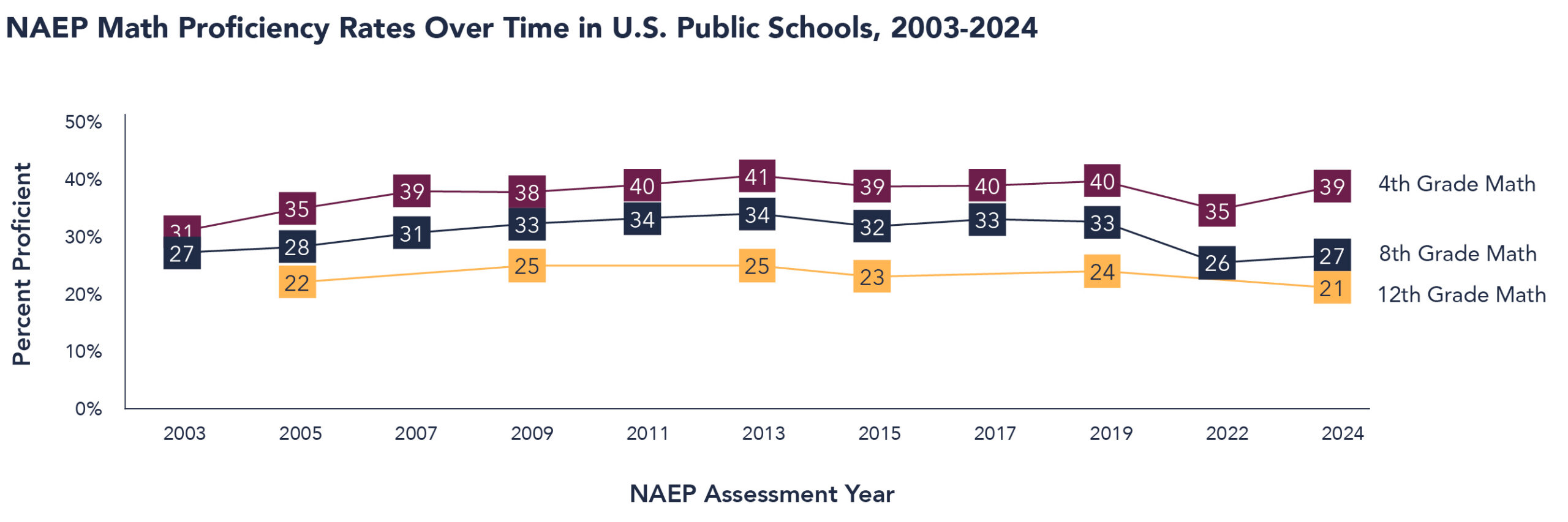
Math achievement in the United States is low, stagnant, and marked by inequalities.
- The U.S. ranks lower than most of its peer countries on international assessments of math.
- Only 39% of fourth graders, 27% of eighth graders, and 21% of 12th graders are proficient in math via the National Assessment of Educational Progress (NAEP), and many students score below even a basic level of foundational knowledge.
- Racial and socioeconomic achievement gaps in math are large and mostly unchanged since 2003.
Effective math instruction follows a developmental progression across grade levels. However, not all students have access to instruction aligned with their needs and abilities.
- Math instruction progresses through a standard sequence of content, from foundations of number sense in pre-K to high school, when various math pathways lead to different capstone options with implications for students’ postsecondary options.
- Early math skills are among the strongest predictors of later academic success, college completion, earnings, and life outcomes.
Efforts to improve math learning often face implementation barriers. In recent decades, however, math has been a primary focus of national and state reform efforts.
- States often lack explicit, coherent, and evidence-based policies in mathematics.
- Over the past 30 years, national math policy efforts have focused on standards, accountability, curriculum quality, acceleration, and course access.
- A number of states — such as Maryland, Ohio, and Alabama — have recently enacted policies designed to strengthen early math learning, identify and support struggling learners, improve student access to advanced math, and innovate around high school math pathways.
Improving math outcomes requires a coherent, cradle-to-career strategy that treats math learning as a cumulative progression.
Read more about the current state of play in the research, policy, and practice of math across the country in Solving for X.
Key Considerations
Math skills are vital for students’ future academic and socioeconomic outcomes, but performance on math assessments is distressingly low across the country. Progress in math education requires a concerted effort across research, policy, and practice and an honest commitment to grounding in facts, evidence, and data and to viewing math as a cumulative, cradle-to-career progression rather than a series of disconnected courses.
Foundations in quality math policy and practice exist, but implementation is a barrier to improved outcomes.
To effectively improve math learning for all students at all grade levels, school leaders, practitioners, and policymakers must recognize a solid and growing evidence base about what “Science of Math” education can look like for students in different stages of their academic careers, including effective instructional approaches, standard sequences of content and learning progressions, and strategies for targeting instruction to student needs and abilities.
Efforts to reform math policy and practice often confront obstacles such as inadequate teacher preparation, uneven implementation of high-quality instructional materials and aligned professional development, missing or incoherent state policies, and a culture of math anxiety.
Promising signs are emerging for improving math instruction in the field.
As the national conversation about improving math policy and practice grows, stakeholders should use and strengthen research to deepen understanding of how and when young people most effectively learn math, including identifying the most appropriate and high-impact instructional approaches, content standards, and course sequences across the pre-K through Grade 12 continuum.
Policymakers and school leaders can invest in high-quality math instruction, including in improved academic standards, accountability systems, educator preparation and in-service support, instructional materials, family engagement, and math pathways aligned with postsecondary options.
Learn more on the current state of math research, practice, and policy in Solving for X.
Acknowledgments, About the Authors, About Bellwether
Acknowledgments
We would like to thank the many experts who gave their time and shared their knowledge with us to inform our work, including Sarah Powell, Liz Cohen, and Joel Rose. Thank you also to the Valhalla Foundation and the Walton Family Foundation for their financial support of this project.
We would also like to thank our Bellwether colleagues Emily Shisler, Nate Geller, Michelle Croft, Bonnie O’Keefe, Titilayo Tinubu Ali, and Kelly Robson Foster for their input, Alexis Richardson for her support, and former colleague Sharmila Mann for her early and thorough research and insights. Thank you to Amy Ribock, Kate Stein, Andy Jacob, McKenzie Maxson, Temim Fruchter, Julie Nguyen, and Amber Walker for shepherding and disseminating this work, and to LJ Carter Creative and Super Copy Editors.
The contributions of these individuals and entities significantly enhanced our work; however, any errors in fact or analysis remain the responsibility of the authors.
About the Authors

DAVID CASALASPI
David Casalaspi is an associate partner at Bellwether. He can be reached at david.casalaspi@bellwether.org.

BRIAN ROBINSON
Brian Robinson is an associate partner at Bellwether. He can be reached at brian.robinson@bellwether.org.

JULIET SQUIRE
Juliet Squire is a senior partner and the head of emerging approaches at Bellwether. She can be reached at juliet.squire@bellwether.org.

MARK BAXTER
Mark Baxter is a partner at Bellwether and leads the organization’s work on state and federal systems. He can be reached at mark.baxter@bellwether.org.

ANSON JACKSON
Anson Jackson is a senior partner at Bellwether and leads the organization’s work on academic and program design and improvement. He can be reached at anson.jackson@bellwether.org.

Bellwether is a national nonprofit that works to transform education to ensure young people — especially those furthest from opportunity — achieve outcomes that lead to fulfilling lives and flourishing communities. Founded in 2010, we help mission-driven partners accelerate their impact, inform and influence policy and program design, and bring leaders together to drive change on education’s most pressing challenges. For more, visit bellwether.org.
© 2026 Bellwether
This report carries a Creative Commons license, which permits noncommercial reuse of content when proper attribution is provided. This means you are free to copy, display, and distribute this work, or include content from this report in derivative works, under the following conditions:
Attribution. You must clearly attribute the work to Bellwether and provide a link back to the publication at www.bellwether.org.
Noncommercial. You may not use this work for commercial purposes without explicit prior permission from Bellwether.
Share Alike. If you alter, transform, or build upon this work, you may distribute the resulting work only under a license identical to this one. For the full legal code of this Creative Commons license, please visit www.creativecommons.org.
If you have any questions about citing or reusing Bellwether content, please contact us.
