
Systemic Impact
Introduction to Designing Effective Strategies
Introduction
“Strategy is how we turn what we have into what we need to get what we want.” —Marshall Ganz1
In January 2025, Bellwether launched an initiative to explore strong practices in Systemic Impact (how an organization shifts mindsets, relationships, and power to in turn shift policies, practices, and resource flows to create conditions for systems-level adoption of an organization’s program model). This is the fourth in a series of publications exploring how nonprofit organizations, including those in the education sector, can effectively design and execute Systemic Impact strategies to achieve their ambitions. Learn more by reading Bellwether’s Systemic Impact series:
1. The Only Path to Scale, Success, and Sustainability
2. Systems, Markets, and Infrastructure
3. Mapping Authority in Postsecondary Systems
4. Introduction to Designing Effective Strategies
5. Designing and Executing Effective Campaigns
6. Using Measurement to Manage, Maximize, and Demonstrate the Value of Campaigns
7. The Importance of Implementation
This initiative builds on Bellwether’s Pragmatic Playbook, published in June 2022, which explores how organizations can employ three strategies to maximize their overall impact and their ability to effectively compete in the education sector.2
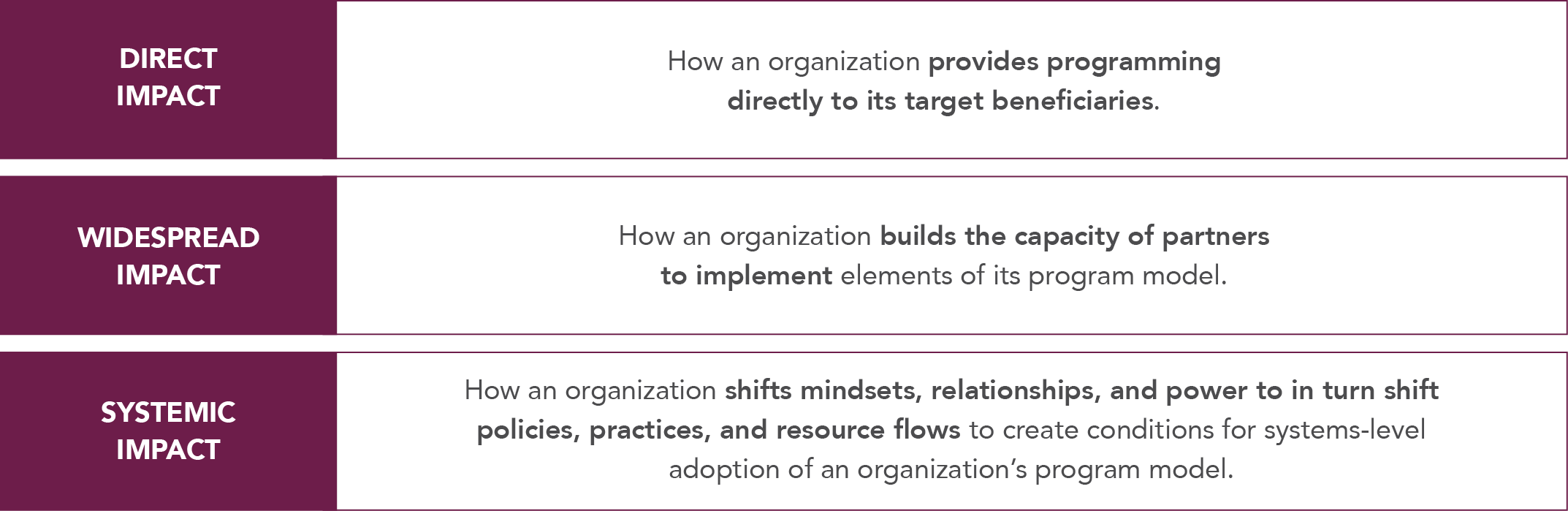
A Note on Language: Although the sector uses the terms “Systemic Impact” and “Systems Change” interchangeably, this report anchors on “Systemic Impact” (except in direct quotes). At times, the most important Systemic Impact work is not to create a change but rather to preserve the status quo or “play defense” to preserve existing progress — to resist change that is in opposition to an organization’s agenda.
These three strategies are not mutually exclusive and can, in fact, be mutually reinforcing (Figure 1).
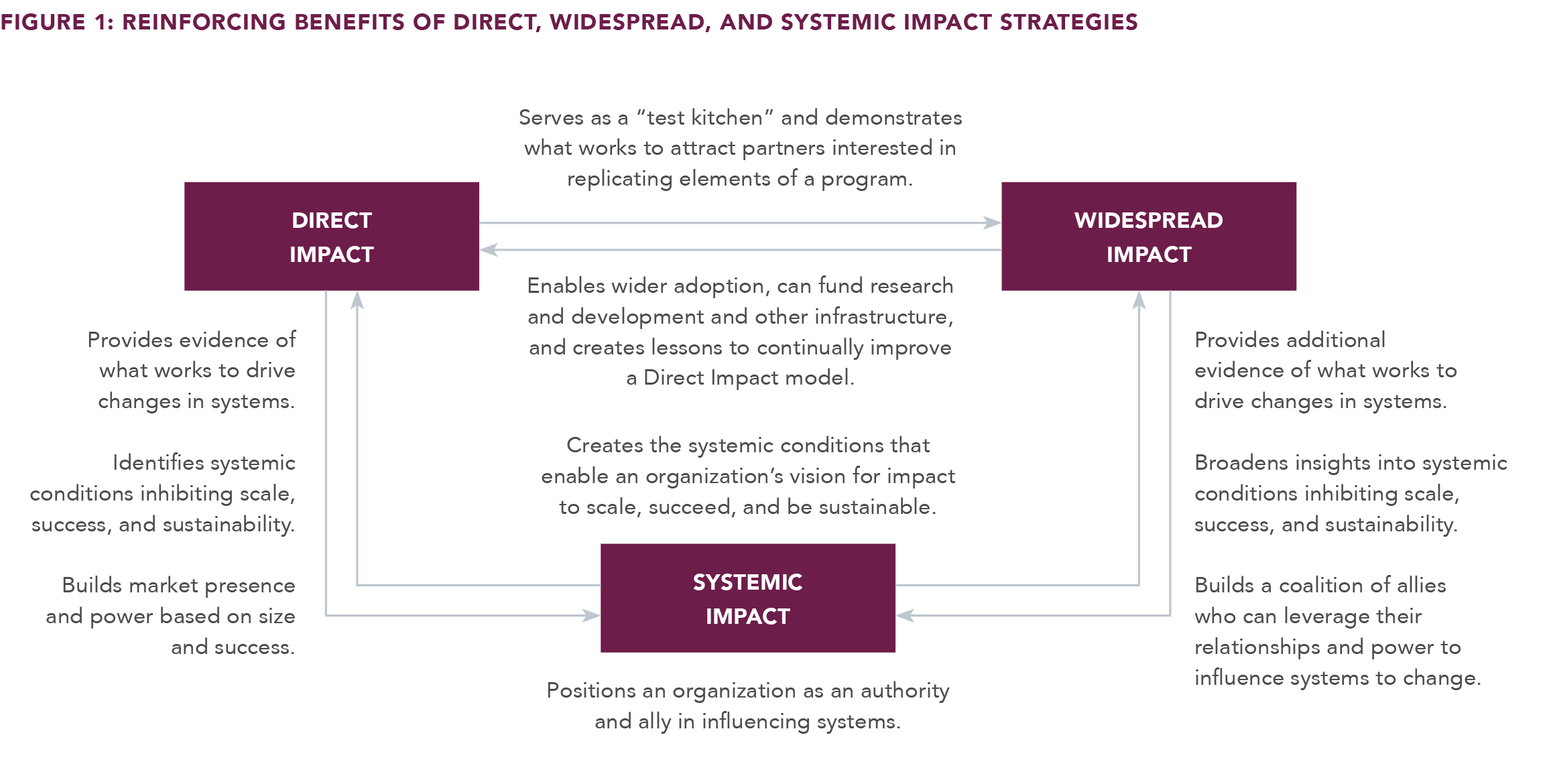
Over the past three-plus years, dozens of organizations across the country have adopted this framework for strategic decision-making and have used its key principles to communicate priorities in a clear, compelling external pitchbook to attract clients, partners, funders, and allies, and as an internal playbook to build alignment within their organizations. One of the biggest areas of need organizations frequently cite is access to more guidance and resources on how to build their ability to pursue Systemic Impact, including making the case internally and externally to other stakeholders such as funders.
Many strong education and social innovations struggle to reach population-level scale, success, and sustainability because they assume systems will automatically embrace strong results. However, systems are not wholly rational — they are also political, existing in a complex web of money, power, interests, and values. Because social problems are owned by social systems, pursuing Systemic Impact strategies is the only “exit strategy” for foundations and is the ultimate in business development for program providers.
Systemic Impact is not simple. It is unapologetically about power and who controls the agenda. It is neither a sprint nor a marathon, but rather a commitment to walk 10,000 steps every day, frequently around the same track, and sometimes walking backwards because those with competing agendas will push back. It requires becoming adept at designing and executing a range of Systemic Impact campaigns — and it requires funding.3
However, Systemic Impact is also possible — and it is happening all the time. There is no single recipe or formula for a Systemic Impact strategy. This series of publications provides a “pragmatic playbook” of design decisions (and options for many of those decisions) that each organization must make about its Systemic Impact strategy, guided by its specific values, circumstances, and ambitions. It concludes with a design and execution template for organizations to use to develop a Systemic Impact strategy and to use as a social contract for successful implementation.
What Are the Design Elements of a Systemic Impact Strategy?
Organizations must clearly articulate their answers to the following when designing and executing a Systemic Impact strategy (Figure 2). This publication provides guidance for how organizations can develop clarity on the future-state vision they want to achieve, the barriers to achieving it, and an introduction to campaigns. The next set of publications in this series provides a more detailed playbook for organizations to use in considering how to design and execute Systemic Impact campaigns.
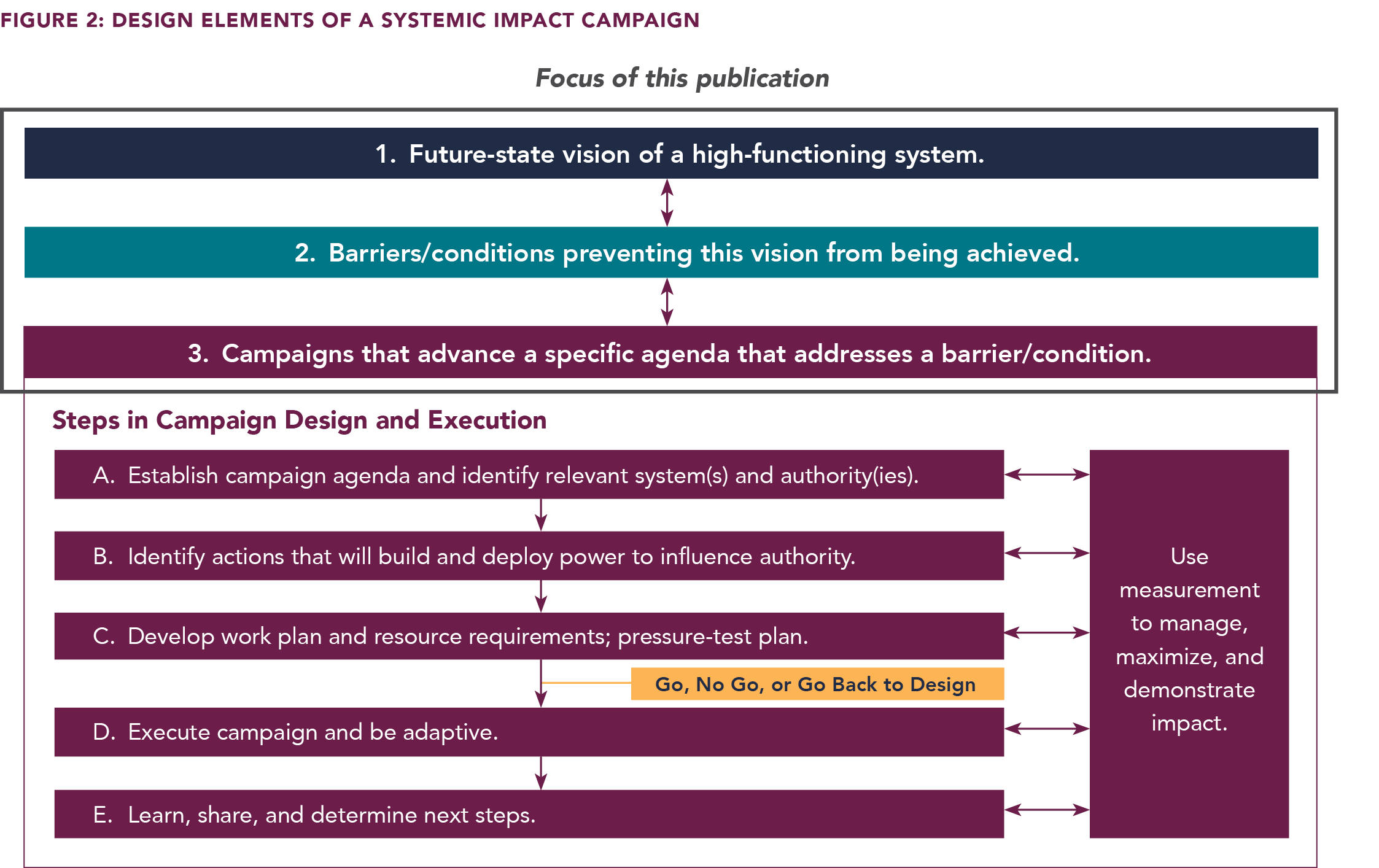
To address these design elements, organizations should engage with communities to understand their perspectives and co-design a Systemic Impact strategy that reflects their needs and priorities.
Communities are the ultimate stakeholders impacted by systems and most proximate to the problems and opportunities being addressed, yet they are often excluded from shaping Systemic Impact campaigns. As Daniel Anello, CEO of Kids First Chicago, observed, “Make sure that whatever you’re pursuing is not crafted in a way that it has blind spots to it. It’s really important that you defer to that community and try to execute against a campaign that reflects their values. Who are the people that are impacted, and what matters to them?”4
In Systemic Impact, power is defined as “the ability to decide an agenda and make action happen to advance that agenda.” Yet every community and every person has their own definition of success and happiness, and those definitions shape the agendas they pursue. When well-meaning education or social change efforts fail to ask communities how they define success or happiness, the leaders of those efforts risk imposing their own definitions.
Additionally, organizations do not ”empower” people; people have innate power. The role of stakeholders driving Systemic Impact is to inform and organize communities so they can exercise their innate power to shape the systems that govern them.5
Unfortunately, investing in informing and organizing is often necessary because while people cannot be “empowered” by others, they can be “disempowered” by others — and many systems have been structured to exclude the voices of communities. Arundhati Roy noted, “There’s really no such thing as the ‘voiceless.’ There’s only deliberately silenced, or the preferably unheard.”6
When a Systemic Impact strategy is being supported by well-intentioned outsiders with resources, it is essential that they adopt the mindset that success is not about how they invite the community to their table, but rather the investment of effort that outsiders need to make in order to earn trust and credibility so that a community invites them to sit at their table. This starts with building relationships, and that often requires digging out of some big holes from prior efforts, recognizing the assets of a community, sharing and receiving information, and reducing barriers to participation. Too often, communities are not at the table where decisions about systems are being made; often, they are not even invited into the building.7
—PARENT LEADER, PARENTS AMPLIFYING VOICES IN EDUCATION (PAVE), WASHINGTON, D.C.8
I. Designing a Future-State Vision of a High-Functioning System
Some very successful organizations have executed effective individual Systemic Impact campaigns that make substantive progress without pausing to reflect on what the ultimate future-state vision is that they are trying to reach. Backward planning from the ultimate end in mind has the potential to significantly change the focus of campaigns and contribute to greater impact. According to Courtney Criswell, principal at Waypoint Education Partners, “ALWAYS begin with the end in mind — what do you want to change, what are the biggest problems? Then identify opportunities to solve it.”9
For example, in the late 2010s, a parent organizing group in California was having success running issue campaigns to enable high-quality charter school providers to open new schools. However, during a team retreat, leaders wrestled with the question “What is our vision of a transformed school district?” In discussing this end state, the team quickly agreed it was not their vision to create an all-charter school district, though charters played a role serving as powerful proof points. Rather, they wanted to see a set of policy and funding changes to enable all district schools to operate with charter-like autonomy (and charter-like accountability systems).
Achieving this vision meant taking on not only a broader set of district policies beyond charter school growth, but also state-level campaigns to influence key policies set in Sacramento. This process gave the organization an opportunity to freshly reflect on its strategy, identify barriers to its future-state vision, and determine the agendas and corresponding campaigns it would need to pursue beyond (but still inclusive of) charter school growth. Designing a future-state vision starts with three questions:
1. What is the target population included in this future-state vision?
2. What are they able to achieve in this future-state vision?
3. How does a transformed system function, and what does it do for the target population to realize that vision? Who is involved in delivering this transformed system, and how are they resourced?
When articulating a future-state vision, organizations must navigate the tension between ambition and focus. A future-state vision of a transformed system is inherently ambitious in its scope (and therefore its lift), but it still requires being specific and making strategic trade-offs. Jaclyn Piñero, CEO of uAspire, shared, “When you commit to this work, you want to do it all — but you can’t. You have to make hard calls about what you aren’t going to advocate for. It’s a constant pull and tug back to our mission, unique expertise, and role our organization plays in the broader ecosystem.”10 An organization’s values- and mission-aligned answers to these questions serve as its North Star to guide decision making and trade-offs as it prioritizes how to deploy resources toward Systemic Impact. A clear articulation of an organization’s future-state vision is also important in attracting allies for its Systemic Impact campaign, including funders.
II. Identifying the Barriers Preventing a Future-State Vision From Being Achieved
An organization’s future-state vision may not currently exist for specific reasons — there are barriers preventing it from being achieved, sometimes also called “the conditions that hold a problem in place.”11 Systemic Impact is often about addressing those barriers and changing those conditions. However, some Systemic Impact is about playing defense to preserve a status quo by preventing a new barrier from being created. In identifying barriers to a future-state vision, organizations must consider the following set of questions:
- What is the barrier, and why does this barrier exist? Where did it originate (underscoring that Systemic Impact happens in a place with its own history)? Does the barrier exist because of policies, funding, historic practices, or market conditions?
- Are there particular, established mindsets that created and continue to sustain this barrier?
- Does this barrier exist within a single system or because of the interactions between multiple systems?
Community voice is essential to identifying and breaking down barriers. Janeira Forté, chief impact officer at uAspire, shared, “How do we identify barriers? Our students tell us. Our policy team has direct access to advisers, and we have student policy fellows that represent this same population of students we serve. We have information coming directly from our students’ and advisers’ experiences navigating the financial aid process.”12
Achieving a future-state vision usually requires removing multiple barriers, which may not be possible to tackle all at once and will require multiple Systemic Impact campaigns over time (Figure 3).
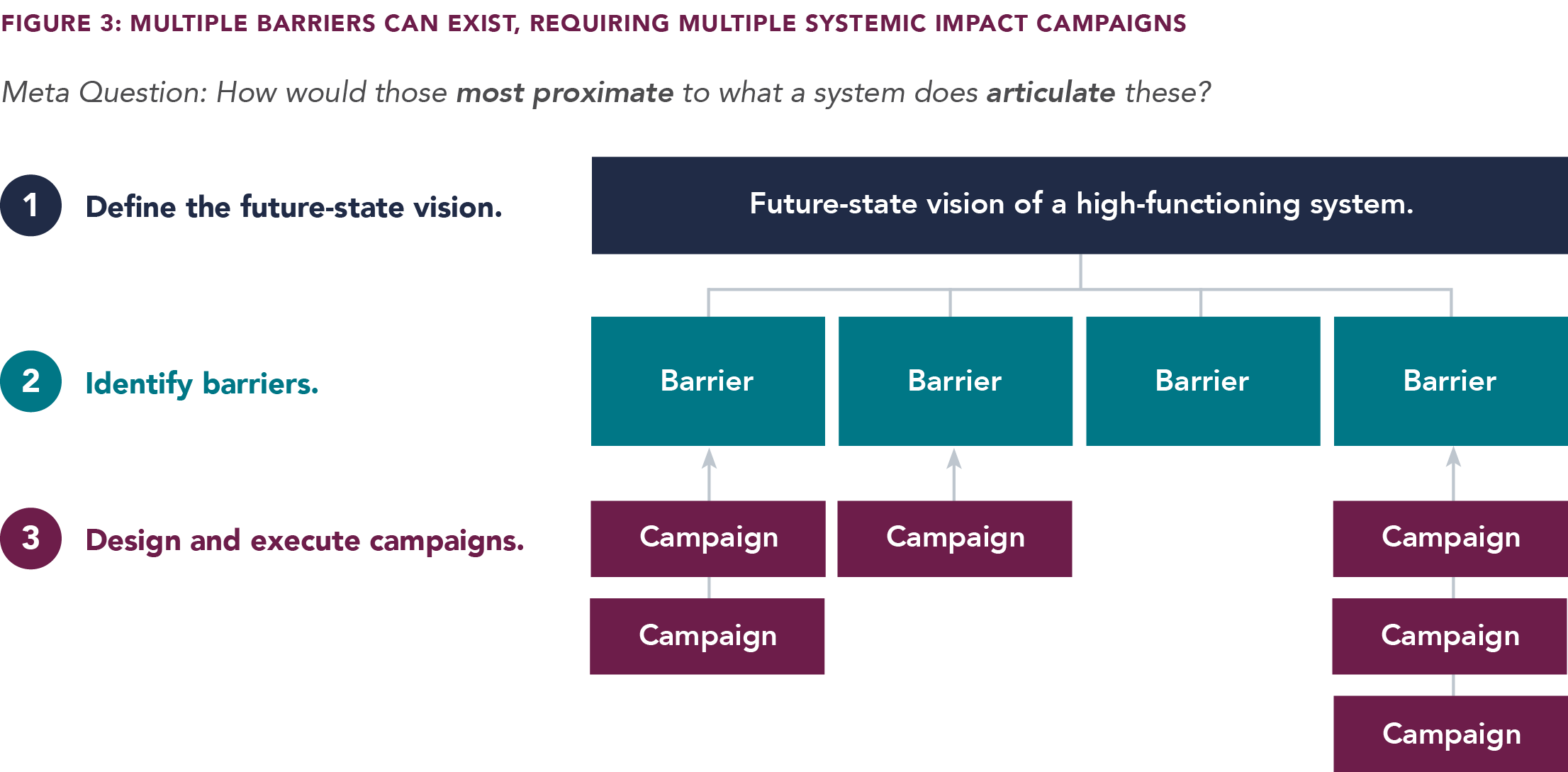
As with defining a future-state vision, identifying barriers is a balancing act between grand ambition and focusing on the specific problem a Systemic Impact campaign should be designed to address.
This is where root cause analysis can be beneficial. For example, when assessing the root cause of education inequity, it is reasonable to identify one root cause as intergenerational poverty. But that itself is such a big barrier that it can feel overwhelming and impossible to design a campaign to address. Sometimes, the only and/or best way to create an actionable agenda is to break a big challenge into smaller component parts to tackle in parallel or in sequence (Sidebar). Many organizations utilize a range of tools and frameworks to help identify the root cause of a given barrier, and in doing so also break it down to an actionable size through a range of approaches, including:
- The 5 Whys: Asking the question “Why?” approximately five times can lead to the root cause (Why did a student drop out after the first year? They were failing multiple courses. Why was that? They were not getting academic support. Why was that?).13
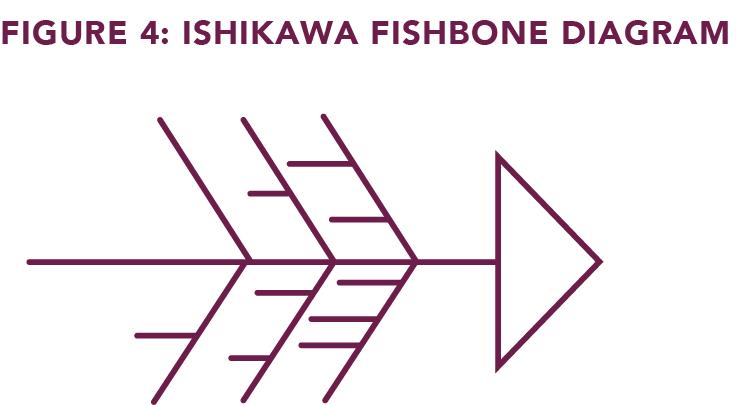
- Ishikawa Fishbone Diagram: Visually mapping potential causes of a barrier and the sub-causes that drive each “bone” in the diagram can help organizations identify categories of potential root causes to address, while also encouraging prioritization if the list is extensive (Figure 4).14
- Data Visualization: Organizing and presenting data in different ways can have a significant impact on an organization’s ability to access and make meaning of it. This can be anything from simple data graphics to detailed statistical analyses.
Root Cause Analysis in Action
An organization advocating for state policies that provide pathways to economic mobility is guided by a future-state vision in which “education systems serve all people to enable them to achieve economic self-sufficiency.”15 As the organization’s leaders mapped out barriers preventing this future-state vision from being achieved, they identified several, one of which was how the existing education system failed many people. But this is daunting and by itself hard to make actionable. Why was this failure happening? As leaders conducted a deeper root cause analysis, they uncovered a progressively more detailed strand of barriers that shaped a campaign they needed to pursue.
Barrier (one of many): Existing education systems are failing many people.
- Why? (one of many): Individuals, institutions, and policymakers lack access to clear, timely, actionable information on economic mobility outcomes by postsecondary pathway.
- Why? (one of many): Because the state has not created a longitudinal data system to connect postsecondary and workforce data systems.
- Why? (the specific barrier to address in a campaign): The teams managing the two data systems are not required to connect their data using common unique identifiers.
- Why? (one of many): Because the state has not created a longitudinal data system to connect postsecondary and workforce data systems.
Examining one root cause revealed the need to raise awareness of — and apply influence to — a data-sharing disconnect between two systems and the people who manage them. It did not require a big campaign to create legislation, but rather a change in a specific practice to require data-sharing cooperation. Without this root cause analysis, the organization might have constructed a Systemic Impact campaign that did not focus on the specific thing that needed to change, instead pursuing a solution to the wrong problem.
Getting to this level of specificity, while critical, is not always easy. As the organization’s leader in this example explained, “As an actor outside of the system, it has taken MONTHS to get to a really clear problem diagnosis of ‘here are the exact data systems that aren’t talking to each other, here are the people in charge of those systems, and here’s what a fix would look like.’ It’s kind of astounding to me how much work it’s taken to get to this point of understanding.”16
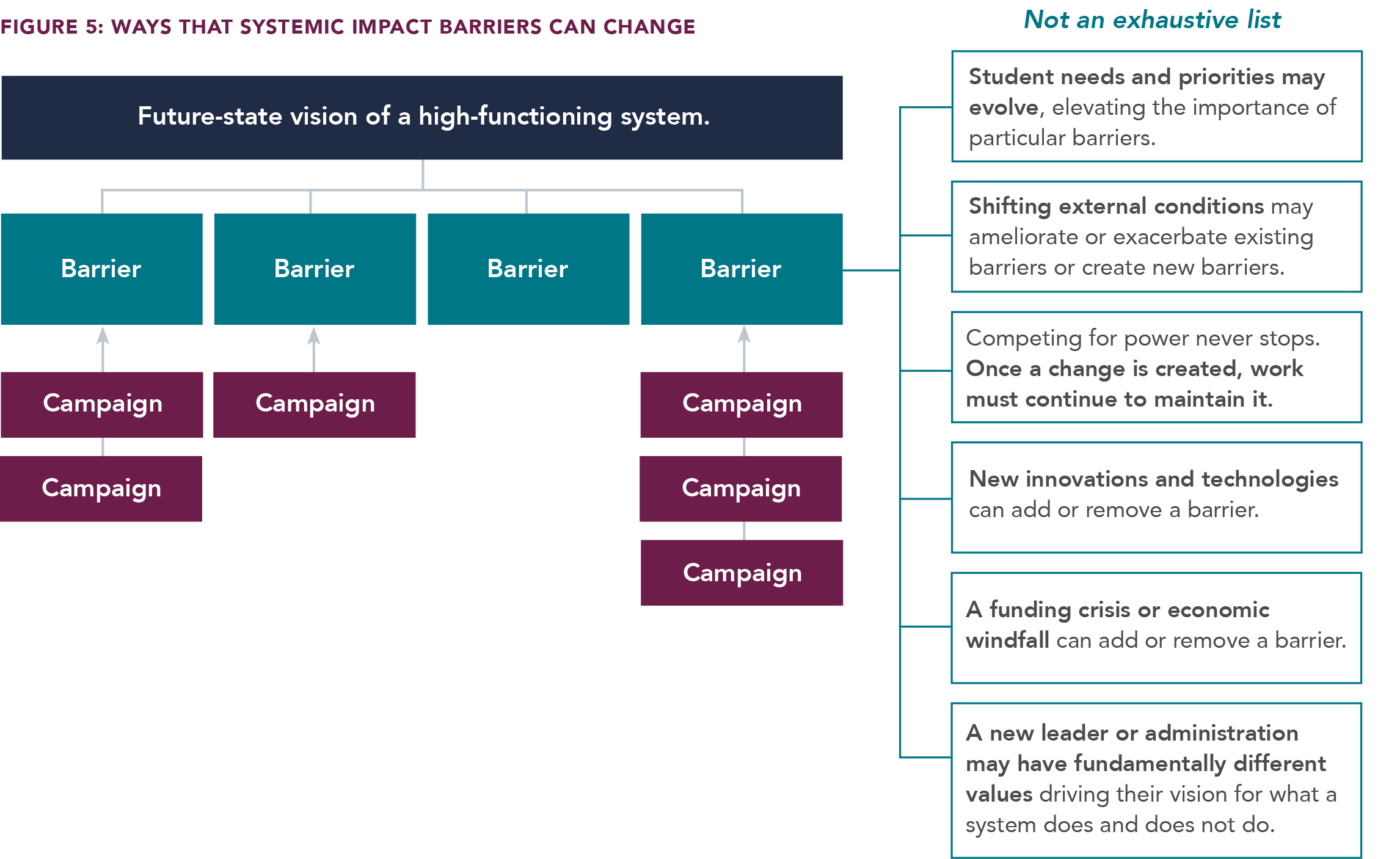
Barriers are also not static. Systems are living and dynamic. Existing barriers may fall and new ones may arise in relation to what an organization is trying to achieve (Figure 5).
III. Designing an Effective Systemic Impact Campaign
A campaign is a plan to accomplish a specific agenda for impact (whether changing something or preserving something) in a specific system, for a specific population, in a specific time frame. This publication intentionally uses a broad definition of campaign that can encompass many possible agendas and approaches to achieving them (e.g., not exclusively focused on political or electoral campaigns).
Armed with a future-state vision and set of clearly identified barriers, organizations designing a Systemic Impact campaign should follow a set of five steps (Figure 6).
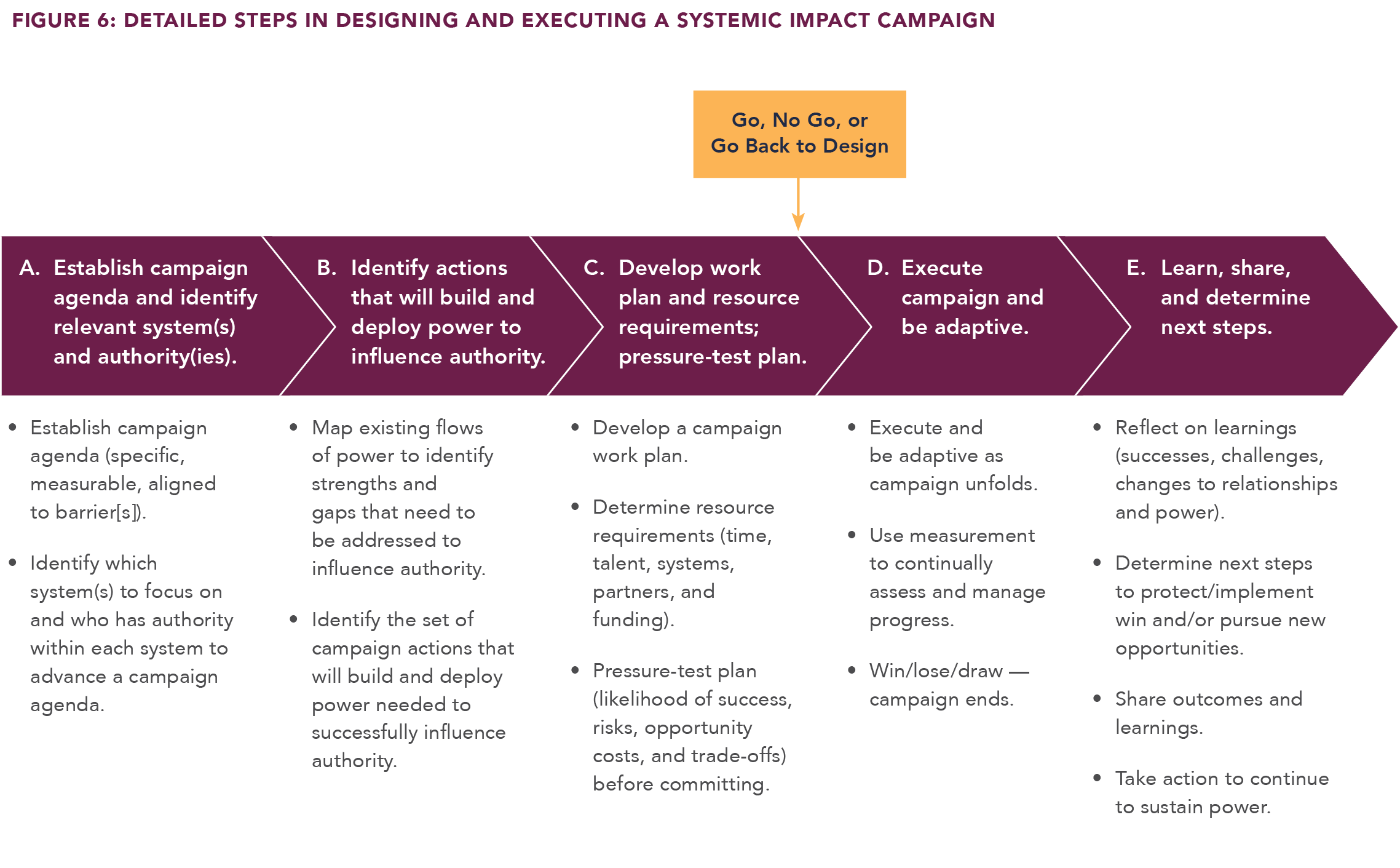
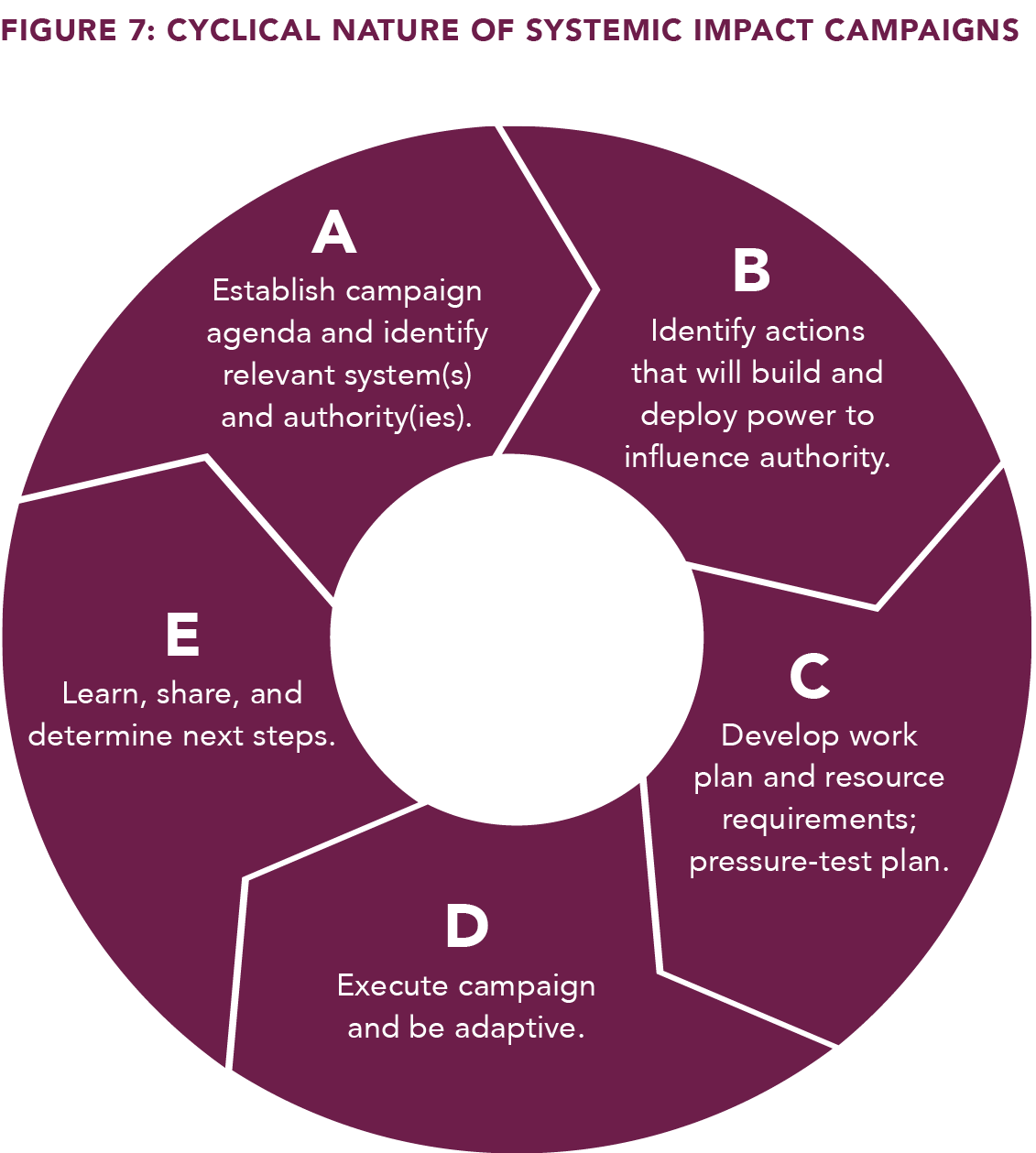 For purposes of illustrating elements of Systemic Impact campaign design, this publication outlines the process linearly. However, Systemic Impact is nonlinear and cyclical (Figure 7). As Peter Senge, one of the authors of The Water of Systems Change, observed, “Reality is made up of circles, but we see straight lines.”17
Creating and sustaining Systemic Impact requires continual campaigns because:
- Campaigns may not initially win and can require multiple campaign cycles to achieve success.
- Campaigns may need to win at multiple levels (local, district, state, and/or federal) to fully realize an impact agenda.
- Changes in conditions (such as change in leadership or change in financial situation) can require new campaigns to advance new opportunities and/or sustain/protect existing progress — sometimes, the most important campaigns play defense.
- Campaigns by those with a competing agenda can undo campaign progress an organization has made — the wheel is always turning.
- Success in one campaign can reveal the need for another campaign.
Lori Chajet, co-founder and co-executive director of College Access: Research and Action, observed, ”Systemic Impact has a long timeline and is not linear. We needed to be clear that we were in it for the long term and at the same time what we were doing in each step of a specific campaign.”18
Given the many campaigns likely needed over time to achieve an organization’s future-state vision, it is important to prioritize and thoughtfully sequence which campaign(s) an organization pursues. Trying to do everything at once risks accomplishing nothing.
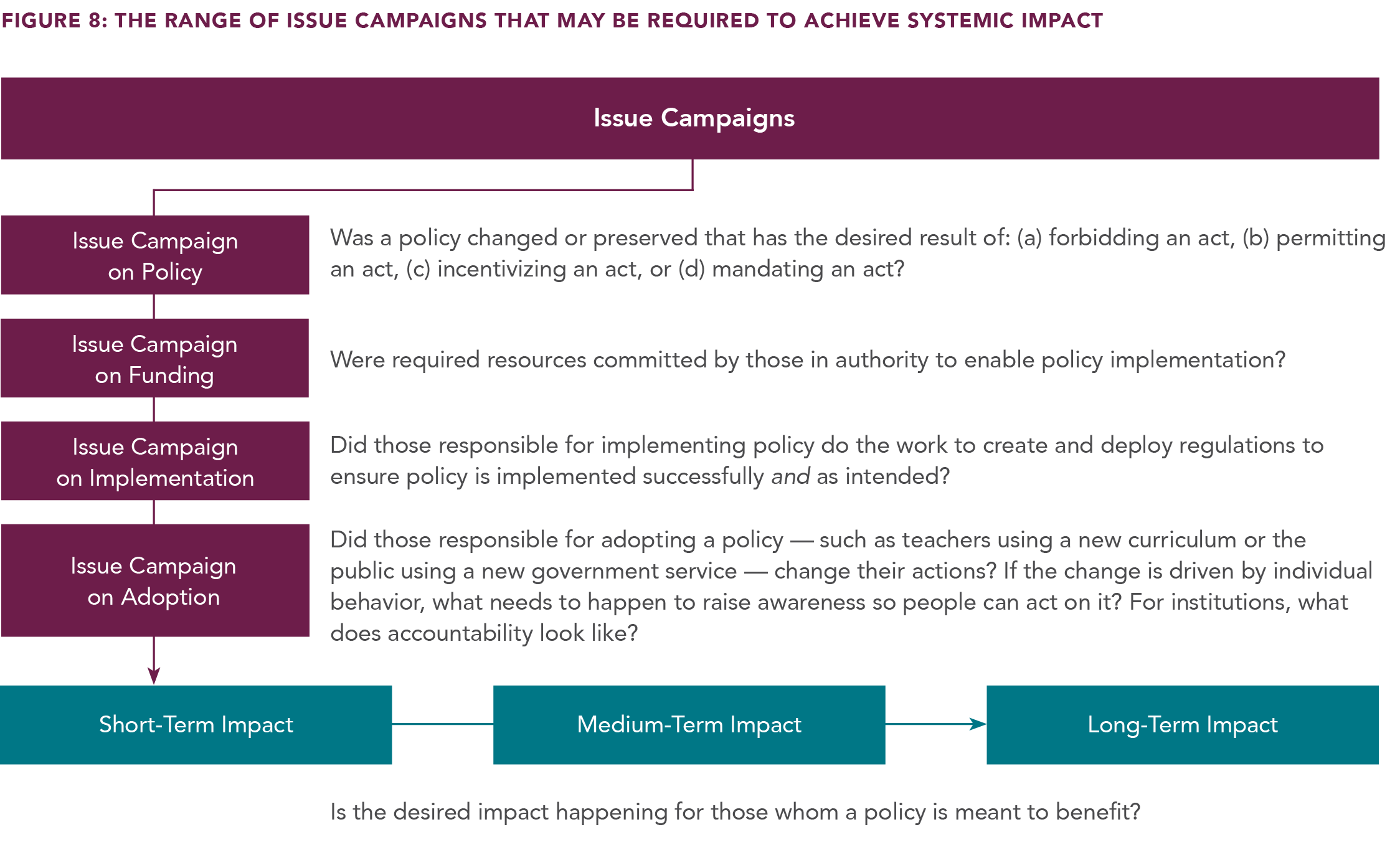
Systemic Impact campaigns get even more complicated because there are multiple types of campaigns potentially required before actual impact in terms of a value created for the campaign’s target population.
Issue campaigns are about getting those in authority in a system to act to advance a campaign’s agenda. Sometimes, it is known as “Big P” legislated changes in policy, and sometimes it is “Little P” changes that can be made in regulations or practices without a legislative change (and there is a range of ways people define these Ps) (Figure 8).
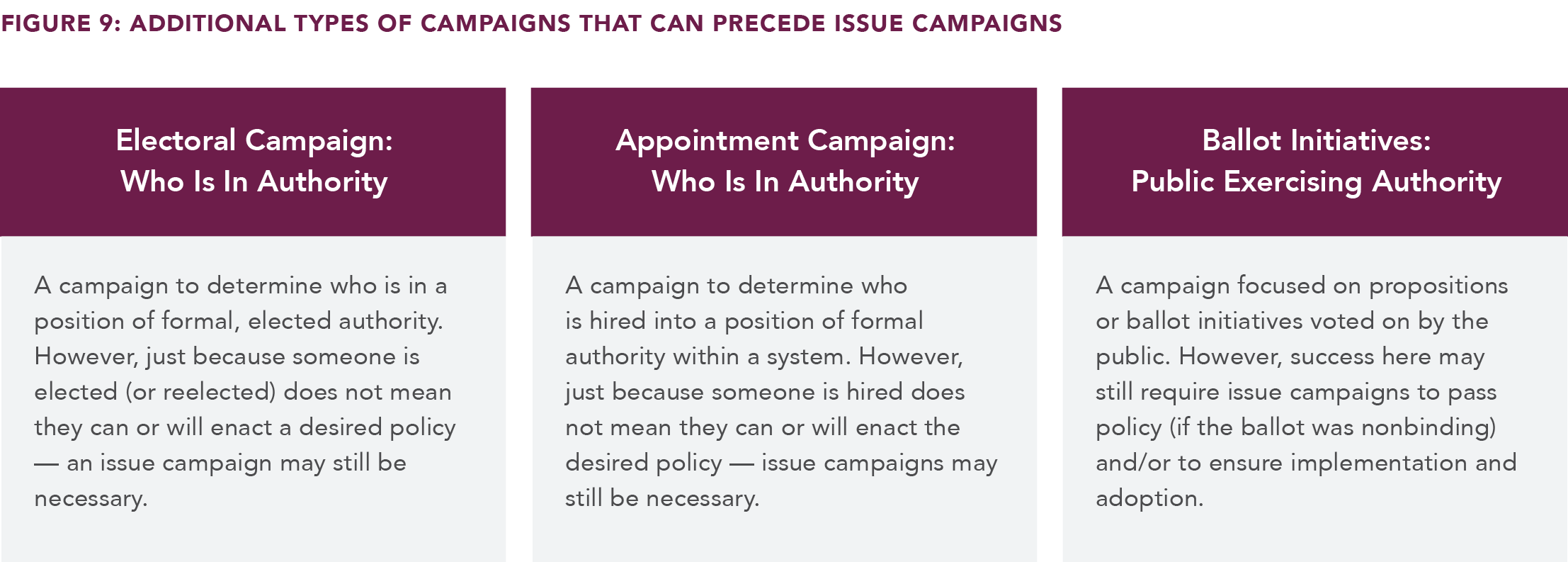
However, sometimes organizations must first change who is in a position of authority to advance their agenda because there is simply no way to influence those in positions of authority (Figure 9). In this case, and where considered viable, organizations can pursue either electoral campaigns in situations where the position of authority is elected, or “appointment campaigns” where the goal is to influence who is hired into a position of authority (e.g., a secretary of education, K-12 commissioner, or college president). There are also opportunities in some states to put decision-making directly to voters as a ballot initiative. Even when these ballot initiatives successfully address policy, they still typically require issue campaigns to ensure implementation and adoption.
Systemic Impact can involve both proactive and reactive campaigns. “In times of political turmoil, events can move from impossible to inevitable without even passing through improbable.” —Anatole Kaletsky, Economist19
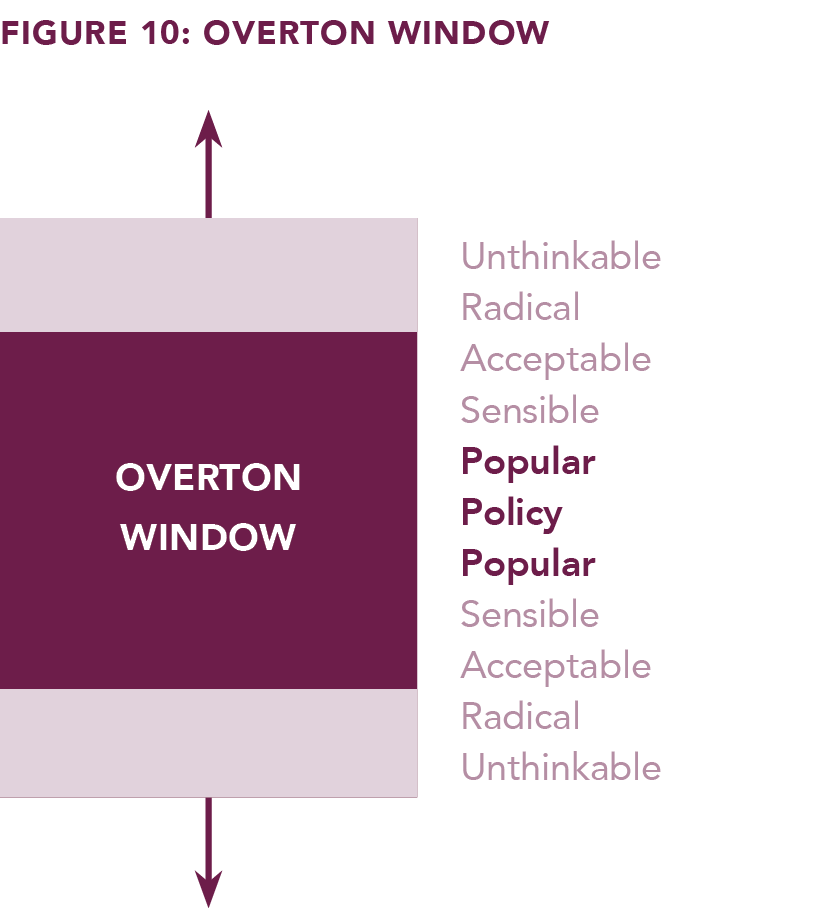 Circumstances can create unplanned windows of opportunity or obstacles (often referred to as the Overton Window20), in both deciding whether to pursue a campaign and making changes in the midst of a campaign (Figure 10). At times, campaigns must be strategic and nimble, shifting from offense to defense to advance or protect an agenda amid evolving barriers and conditions. In other cases, campaigns pursuing critical issues must doggedly pursue a campaign despite long odds of success. Fortunately, with the right deployment of power, even long odds can pay off, and an idea can move from proposal to policy.
Source: Mackinac Center for Public Policy, “The Overton Window.”
For example, in the campaign to create the 19th Amendment, which guaranteed women’s right to vote, the ratification by a 36th state came down to a single vote in the state legislature, which was deadlocked. Harry T. Burn, a 24-year-old representative to the Tennessee State House, was expected to cast the decisive vote to break the tie in opposition to the amendment. However, he surprised his fellow legislators by voting yes, tipping the amendment to national ratification. He attributed his change of heart to a letter sent to him by his mother, imploring him to “be a good boy” and vote for the amendment,21 which is an example of how those in authority who make a decision can be influenced by those with power — like a mother.
This element of timing — and the need to be both proactive and reactive — reinforces the importance of articulating a future-state vision at the outset. That way, when opportunities (or challenges) arise, an organization can assess options and trade-offs relative to its ultimate goal for impact.
When designing Systemic Impact campaigns, organizations should think about both short- and long-term wins. Some campaigns can create quick wins to build buy-in, power, and momentum toward more ambitious campaign agendas. As Maya Martin Cadogan, founder and CEO of PAVE, counseled, “It’s important to start small because folks like to win first. I think you can get to bigger visionary stuff once people feel like they are part of something winning, but if it is so big that you can’t win, people lose steam fast.”22 In “A Conversation on Building People Power for Transformative Change,” Mike Miller and Ricardo Levins Morales shared a similar sentiment:
“You cannot build a powerful movement for transformative change, and the powerful organizations that are required to sustain such a change movement, without victories along the way. The victories are essential to convince people of the efficacy of collective action and to sustain themselves in it; to invest their time, talent, and money in such a movement; to see it as a vehicle to express deeply their values like democracy, freedom, equality, security, community, and justice; to understand it as a means to defend things most important to them — their personhood, families, friends, neighborhoods, work and income. … Victories allow initial participants to go home and tell their families, friends, co-congregants, fellow workers, and neighbors ‘look at what we did. We can do even more with more people.’”23
Systemic Impact is often not a solo activity. Organizations can consider their role in building or participating in coalitions to advance a set of shared goals. Coalitions can be an incredibly powerful Systemic Impact tool and have been at the core of many social and civil change efforts over the course of history. At the same time, coalitions are not costless — they take time, energy, and resources to join or lead. Coalitions are also complex, because they require consensus on a common agenda, the campaign’s actions, establishing roles (including who is taking what risks), and negotiating resources.
Participation in a coalition has implications for each step of the campaign process. For example, members may work to jointly shape a campaign agenda (through consensus or a majority vote), coordinate actions, and contribute resources. Given these dynamics, it is valuable to consider whether to join or lead a coalition at the start of the campaign design process; however, the choice can and should be revisited at each step along the way.
“Coalition” is a broad term. Coalitions can vary based on many dimensions, such as purpose, geographic scope, and structure. When joining or forming a coalition, an important dimension to consider is the level of commitment, which may range from: simply agreeing to put an organization’s name on something to an alliance where members agree to work together on a specific issue campaign (but are not creating an ongoing formal collaboration structure) to a formal coalition where members form a new “organization of organizations … [for which] all groups own a stake in the operations and the outcomes.”24
Additionally, there must be clarity about how decisions will be made, which itself is a function of the power between organizations within a coalition. Organizations can consider forming and leading a coalition or joining an existing coalition — and should reflect on the pros and cons of a coalition relative to pursuing their campaign on their own (Table).
TABLE: OPTIONS WHEN CONSIDERING COALITIONS IN SYSTEMIC IMPACT
| Pursue Alone | Join an Existing Coalition | Form/Lead a Coalition |
| ❏ The organization is uniquely well positioned to pursue this campaign agenda (given its expertise, resources, and credibility).
❏ The organization has, or can build, sufficient power to influence on its own. ❏ The need/opportunity is urgent (cannot wait to form a coalition). ❏ No other organizations are positioned to help advance a campaign agenda through collaboration (or their involvement would dilute the agenda). |
❏ An aligned and effective coalition already exists with the necessary resources and credibility.
❏ The organization can add value by filling gaps without assuming responsibility for forming a new coalition. ❏ The organization is willing to compromise by accepting less direct control than it would have by leading. ❏ The organization may limit risk exposure by being part of a larger coalition led by others versus being the “tip of the spear.” |
❏ No aligned and effective coalition currently exists …
❏ … and influencing authority requires a combination of voices, expertise, resources, and relationships that no organization can provide alone … ❏ … and the organization has the capacity, trust, resources, and power required to lead. |
Ultimately, coalitions are a means to build and deploy power. Being thoughtful about when to act alone, when to join a coalition, and when to lead one helps ensure collective action is used intentionally and an organization’s energy and resources are optimized to advance a specific Systemic Impact goal as it embarks on the five steps to designing and executing a campaign.
What Comes Next
The next set of publications in this series provides a more detailed playbook for organizations to use in considering how to design and execute Systemic Impact campaigns.
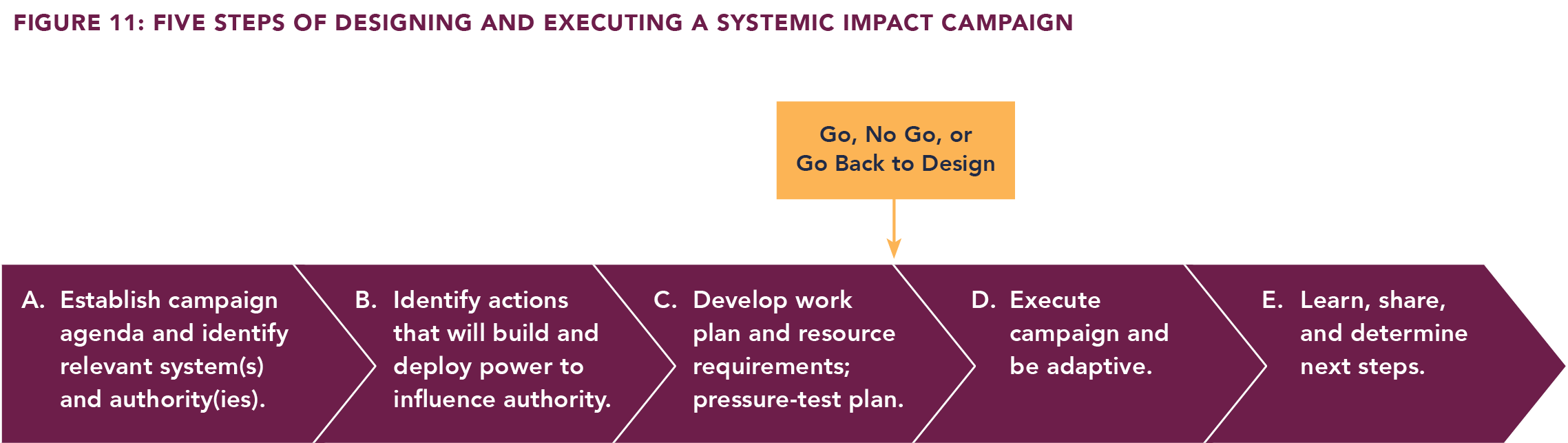
5. Designing and Executing Effective Campaigns outlines how successful Systemic Impact campaigns follow five steps (Figure 11).
6. Using Measurement to Manage, Maximize, and Demonstrate the Value of Campaigns addresses how organizations can apply measurement practices to strengthen the planning, execution, and improvement of Systemic Impact campaigns.
7. The Importance of Implementation examines why strong implementation is necessary for campaigns to successfully achieve their intended outcomes.
Conclusion
The work of Systemic Impact can be daunting — it involves not only identifying a solution but also addressing the fundamental conditions that created and hold the problem in place. It also requires acknowledging that Systemic Impact is unapologetically about power. But when successful, Systemic Impact can be transformative. The late Civil Rights leader and Congressman John Lewis, reflecting on his history of creating Systemic Impact, observed, “Take a long, hard look down the road you will have to travel once you have made a commitment to work for change. Know that this transformation will not happen right away. Change often takes time.“25
- 1. Marshall Ganz, Why David Sometimes Wins: Leadership, Organization, and Strategy in the California Farm Worker Movement (Oxford University Press, 2009). ↩
- 2. Alex Cortez and Christine Wade, A Pragmatic Playbook for Impact: Direct, Widespread, and Systemic (Bellwether, 2022), https://bellwether.org/publications/pragmatic-playbook-for-impact/. ↩
- 3. Alex Cortez, Christine Wade, and Kateland Beals, Systemic Impact: The Only Path to Scale, Success, and Sustainability (Bellwether, 2025), https://bellwether.org/publications/systemic-impact/. ↩
- 4. Panel with Daniel Anello, Kids First Chicago, Aug. 27, 2025. ↩
- 5. Alex Cortez, Systems Change & Parent Power (New Profit, 2020), https://newprofit.org/wp-content/uploads/2021/06/Parent-Power-and-SystemsChange-in-Education-VF-New-Profit-2020.pdf. ↩
- 6. Arundhati Roy, “2004 Sydney Peace Prize Lecture,” Sydney Morning Herald, November 4, 2004, https://www.smh.com.au/national/roys-full-speech-20041104-gdk1qn.html. ↩
- 7. Cortez, Systems Change. ↩
- 8. Ibid. ↩
- 9. Interview with Courtney Criswell, Waypoint Education Partners, January 30, 2025. ↩
- 10. Interview with Jaclyn Piñero, uAspire, March 20, 2025. ↩
- 11. John Kania, Mark Kramer, and Peter Senge, The Water of Systems Change (FSG, 2018), https://www.fsg.org/resource/water_of_systems_change. ↩
- 12. Interview with Janeira Forté, uAspire, March 20, 2025. ↩
- 13. Learning Enrichment Activity: 5 Why Problem Solving (Oakland University, Pawley Lean Institute), https://www.oakland.edu/Assets/upload/docs/Pawley/Lean-Enrichment-Activities/LEA---5-Whys.pdf. ↩
- 14. “What Is Ishikawa (Fishbone Diagram)?,” SixSigma, March 23, 2017, https://www.6sigma.us/etc/what-is-ishikawa-fishbone-diagram/. ↩
- 15. Interview, February 12, 2025. ↩
- 16. Interview, February 12, 2025. ↩
- 17. Peter M. Senge, The Fifth Discipline: The Art & Practice of the Learning Organization (Currency Doubleday, 1990). ↩
- 18. Lori Chajet, College Access: Research and Action, email on February 13, 2026. ↩
-
19.
Anatole Kaletsky, "Is Canceling Brexit Now Inevitable?" Advisor Perspectives, December 28, 2018, https://www.
advisorperspectives.com/ commentaries/2018/12/28/is- canceling-brexit-now- inevitable. ↩ - 20. “The Overton Window,” Mackinac Center for Public Policy, https://www.mackinac.org/OvertonWindow. ↩
- 21. Lacey Morris, “A Mother’s Letter: Febb Burn and the 19th Amendment,” Tennessee State Museum blog, October 21, 2024, https://tnmuseum.org/junior-curators/posts/a-mothers-letter-febb-burn-and-the-19th-amendment. ↩
- 22. Interview with Maya Martin Cadogan, Parents Amplifying Voices in Education, February 12, 2025. ↩
- 23. Ricardo Levins Morales and Mike Miller, “A Conversation on Building People Power for Transformative Change,” Social Policy (Winter 2011): 50–53, https://www.organizetrainingcenter.org/uploads/9/0/6/0/90602997/building_people_power_san_francisco.pdf. ↩
- 24. Tom Novick and Michael O’Loughlin, To Be (a Coalition) or Not to Be (a Coalition) (M+R Strategic Services), https://www.countyhealthrankings.org/sites/default/files/ToBeOrNotToBeCoalition.pdf. ↩
- 25. John Lewis, with Brenda D. Jones, Across That Bridge: A Vision for Change and the Future of America (Hachette Books, 2017). ↩
Acknowledgments
We would like to thank the many experts who shared their knowledge with us to inform our work, including interviewees for their time, insights, and expertise as well as the community of practice participants who contributed to this publication. Thank you also to ECMC Foundation for its financial support of this project.
Thank you to Amy Ribock, Kate Stein, Andy Jacob, McKenzie Maxson, Temim Fruchter, Julie Nguyen, and Amber Walker for shepherding and disseminating this work, and to Super Copy Editors.
The contributions of these individuals and entities significantly enhanced our work; however, any errors in fact or analysis remain the responsibility of the authors.
About the Authors

ALEX CORTEZ

CHRISTINE WADE

KATELAND BEALS

Bellwether is a national nonprofit that works to transform education to ensure young people — especially those furthest from opportunity — achieve outcomes that lead to fulfilling lives and flourishing communities. Founded in 2010, we help mission-driven partners accelerate their impact, inform and influence policy and program design, and bring leaders together to drive change on education’s most pressing challenges. For more, visit bellwether.org.
This report carries a Creative Commons license, which permits noncommercial reuse of content when proper attribution is provided. This means you are free to copy, display, and distribute this work, or include content from this report in derivative works, under the following conditions:
Attribution. You must clearly attribute the work to Bellwether and provide a link back to the publication at www.bellwether.org.
Noncommercial. You may not use this work for commercial purposes without explicit prior permission from Bellwether.
Share Alike. If you alter, transform, or build upon this work, you may distribute the resulting work only under a license identical to this one. For the full legal code of this Creative Commons license, please visit www.creativecommons.org.
If you have any questions about citing or reusing Bellwether content, please contact us.
