
Systemic Impact
Systems, Markets, and Infrastructure
Introduction
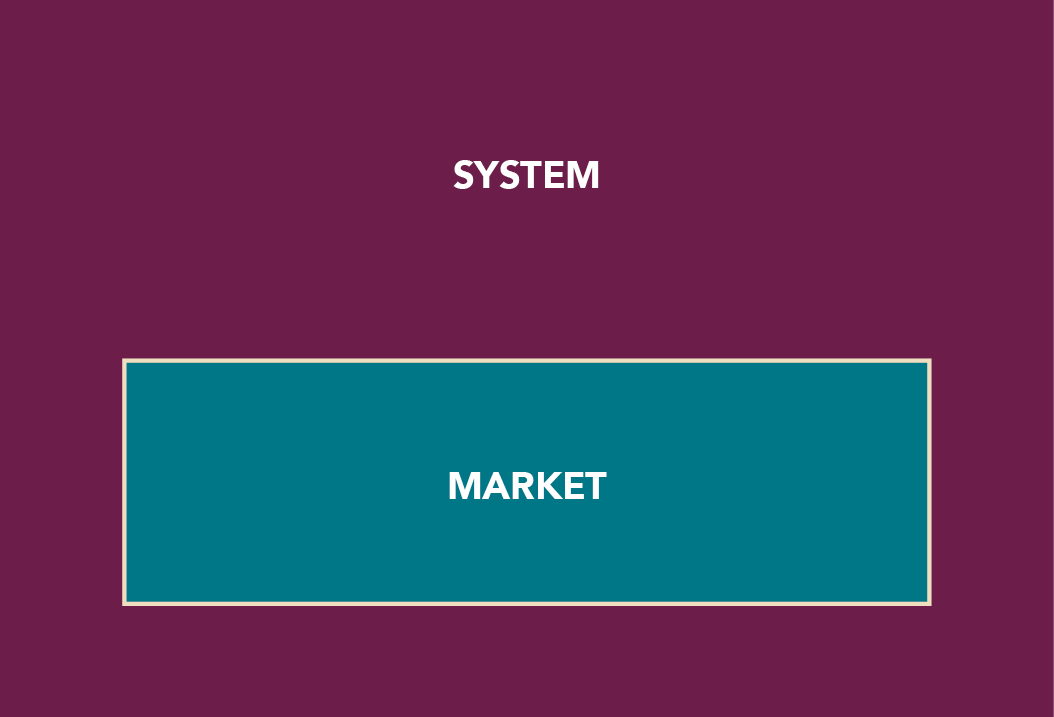
Although competition is not a popular term in the nonprofit sector, it is an inevitable practice.1 As nonprofit organizations — including those in education — seek to grow their scale of reach, success in creating impact, and financial sustainability, they must be strategic about how to compete at two levels:
- In the markets in which they operate.
- In the surrounding systems that govern how those markets operate (e.g., Systemic Impact2).
In June 2022, Bellwether published the Pragmatic Playbook, which explored how organizations can employ three strategies to maximize their overall impact and their ability to effectively compete in the education sector.3
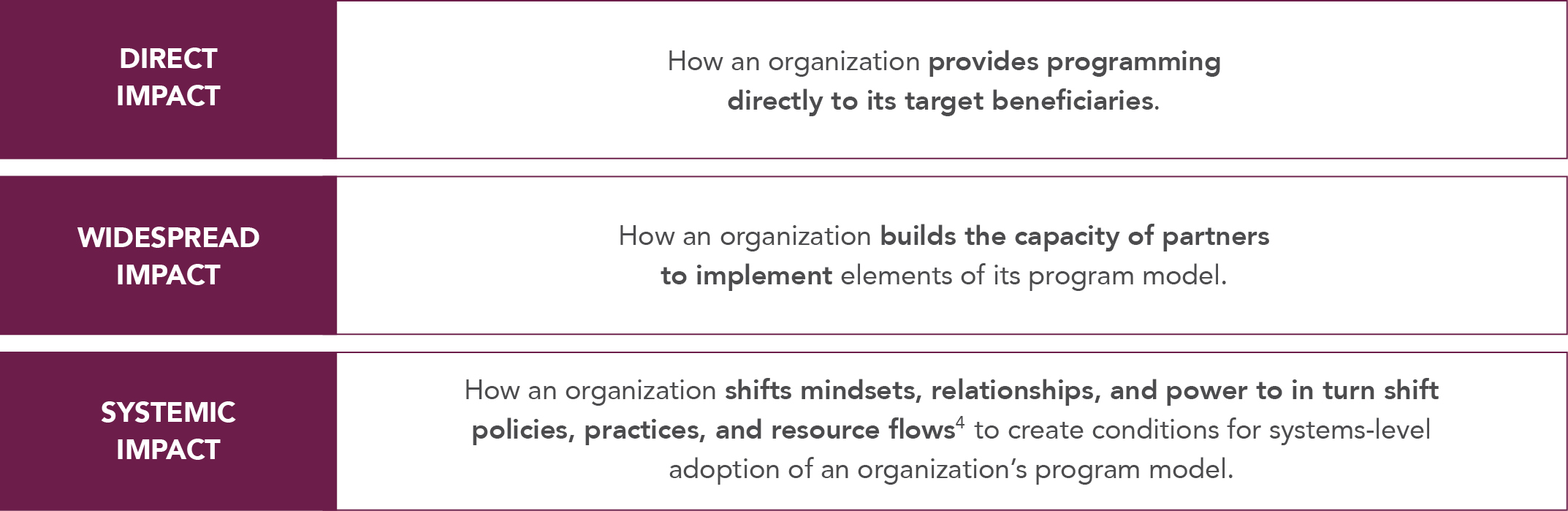
Over the past three-plus years, dozens of organizations across the country have adopted this framework for strategic decision-making and have used its key principles to communicate priorities in a clear, compelling external pitchbook to attract clients, partners, funders, and allies, and as an internal playbook to build alignment within their organization.
One of the biggest areas of need organizations frequently cite is access to more guidance and resources on how to build their ability to pursue Systemic Impact. In January 2025, Bellwether launched an initiative to explore strong practices in Systemic Impact. This is the second in a series of publications exploring why nonprofit organizations, including those in the education sector, must pursue Systemic Impact strategies to achieve their ambitions, and how organizations can effectively design and execute Systemic Impact strategies.
Navigating, surviving, and even succeeding in a social venture requires that education organizations acknowledge the need to be competitive in the markets in which they play. However, to achieve their ambitions, they also need to compete in Systemic Impact to set the rules that govern how those markets operate.
A Note on Language: Although the sector uses the terms “Systemic Impact” and “Systems Change” interchangeably, this report anchors on “Systemic Impact” (except in direct quotes). At times, the most important Systemic Impact work is not to create a change but rather to preserve the status quo or “play defense” to preserve existing progress — to resist change that is in opposition to an organization’s agenda.
Education Organizations Compete in Markets
A market in any sector is the place where various stakeholders come together and compete to exchange value. Markets exist because of competition. Markets can grow as this exchange of value creates demand for more of a product or service, and those supplying that product or service grow to meet that demand.
Education nonprofits compete in markets, whether their leaders like it or not (and nonprofits may achieve more impact if they accept this reality), be it a consumer market to get individuals to purchase a program or service, or a market seeking to convince organizations to purchase a program or service. Most of these markets are competitive, with nonprofits and sometimes for-profits in a contest for scarce resources such as customers or funding.
The concept of markets can make some nonprofit leaders uncomfortable; however, the idea of markets existed in antiquity and precedes contemporary capitalism. Even within more socialist economies, markets still exist. Centrally planned social systems have markets, though they are usually state run and highly restricted. And contemporary America functions as a capitalist market. As one nonprofit leader noted, “We don’t necessarily like the idea of capitalism, but we all jump to compete when [a request for proposals] comes out.”4
A market is a useful construct for social ventures to think about how to create value. Markets require an understanding of what role different stakeholders play in creating value: who is a customer (and in education, the purchaser is not always the same as the end user), what they want, what a social venture can provide in response to that demand, how it wants to compete (price, quality, brand loyalty, etc.), and who else is competing to meet that demand.
In Bellwether’s recent work with innovative education workforce programs, the concept of a market has been essential in developing strategies for success. For example, for teacher apprenticeship degrees to be successful (as explored in Bellwether’s October 2024 Best of Both Worlds report), it must create compelling value relative to existing alternatives for individuals pursuing this degree, institutions of higher education providing the degree component, and the employers providing the apprenticeship opportunities. For this market to work, it must create value for employers; “altruism doesn’t scale.5
Systems Govern How Markets Operate
Systems are a group of stakeholders and relationships with a common set of processes and beliefs about how they interact. Systems have a formal structure of governance that guides how power flows to influence those interactions.
Because many (though not all) human interactions happen through markets, a critical role of systems is to govern how markets operate. In this framing, a system is a governing body that determines the rules of competition in a market through four types of policies:
- Policies that forbid a behavior or action in a market.
- Policies that permit a behavior or action in a market.
- Policies that encourage a behavior or action in a market through incentives.
- Policies that mandate a behavior or action in a market and with enforcement.
Stakeholders can and do compete to influence the policy decisions of systems because they shape how the market or markets they play in operate. Competing in a market and competing to shape the system rules that govern a market require an understanding of what a market is and how it works. A well-functioning market has the following qualities:
-
- Information transparency, where clear, timely, credible, and universally accessible information is available on price, quality (e.g., value), and availability, which enables stakeholders to easily match supply and demand.
- Low transaction costs, which information transparency helps enable.
- Competition among many stakeholders to mitigate against any one stakeholder having too much market influence (though stakeholders will compete to gain market share, which can bring with it market influence).
- Low barriers to entry and exit (though some stakeholders may compete to raise barriers to entry to provide/ sustain a market advantage).
- Adaptability, in which stakeholders in the market can quickly change in response to new information, innovation, and/or changes in economic conditions that impact the level of supply or demand.
- A regulatory framework with a well-structured set of rules and guidelines that ensures fair practices and protects market participants — which is what the system provides to enable the market to function competitively.
Markets — particularly those addressing social problems or social needs like education — can frequently break down without clear, timely, actionable information.
Information is a critical component of an effective and efficient market. But information itself is something that stakeholders compete to access and sometimes control to provide them with a competitive advantage. Information is power — in general, and specifically in markets. This differential access to information is a particular competitive advantage when those selling have more information than those buying.
For example, in higher education, there are huge disparities in access to information about the performance of postsecondary credentials, both degree and nondegree. Students are asked to make momentous life choices without knowing the probability of successful outcomes. Sometimes, they even receive misinformation about the true cost of pursuing a credential and the probability of its resulting in economic value.6
Without information, there is not a functioning market. Information should also ideally drive policy based on what does and does not create value in a market. However, most systems — including education systems — are not wholly rational; they are also political. Information itself can become politicized, with stakeholders competing to shape policies about what information is collected and shared (or not) that aligns to their interests (and which may not be in the interest of other market stakeholders, such as consumers).
One of the critical ways to shape the rules that govern a market is to shape the information provided (and to whom) about how the market operates. Systems can determine what information is available to a market by passing policy and then sometimes also serving as the entity responsible for collecting and sharing information.
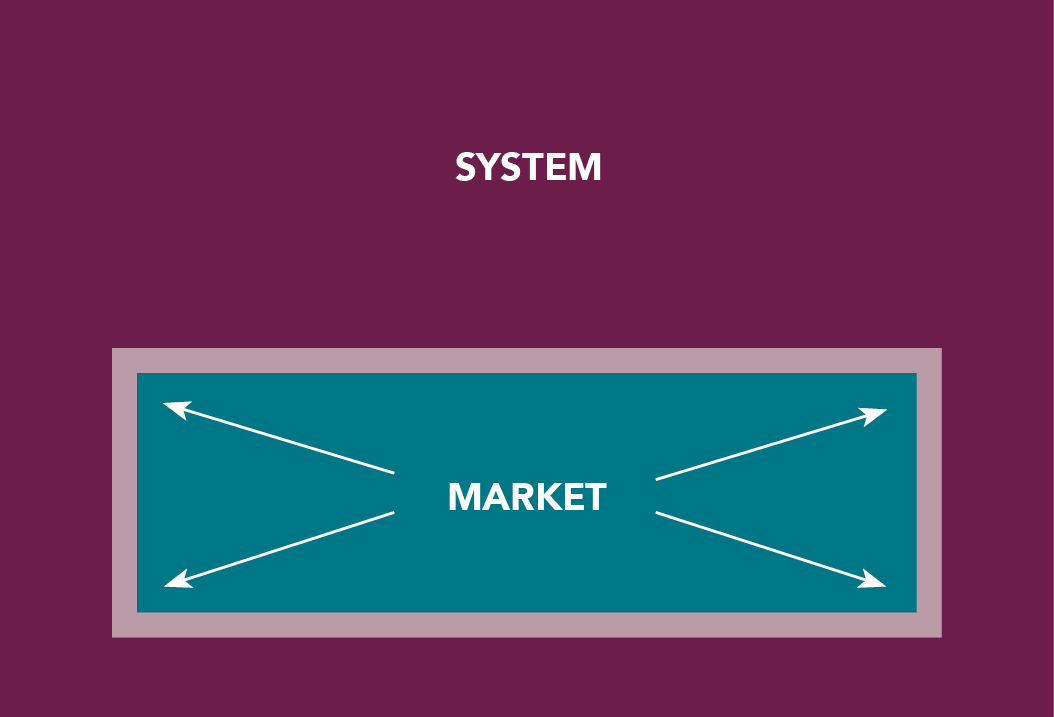 Education organizations sometimes have no choice but to compete to change the rules of a system in order to grow a market. Perhaps there is a legislated limit on growth, such as the cap on charter schools in Massachusetts. There can be disparities between different players in the market that create significant disadvantages to being competitive, such as disparities in per-pupil funding or access to facilities for charter schools. There can also be heavy costs of reporting and compliance, which increase transaction costs and create barriers to market entry (e.g., applying to be a registered apprenticeship program provider). Or, there can be a disparity in the amount organizations can charge for indirect costs and overhead.
None of these can be addressed through competition in the market — in fact, most of these rules are designed to limit competition, and they can be addressed only by competing to change the rules of a system.7
In some cases, such as school choice, vouchers, and education savings accounts, the Systemic Impact competition to change policy has an explicit goal of creating new markets (although, without clear, timely, accessible information on quality/value, these will not be competitive markets; they also will not be particularly good policy).
Stakeholders can use their market influence to influence the rules of a system, usually in a way to sustain or increase their competitive market advantage. Some stakeholders have strong market positions because they have a larger share of the market or have a strong brand and can use this to exercise influence on the rules of the market. They may also have relationships with or can organize the demand of buyers (e.g., students, parents, educational institutions) who can influence the market not only in where they choose to buy, but also in where they choose not to buy through boycotts.
However, influence can paradoxically also undermine a market if market power becomes too concentrated. Unchecked, a concentration of market power can lead to an oligopoly (a few stakeholders with significant or total control) or a monopoly (one stakeholder with significant or total control). These are commonly considered “market failures” because of their negative impact on the power of consumers in the market (individuals or institutions), though it should be noted that a monopoly is not a market failure to a monopolist. Breaking up monopolies or oligopolies is also achieved through competing to change the rules a system puts in place to govern a market — in these cases pursued by other stakeholders who believe a more competitive market would be in their interests and/or those of the broader social good.
Sometimes, competing in systems to change the rules that govern a market requires addressing existing inequitable market dynamics that have structurally advantaged some stakeholders and structurally disadvantaged others (e.g., education redlining, inequitable funding formulas, and access to resources like transportation).
Both Communities and Philanthropy Shape Markets and Systems
Community stakeholders (e.g., students, parents, teachers, and other individuals) also play a critical role in shaping both education markets and systems.
-
- Within markets addressing social needs (e.g., education), community stakeholders are the ultimate beneficiaries, though, unfortunately, their needs are not always sufficiently considered by other market players and the systems that govern those markets. Communities have been and often continue to be disenfranchised in the market. However, when they organize, communities can exercise market power collectively as consumers through the choices they make (assuming it is a market where they have the ability to make choices).
- Within systems that govern markets addressing social needs, community stakeholders can also exercise their innate power to influence changes in systems so that a market is designed to better meet their needs. Organizing to build movements can be a critical component, if not the main approach to executing a Systemic Impact campaign.
Philanthropy can also play a critical role in shaping both education markets and systems.
Within markets addressing social needs, philanthropy can play multiple roles:
-
- Philanthropy can define a market by funding new innovations — creating supply and demand.
- Philanthropy can influence an existing market by dictating who, what, and where it funds. The more a market and market stakeholders depend on philanthropy, the more influence philanthropy can exert.
- Philanthropy can disrupt an existing market when it chooses to exit the market without supporting a strategy that creates sustainable long-term funding, which can come from either systems or growing a consumer market.
Within systems that govern markets addressing social needs, philanthropy can also play multiple roles:
-
- Philanthropy can fund Systemic Impact via direct funding to organizations and building the capacity of those organizations to pursue Systemic Impact campaigns. Ideally, philanthropy has the funding fortitude to play the long game that Systemic Impact requires.
- Philanthropy can be an actor in Systemic Impact as an active stakeholder using its influence and the influence of its board and a foundation’s principals, along with its platform as a messenger, to directly influence a system.
When Does an Organization Compete in a Market Versus a System?
Sometimes, what is thought of as Systemic Impact is just good business development (e.g., securing more customers) and healthy competition in the market. This distinction matters because an organization’s strategy (its goals, priorities, actions, etc.) may be different if it is pursuing market growth via business development versus trying to influence a whole system via Systemic Impact.
How do leaders distinguish between when their organization is engaged in Systemic Impact to shape a market and when they are merely good at business development via healthy competition within a sector? Imagine, for example, a postsecondary advising organization and the following set of Systemic Impact hypotheticals.
1. The postsecondary advising organization wins a new contract to expand its advising for students in a community college system by demonstrating strong results.
This is an example of successful business development in a competitive market, not Systemic Impact: The advising organization delivers quantifiable value (perhaps through ongoing measurement and a randomized control trial evaluation indicating strong results) and is competitive relative to other investments (including other advising providers) the community college system may pursue to achieve student and/or financial results from increased student re-enrollment and persistence.
2. The postsecondary advising organization prevents a college campus from cutting funding for postsecondary advising. The advising organization identifies who has authority within the college to prevent these potential cuts and then launches a successful campaign to influence them to preserve funding, which may include actions such as promoting evidence of student outcomes and financial return on investment from advising, leveraging relationships with key stakeholders in the college, a media campaign, speaking at board meetings, and/or supporting students to organize and advocate for advising that they value.
This is an example of Systemic Impact to influence a market: The organization is competing to defend a policy that governs funding to maintain market demand for its services. Systemic Impact can, at times, include playing defense to keep an existing market condition in place.
3. The postsecondary advising organization influences a state college system to make postsecondary advising universally mandated and funded. The organization launches a campaign to influence those in authority to make advising a requirement of the system, and with funding for implementation.
This is an example of Systemic Impact to influence a market: The organization undertakes a campaign to successfully shift the rules of a system to require that all state colleges provide postsecondary advising (and allocates funding for it) — increasing the potential market for advising and therefore potential systemwide impact to the benefit of both this advising organization and other advising providers.
4. The postsecondary advising organization influences a state to mandate and exclusively fund that organization’s specific model of postsecondary persistence advising. The organization focuses its campaign on a state legislature to mandate advising for all colleges in that state and to ensure funding specifically supports only that advising organization’s program design (e.g., the dosage, format, and mix of talent/ technology). The organization’s Systemic Impact campaign is focused on both growing the market and giving itself a significant competitive advantage in the market relative to peer organizations with substantially different advising models.
This is an example of Systemic Impact to influence a market: The organization successfully changes policy to ensure that its specific model of postsecondary advising is the only one allowed and funded, effectively excluding others that approach advising differently. Some social ventures (e.g., tutoring, postsecondary advising, mentoring) compete in the same market but can have radically different models (e.g., different dosages, different formats) with radically different costs, price points, and outcomes. Systemic rules governing what the market can and cannot buy become a significant competitive advantage or disadvantage.
Not All Systemic Impact Is About Influencing a Market
Sometimes, Systemic Impact efforts are about getting existing systems to work better without seeking to change competitive dynamics. Building on the prior postsecondary advising hypothetical:
5. The postsecondary advising organization identifies challenges to student success leading to higher dropout rates within a college system and launches a campaign to influence the system to address these challenges. Through expansion, the organization serves more students and demonstrates the value of its model. It also observes that there are other obstacles separate from access to robust advising that prevent student success. This can include but is not limited to (a) other critical student needs (e.g., student needs around food, housing, tutoring, career services) or (b) where existing system policies (e.g., holds on registration because of an outstanding debt of any amount) or system practices (e.g., disconnects between the bursar and registrar) create significant challenges to student persistence and completion. The organization launches a Systemic Impact campaign that leverages these insights, its credibility and relationships with stakeholders within the system, a media campaign, and student advocacy to shift how the system operates, thereby removing these obstacles, meeting student needs, and improving their ability to succeed.
This is an example of Systemic Impact that does not involve changing a market: Improving cooperation between the bursar and registrar to eliminate an obstacle leading to students dropping out is about how to address a failure of how the system operates, not a failure in a marketplace where products/services are exchanged. The bursar and registrar are the only suppliers of what students are seeking as consumers. The change — if successfully made — benefits students; it is not about changing a competitive dynamic. Making more funding available for a critical need like food or housing insecurity is about benefiting students who face a need that is impeding their ability to succeed; it is not about changing competitive dynamics.
Whether Systemic Impact is or is not about influencing how a market operates may depend on the time frame involved. In this final hypothetical, these changes to systems are not about creating a more competitive market within a college. However, colleges themselves often exist in a competitive market, and these changes might make a college more successful and elevate its brand and national rankings, which could make it more compelling over the long term in the market competition for enrollment.
Infrastructure Exists Between Markets and Systems
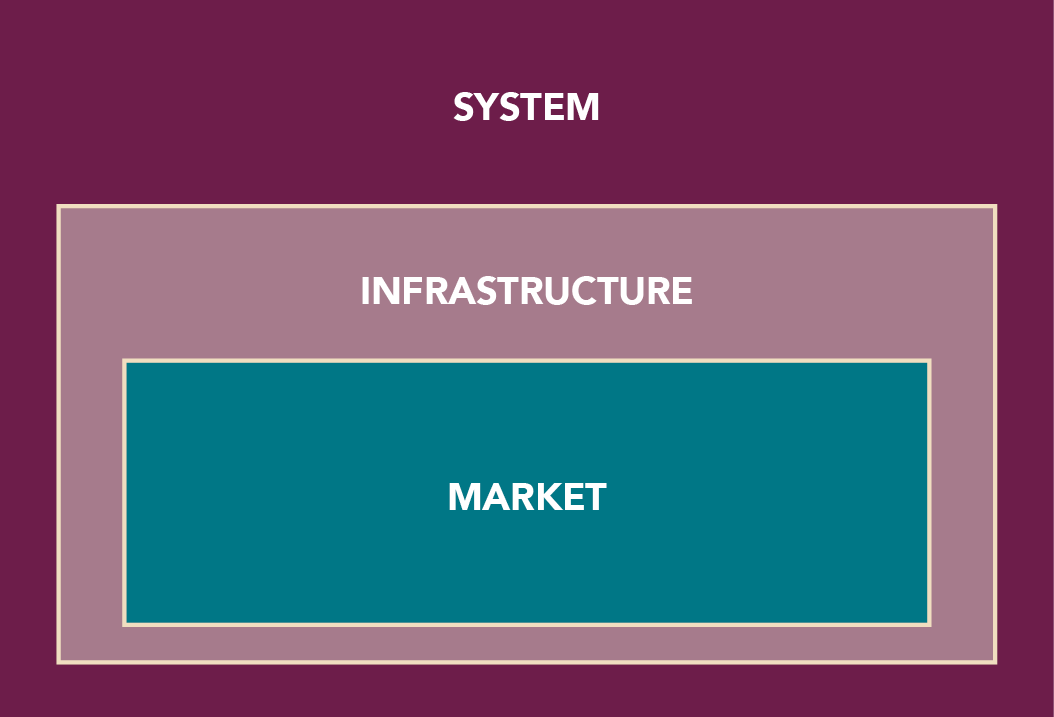
Between markets and systems, there can exist an interim layer, infrastructure, which reduces barriers and/or creates opportunities for a market to better function and grow by serving many or even all stakeholders in a market (i.e., it does not provide an advantage to just one stakeholder). Infrastructure can manifest in multiple ways, including:
- A common language or framework adapted by all stakeholders (e.g., a common lexicon of skills) that enables a market to work better. Without a common language, it is hard to communicate, cooperate, or conduct commerce.
- A mechanism to provide information about performance in a market of a product or service to enable everyone in that market to be able to make decisions and to help level the playing field of competition.
- An element of oversight or quality control, such as licensures or accreditation, though those can also become obstacles to market competition depending on how objectively the policies of licensure/accreditation are applied and the costs that they raise as a barrier to entering a market.
- A reduction in barriers to entry and participation in a market, through capacity-building and/or resources. This can include critical training (and may relate to the licensures previously mentioned) or providing tools to lower the cost of entry or create the ability for more stakeholders to enter a market. One of the many aspects of artificial intelligence (AI) to monitor is not only how it changes both supply and demand in a market, but how AI resources reduce the barriers for more stakeholders to compete in a market.
Infrastructure can be self-organized by stakeholders in the market, though systems that govern the market have to monitor when this self-organization is creating a stronger, more competitive market through collective action versus limiting the competitiveness of the market through collusion. Stakeholders in the market may also organize infrastructure (such as associations or guilds) because it builds their collective power to influence system policies.
Systems can also authorize and operate critical aspects of infrastructure to make a market function and be more competitive. For example, the federal government collects and administers the Integrated Postsecondary Education Data System and the College Scorecard as a set of data that provides some — albeit limited — information on what value pathways are conferring in terms of completion and economic indicators of value. Systems can also create and/ or fund third parties to implement the rules they have established to govern a market.
Some organizations may choose to explicitly position themselves as infrastructure — even if they are not competing in the market directly — to influence how the market operates.
For example, EdReports is the dominant infrastructure player in indicating the quality of K-12 high-quality instructional materials (HQIM). EdReports does not itself produce and deliver materials — it is not a provider in the HQIM market. However, district purchasing and philanthropic funding decisions are heavily influenced by its ratings, which both provide a critical data point in the market and also influence the market based on EdReports’ belief about what quality in the K-12 HQIM market should look like.
Another example is GreatSchools, which provides a national platform for the public (as well as nonprofits, for-profits, and policymakers) to access and act on crucial information on the performance of schools across a range of attributes. Well-functioning, competitive markets require information in value to enable stakeholders to make decisions. GreatSchools does not itself provide great K-12 schools, but it does provide information for parents and practitioners to make a local school marketplace operate better.
One twist: Becoming an infrastructure player may be the way some market players compete to have the market position they want and influence the market to operate the way they want it to.
Over time, some players in the market may attempt to move into more of an infrastructure role, although that line can be blurry. Returning to the example of postsecondary advising, an emerging number of advising organizations are not only directly running advising programs but also creating Widespread Impact models8 where they are taking a critical component of their advising model, like a software platform to manage advising, and selling that as a product to other advising organizations and institutions that provide advising (like colleges). In this example, the advising organization is providing a different product to compete in its current market to provide advising but also broadening the market (or playing in a separate market) by competing to sell its software platform to stakeholders with whom they otherwise compete in directly running advising programs (which also illustrates how competition and collaboration are not mutually exclusive).
However, at some tipping point where most or all stakeholders are adopting a common product or service (or are obligated to adopt a common product or service), that product or service becomes infrastructure — a ubiquitous component of a market.
Conclusion
Across the country, education organizations aspire to create value and leave a lasting impact within markets that are governed by systems. As such, education leaders must compete in markets to grow their scale, success, and sustainability. But they also cannot be passive actors as systems create rules about how those markets operate. Achieving a population-level ambition for impact means embracing a willingness and building the capability to compete in both.
- 1. Competition” and “cooperation/collaboration” are not mutually exclusive. Organizations can and often do come together to support each other — in order to be more competitive in what they are trying to achieve. In the nonprofit sector, organizations can cooperate and compete at the same time. ↩
- 2. John Kania, Mark Kramer, and Peter Senge, The Water of Systems Change (Foundation Strategy Group, 2018), https://www.fsg.org/resource/water_of_systems_change/. ↩
- 3. Alex Cortez and Christine Wade, A Pragmatic Playbook for Impact: Direct, Widespread, and Systemic (Bellwether, 2022), https://bellwether.org/publications/pragmatic-playbook-for-impact/. ↩
- 4. Conversation at convening, June 25, 2025. ↩
- 5. Alex Cortez, Michaela Gaziano, and Alexandria Smith, Best of Both Worlds: Teacher Apprenticeship Degrees (Bellwether, 2024), https://bellwether.org/publications/best-of-both-worlds/. ↩
- 6. Alex Cortez, “Beta by Bellwether: Admission,” presentation, May 2023, https://bellwether.org/wp-content/uploads/2023/05/AdmissionVirtualBriefing_BetaByBellwether_May2023.pdf; Stephen Burd et al., Decoding the Cost of College: The Case for Transparent Financial Aid Award Letters (New America, 2018), https://www.newamerica.org/education-policy/policy-papers/decoding-cost-college/. ↩
- 7. These are separate from natural challenges to succeeding in a market. Some market players may just not deliver competitive value (like a poor-performing school or curriculum), or they may face increased competition from new market entrants or major new substitutes, or they may face decreased demand — for example, shifts in consumer sentiment or, in the case of American education, a decline in high school graduates. However, it can be hard to know who the poor performers are without access to information in the marketplace. Without this, poor performers can still have significant influence. ↩
- 8. Cortez and Wade, Pragmatic Playbook. ↩
Acknowledgments
We would like to thank the many experts who shared their knowledge with us to inform our work, including interviewees for their time, insights, and expertise as well as the community of practice participants who contributed to this publication.
We would also like to thank our Bellwether colleagues Mark Baxter, Nick Lee, and Jennifer O’Neal Schiess for their input. Thank you to Amy Ribock, Kate Stein, Andy Jacob, McKenzie Maxson, Temim Fruchter, Julie Nguyen, and Amber Walker for shepherding and disseminating this work, and to Super Copy Editors.
The contributions of these individuals and entities significantly enhanced our work; however, any errors in fact or analysis remain the responsibility of the authors.
About the Authors

ALEX CORTEZ

CHRISTINE WADE

KATELAND BEALS

Bellwether is a national nonprofit that works to transform education to ensure young people — especially those furthest from opportunity — achieve outcomes that lead to fulfilling lives and flourishing communities. Founded in 2010, we help mission-driven partners accelerate their impact, inform and influence policy and program design, and bring leaders together to drive change on education’s most pressing challenges. For more, visit bellwether.org.
This report carries a Creative Commons license, which permits noncommercial reuse of content when proper attribution is provided. This means you are free to copy, display, and distribute this work, or include content from this report in derivative works, under the following conditions:
Attribution. You must clearly attribute the work to Bellwether and provide a link back to the publication at www.bellwether.org.
Noncommercial. You may not use this work for commercial purposes without explicit prior permission from Bellwether.
Share Alike. If you alter, transform, or build upon this work, you may distribute the resulting work only under a license identical to this one. For the full legal code of this Creative Commons license, please visit www.creativecommons.org.
If you have any questions about citing or reusing Bellwether content, please contact us.
