
Building for Fewer Students
Rethinking State K-12 School Facilities Funding and Policy in an Era of Declining Enrollment
Overview
As K-12 public school enrollment continues to decline, district leaders across the United States will increasingly face a difficult balancing act: needing to modernize their aging facilities while considering whether to close some of them.1 Earlier this year, the School District of Philadelphia announced that it is both closing 17 schools and investing $3 billion in school capital projects as part of a 10-year facilities master plan.2 Houston Independent School District has faced similar pressures, moving to close a dozen campuses in response to demographic shifts and to prioritize capital improvements in its remaining facilities.3 Aging infrastructure and declining enrollment are creating a complex set of challenges for district and state leaders. How leaders respond within districts, across districts, and at the state level will shape students’ learning environments for decades to come.
Even as enrollment declines and districts need fewer classrooms, they still need safe, high-quality facilities for students. However, declining enrollment can make it more challenging for districts to build and maintain these facilities. As enrollment falls, districts face higher per-pupil facilities costs because borrowing and maintenance costs remain fixed. Districts facing declining enrollment must also make difficult decisions about pursuing major capital investments while weighing staffing reductions, school closures, and, in some cases, district consolidations. At the same time, those districts may have less access to state support because most state facilities funding systems are better designed to address overcrowding than declining enrollment.
As more districts serve fewer students and operate underused buildings, state policymakers will need to consider whether existing facilities funding systems can support safe, high-quality learning environments. State leaders can help districts navigate these challenges by:
- Improving monitoring of facility needs, quality, and usage.
- Aligning state facilities funding systems with enrollment realities.
- Helping districts adapt their facilities portfolios to changing enrollment levels.
State funding systems have long faced challenges in adequately and equitably supporting public school facilities. In 2020, the U.S. Government Accountability Office estimated that more than half of public school districts need to update or replace multiple building systems or features in their schools.4 Declining enrollment has not eliminated this need, but it is reshaping the challenge districts face in maintaining and modernizing their school facilities. In response, state leaders must similarly reshape how they support districts in maintaining and modernizing the schools they need while consolidating or repurposing facilities they no longer require.
Why Should States Invest in High-Quality School Facilities?
Access to safe, high-quality learning environments can contribute to better student academic and health outcomes. From the air students breathe to the equipment they can use, school facilities set the foundation for productive classrooms in which all students have an opportunity to thrive. Amid rising school construction costs and evolving needs for school facilities, state policymakers can play a key role in ensuring all students have access to effective, healthy learning environments.
High-quality school facilities can improve student outcomes.
Some researchers investigating school capital investments have found that spending improves student outcomes,5 with others finding limited or no discernible effects.6 In 2025, a comprehensive study spanning 29 states found that increased capital spending improves student achievement on average, with larger effects in lower-income districts and for investments in core building infrastructure, such as HVAC systems and classroom space.7 These findings align with a broader body of research connecting the quality of learning environments to student outcomes.8 Given the importance of high-quality learning environments to students, state governments have a consequential role to play in supporting school infrastructure to fulfill their constitutional obligations to provide all students access to a public education.9
Widespread school infrastructure needs limit access to high-quality facilities.
U.S. public schools require substantial investment to ensure all students have access to safe and effective learning environments.10 A recent national survey of U.S. public schools estimated that the average school building is 49 years old — meaning that most buildings date back to an era before federal accessibility requirements and a time when asbestos and lead were standard construction materials.11 Another national survey estimated that a majority of districts need to update or replace major building systems, including 41% of districts that require HVAC updates in more than half their schools.12Districts with larger populations of students from low-income households frequently have greater facility needs.13 Collectively, these facility needs contribute to an estimated $85 billion annual gap between what districts spend and what is needed to adequately maintain and modernize existing school facilities.14
Unmet facility needs are compounded by new demands on school buildings.
As school buildings have aged, they have also had to respond to evolving student needs, school safety concerns, and climate change. Between 2013 and 2021, public school enrollment for students with disabilities and English learner students increased — even as overall enrollment declined.15These shifts have increased the need for accessible facilities equipped with adequate spaces for small-group and one-on-one instruction.16 At the same time, growing school safety concerns have created new demands for school facilities. The prevalence of mass shootings in U.S. public schools has spurred the need for districts to improve campus security systems and access points.17 Climate-related risks are creating another set of facility safety demands. In recent years, climate change has increased the frequency of dangerous heat waves, wildfires, floods, and cold snaps. These events have made it imperative that public schools be climate-resilient and equipped with modern HVAC systems.18
Rising school construction costs intensify growing facility challenges.
The cost of school construction has increased substantially since 2021 (Figure 1). Each month, the U.S. Bureau of Labor Statistics monitors changes in output prices for new K-12 school construction using a measure known as the Producer Price Index (PPI) for New School Building Construction.19 Between 2012 and 2020, this measure largely trended with general U.S. inflation via the Consumer Price Index (CPI) for All Items. However, the cost of new school construction grew by approximately 29% between January 2021 and January 2024, far outpacing general inflation (18%) over the same period. Labor shortages, supply chain disruptions, tariffs, rising energy costs, and elevated interest rates have made school construction more costly for districts.20
FIGURE 1: COST OF NEW SCHOOL BUILDING CONSTRUCTION COMPARED WITH GENERAL INFLATION OVER TIME
These rapid, unanticipated increases in school construction costs have posed challenges for district and state leaders seeking to modernize their facilities. In 2022, voters in Warwick, Rhode Island, approved $350 million in borrowing to rebuild two high schools. However, unexpected costs and delays forced district leaders to seek an additional $50 million in borrowing for the projects, which voters rejected in 2026.21 At the state level, legislators in California, Idaho, Massachusetts, Ohio, and Washington have responded by securing additional funds for new and ongoing school facility projects.22
As public school enrollment declines, these existing and compounding facility challenges will persist. State policymakers must work to ensure that all students experience the benefits of safe, healthy, and effective learning environments, and they must justify investments in school facilities to taxpayers, even as districts serve fewer students and have fewer buildings. In some communities, doing so will require concentrating modernization investments in fewer schools while consolidating, closing, or repurposing underused buildings. In other communities, district-level consolidations may offer a way to reduce costs and achieve economies of scale while preserving or expanding the learning opportunities available to students.
How Do Governments Fund School Facilities?
Local and state governments provide support for public school facilities through capital investments and routine maintenance, while the federal government plays a more limited role (Table 1). Local governments cover the vast majority of public school capital expenditures (80% between school year [SY] 2013-14 and SY22-23), relying heavily on property taxes and borrowing to finance projects.23 Through grant appropriations and financing support, state governments provided 17% of public school capital expenditures over the same period.24 The federal government plays a limited role by providing tax relief that makes it easier for local and state governments to finance capital projects.25 Overall, the heavy reliance on local funding means districts bear much of the responsibility for navigating facility challenges as enrollment declines.
Across these funding sources, U.S. public school districts reported spending $104 billion on capital projects and $77 billion on facilities operations and maintenance in SY23-24, together accounting for 20% of all education spending (Figure 2).26
TABLE 1: KEY K-12 FACILITIES EXPENDITURE CATEGORIES
| Expenditure Category | Amount in SY23-24 | District Example |
| Capital Outlay Expenditures: Funding used to construct a new facility, expand or renovate a building, purchase major equipment, or acquire land. | $2,200 per pupil in U.S. public schools. | In 2024, Oak Park and River Forest High School (Illinois) began a $102 million project to build a new physical education wing equipped with training facilities, locker rooms, multipurpose spaces, and a pool. |
| Operations and Maintenance Expenditures: Funding used for building utilities, grounds maintenance, security, and other repairs to existing structures and equipment. | $1,700 per pupil in U.S. public schools. | In SY23-24, Topeka Public Schools (Kansas) spent $560,000 on heating and $400,000 on repairs and maintenance. |
Sources: Institute of Education Sciences, “Documentation for the NCES Common Core of Data School District Finance Survey,” 2025; National Center on School Infrastructure, “Interactive Data Dashboard on Public School Facilities Funding,” 2025; Oak Park and River Forest High School, “Project 2 Dashboard,” 2026; Topeka Public Schools, “District Budget 2025-2026,” 2025.
FIGURE 2: CAPITAL OUTLAY, OPERATIONS, AND MAINTENANCE EXPENDITURES, SCHOOL YEAR 2023-24
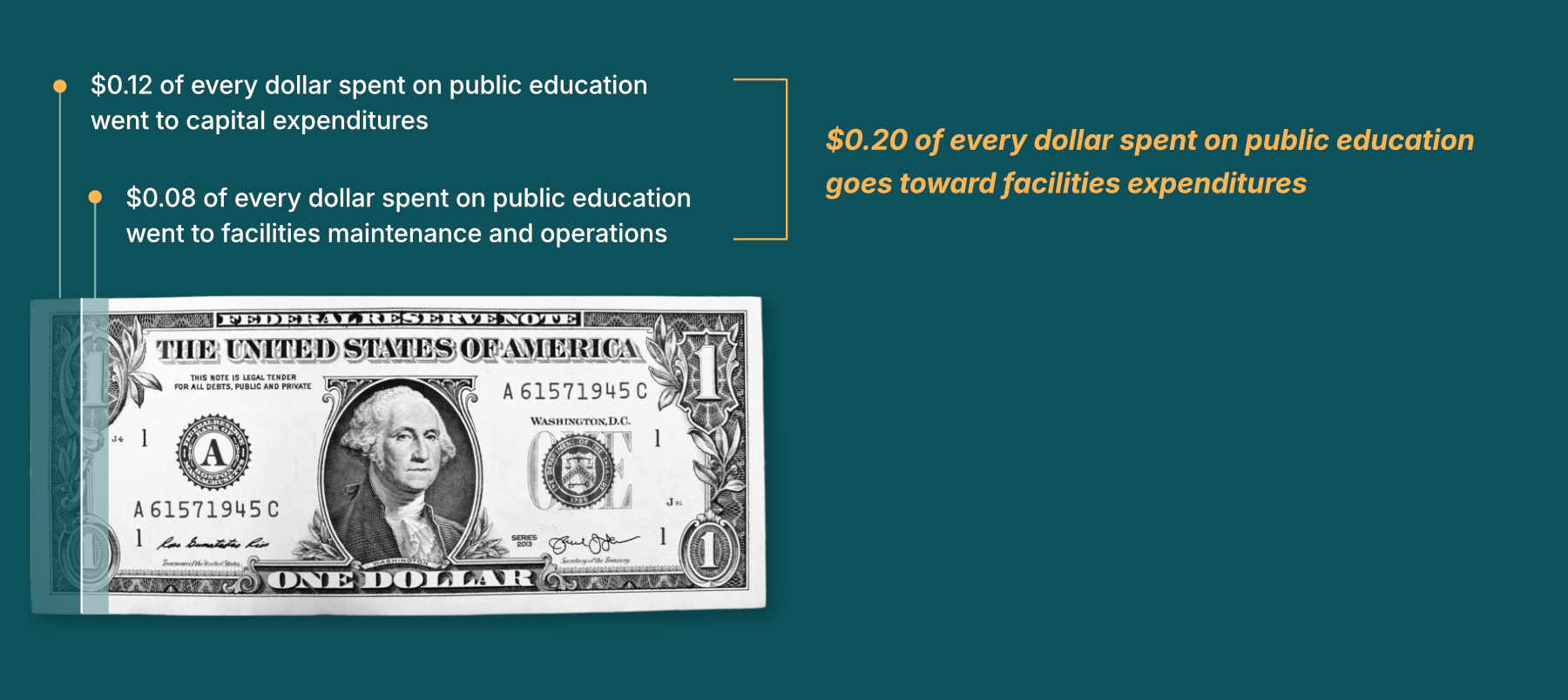
Sources: National Center on School Infrastructure, “Interactive Data Dashboard on Public School Facilities Funding,” 2025; U.S. Census Bureau, “2024 Public Elementary-Secondary Education Finance Data,” 2026.
FIGURE 3: TOTAL PUBLIC SCHOOL DISTRICT CAPITAL OUTLAY EXPENDITURES OVER TIME, NATIONALLY AND BY STATE
Notes: Figure 3 displays total inflation-adjusted district capital outlay expenditures based on the National Center on School Infrastructure’s analysis of the National Center for Education Statistics (NCES) Common Core of Data School District Finance Survey (F-33). Due to state and federal reporting inconsistencies, these data may not fully capture districts’ capital outlay expenditures. The Great Recession took place from December 2007 to June 2009. The COVID-19 Recession took place from February 2020 to April 2020. Sources: National Center on School Infrastructure, “Interactive Data Dashboard on Public School Facilities Funding,” 2025; National Bureau of Economic Research, “US Business Cycle Expansions and Contractions,” last updated March 14, 2023.
Local taxpayers provide the majority of funding for school facilities.
In the U.S., local education agencies (LEAs) have the primary responsibility for modernizing and maintaining their school facilities and rely heavily on property taxes to do so.28 Local governments provide more than three-quarters of public school capital outlays on average, though this share varies depending on state and district context.29 This predominant reliance on local funding contributes to inequities among districts in school facility investment and quality based on differences in local wealth.30 When LEAs need to raise additional revenue for capital projects, they frequently borrow money by issuing bonds to investors or obtaining a loan from a financing institution.31 Charter schools face a different facilities financing landscape (Sidebar).
SIDEBAR
How Do Governments Fund Charter School Facilities?
Because charter school LEAs cannot levy taxes or issue general obligation bonds to pay for facilities construction, they cannot access the same low-cost, tax-supported financing options available to traditional public schools. Instead, charter LEAs rely on private financing, philanthropic funding, and operating funds to acquire, construct, or renovate their facilities.32
Recognizing these challenges, some state governments will provide charter LEAs with dedicated facilities funding, financing options that lower borrowing costs, or preferential access to vacant school buildings. Charter schools nevertheless face substantial fiscal challenges in obtaining, maintaining, and modernizing their facilities.33
Typically, LEAs must raise taxes to repay this borrowing over time. For example, Des Moines Public Schools in Iowa recently raised property taxes through a temporary levy to support the issuance of $265 million in municipal bonds to fund its “Reimagining Education” facilities plan.34Additionally, a large majority of states require that voters approve local bonds before issuing debt.35 In fall 2025, 74% of Des Moines voters approved the borrowing in support of their district’s Reimagining Education plan.36
Each year, local school districts will pay off this borrowing by retiring the principal value of long-term debt and paying additional interest to lenders (Table 2). U.S. school districts collectively held $570 billion ($12,330 per pupil) in long-term debt at the end of SY23-24.37 As enrollment declines and these debt obligations remain fixed, per-pupil interest and debt retirement expenditures will rise.
TABLE 2: KEY SCHOOL DEBT EXPENDITURE CATEGORIES
| Expenditure Category | Amount in SY23-24 |
| Long-Term Debt Retirement Expenditures: Funding used to pay off the par value of long-term debt by repayment or exchange. Includes borrowing for capital projects and other purposes. | $900 per pupil in U.S. public schools. |
| Interest Expenditures: Funding used to pay interest on short- or long-term debt. Includes interest on borrowing for capital projects and other purposes. | $500 per pupil in U.S. public schools. |
State funding for school facility investments varies widely.
There is large variation in how, and to what extent, state governments provide funding for public school facilities.38 In SY23-24, state governments reported providing $219 in per-pupil revenue to support districts in making capital outlay expenditures. Wyoming spent the most per pupil of any state government, while 15 states reported providing no dedicated revenue for school construction and building aid in SY23-24 (Figure 4).
FIGURE 4: PER-PUPIL STATE REVENUE FOR K-12 CAPITAL OUTLAY EXPENDITURES, SCHOOL YEAR 2023-24
Typically, state governments will support school facilities capital projects by appropriating funds or providing financing assistance (Table 3). The state entities that oversee the allocation of these resources must prioritize which projects to support and frequently provide technical assistance to districts undergoing modernization projects. For example, the Massachusetts School Building Authority reviews project applications, reimburses districts for a share of project costs, and provides tailored guidance throughout a nine-step timeline.39 These entities may consider facility quality, local wealth, enrollment trends, and other factors when determining which projects to prioritize for state funding support.40 In Kansas, the State Board of Education lists supporting districts with “enrollment growth and imminent overcrowding” as its second-highest priority when evaluating project applications.41 These state priorities can shape whether declining-enrollment districts receive funding for needed facility modernization projects, even without experiencing overcrowding or enrollment growth.
TABLE 3: STATE FACILITIES FUNDING APPROACHES FOR LEAs
| Funding Approach | State Examples |
| Appropriations: 38 states provide grants or issue reimbursements to LEAs for school capital projects. |
Georgia offers capital funding grants to LEAs for projects in their facilities master plans. Maryland appropriates capital improvement funding based on a formula that considers projected enrollment, student demographics, and other factors. |
| Financing: 35 states and the District of Columbia extend loans, issue bonds, or offer credit enhancements to LEAs for school capital projects. |
Michigan issues bonds to raise money to provide loans or credit enhancements to LEAs engaging in school capital projects. New Hampshire guarantees the bonds issued by LEAs for school capital projects, thereby lowering the cost of borrowing for districts. |
| No Dedicated Support: Five states do not provide dedicated financial assistance for school capital projects. | Iowa, Louisiana, Nebraska, Tennessee, and Wisconsin lack codified financial assistance programs dedicated to supporting public school capital projects. |
The federal government provides limited funding for school facilities.
The federal government plays a limited role in funding public school facilities. Between SY13-14 and SY22-23, the federal government covered just 3% of capital construction and equipment expenditures, largely through a number of smaller, targeted grant programs.42 The federal government also provides emergency funds to repair schools damaged by natural disasters and has included school infrastructure as a small component of broader economic recovery efforts.43
The federal government provides relief to state and local governments financing school facilities projects through a different vehicle: the U.S. tax code. The federal government exempts interest generated on state and local school construction bonds from the federal income tax.44 This exemption allows local and state governments to issue bonds with lower interest rates while still providing competitive returns to investors.45
How Does Enrollment Decline Affect State Facilities Funding?
Across the country, public K-12 school enrollment has declined in recent years and is expected to continue declining through at least fall 2031.46 These shifts are changing the facilities challenges districts face and the types of support they may need from state governments. As more districts serve fewer students and operate underused buildings, state policymakers will need to consider how existing facilities funding systems can continue to support safe, high-quality learning environments.
MORE ON DECLINING ENROLLMENT
For more on how declining enrollment is reshaping the K-12 landscape, read How Student Enrollment Declines Are Affecting Education Budgets, Explained in 10 Figures.
For more on declining enrollment in U.S. public schools, visit Bellwether’s Declining Enrollment resource library.
Public school enrollment is declining across most of the country.
Between fall 2019 and fall 2024, U.S. public school enrollment decreased by 1.4 million students (2.8%) to its lowest level in 15 years (Figure 5).47 NCES estimates that 40 states and the District of Columbia will experience enrollment declines between 2022 and 2031.48 Although many factors shape enrollment trends in individual districts, the national decline in public school enrollment is primarily driven by a reduction in the U.S. birth rate. Between 2012 and 2024, the national birth rate decreased by 15%, reducing the size of the school-age population.49 Additionally, the expansion of school choice options, trends in interstate migration, and federal immigration policies have affected public school enrollment patterns.50 As public school enrollment declines, school districts will face mounting budgetary pressures to reduce staffing, cut programming, merge with neighboring districts, or consolidate under-enrolled campuses.51
Although data on facilities utilization rates are limited, districts experiencing enrollment decline have more empty desks and classrooms. Earlier this year, a report found that the Ithaca City School District in New York is operating its elementary schools at 50%-60% capacity due to enrollment decline, reflecting “significant underutilization across most buildings.” 52 This facilities underutilization creates financial, political, and operational obstacles for districts seeking to maintain and improve their facilities portfolios.
FIGURE 5: TOTAL U.S. PUBLIC SCHOOL ENROLLMENT AND PROJECTED ENROLLMENT OVER TIME
Enrollment decline poses challenges for school facilities funding systems.
Declining enrollment poses three fundamental challenges for districts seeking to maintain or modernize their school campuses. First, many facility costs remain fixed even as enrollment falls, increasing per-pupil costs and placing additional pressure on district budgets. Second, excess building capacity, budget pressures, and potential school closures can weaken support for major capital projects and make local funding more difficult to secure. Third, many state funding systems are designed to prioritize capital projects in districts with increasing enrollment, which warrants the attention of state policymakers as a growing number of districts experience enrollment losses.
Per-pupil facilities costs can increase as enrollment declines.
Regardless of student enrollment levels, each year school districts must cover the fixed costs of maintaining their facilities and paying off borrowing used to finance capital projects. Even with fewer students, districts still need to provide security, maintain their cafeterias, and otherwise sustain their facilities assets. Likewise, districts that borrow to finance a capital project are locked into annual debt payments for decades as enrollment fluctuates.
As enrollment declines and these fixed costs persist, the per-pupil costs of facilities maintenance and debt interest will rise (Figure 6). These elevated per-pupil costs place strain on local budgets, making it difficult to adequately maintain existing facilities, modernize outdated spaces, and cover the annual operating budget. In SY22-23, districts across the country that experienced enrollment declines of 5% or more over the prior decade spent $1,770 per pupil on facilities operations and maintenance, as compared with $1,300 in districts that experienced enrollment growth of at least 5%.53
FIGURE 6: PER-PUPIL DEBT INTEREST EXPENDITURES IN AUSTIN INDEPENDENT SCHOOL DISTRICT, TEXAS
As enrollment declines and borrowing costs remain constant, per-pupil spending on debt interest rises.

Source: Bellwether, edfinr tool.
Declining enrollment can weaken support for school capital projects.
With enrollment declining, school districts are less likely to have overcrowded facilities, which reduces the urgency for school capital projects. Throughout the 2000s and 2010s, many school districts needed to expand their facility capacity to accommodate a growing student population.54 In 2015, Clark County School District in Nevada undertook a $4 billion effort to build 37 new schools and renovate additional facilities after its enrollment grew by 11% between fall 2005 and fall 2015.55
However, as enrollment has declined in recent years, school districts no longer have the same pressure to expand and remodel their facilities. Today, Clark County is exploring school closures and consolidations after its enrollment decreased by 11% between fall 2015 and fall 2025.56
Enrollment declines may also make it more challenging for districts to garner political support for school capital projects. If enrollment-driven budget pressures have forced districts to close schools and reduce staffing, district leaders and voters may refrain from approving necessary but expensive school capital projects. In 2025, Orange County Public Schools in Florida announced it would pause new construction due to enrollment decline and amid cuts to the district’s operating budget.57 With enrollment declining and construction costs rising, voter approval of school construction projects has waned in some areas in recent years.58 At the same time, some districts are trying to persuade stakeholders to support joint modernization and consolidation efforts. Greater Albany Public Schools in Oregon has convened a community-based Long Range Facility Advisory Committee to simultaneously develop bond proposals and consolidation options in response to enrollment decline.59
Many state funding systems are better equipped to support growing districts.
State facilities funding systems are often designed to prioritize supporting projects in districts with overcrowding and enrollment growth, meaning that districts experiencing enrollment decline may have less access to state funding. For example, the Rhode Island Council on Elementary and Secondary Education lists “elimination of existing or prevention of severe overcrowding” as a top evaluation criterion for its project application review process.60 Likewise, Maryland has a capital grant program dedicated to supporting districts experiencing “significant enrollment growth” or districts with a “significant number of relocatable classrooms.”61 These mechanisms prioritize state funds where they will help the most students, but can leave districts experiencing enrollment decline with less support to modernize their facilities.
States can better align facilities funding with declining enrollment by incentivizing districts to combine individual schools into fewer buildings or by supporting mergers among neighboring districts. As of 2023, 18 states provided financial incentives for district consolidation, although many of these incentives are relatively modest.62Through temporary funding protections, formula adjustments, or priority within existing facility programs, states can help districts with fewer students merge and offer economies of scale.63 For example, as part of its project review process, the Ohio School Facilities Construction Commission gives first priority to districts that have recently consolidated.64
Far fewer states provide incentives tied specifically to the consolidation of individual schools or school buildings. These incentives can be particularly helpful for districts experiencing declining enrollment seeking to modernize their facilities. As of 2023, just four states — Georgia, Maine, North Carolina, and Vermont — provide financial incentives for school consolidation.65 For example, Georgia provides state capital funding “to consolidate educational facilities which have fewer pupils than required for the minimum school population […] or which are too expensive to renovate or modernize,” including for new construction, additions, and renovations.66 These types of policies can ensure that school districts modernize their facilities in financially sustainable ways and help consolidated schools accommodate new configurations of students.
How Should State Leaders Respond to School Facility Challenges Amid Declining Enrollment?
Although declining enrollment creates significant fiscal and facilities challenges, state leaders have several options for better supporting districts. Depending on their unique context and available resources, state leaders can pursue changes ranging from modest adjustments to substantial reforms to their facilities planning, implementation, and funding systems.
APPROACH 1
Improve Monitoring of Facility Needs, Quality, and Usage
To holistically oversee districts’ K-12 facilities, state leaders need comprehensive information on the quality, capacity, and utilization of school buildings. Equipped with this facility usage and quality data, state leaders can help appropriately prioritize modernization projects, better support district and school consolidations, and assist districts in repurposing underutilized spaces. Having a deeper understanding of districts’ facilities assets and projected enrollment trends will grow increasingly important as public school enrollment continues to decline. Specifically, state policymakers should consider:
- Routinely monitoring statewide facility conditions to more methodically identify maintenance needs, environmental risks, and modernization opportunities in districts experiencing enrollment growth, stability, and decline. Oregon’s Department of Education conducts facility conditions assessments for all school buildings in the state to catalog deferred maintenance and provide districts with cost estimates.67
- Assisting districts in developing long-term enrollment projections to track facility utilization rates and understand the excess capacity created by enrollment decline. Florida’s Office of Economic and Demographic Research meets twice annually to develop five-year district-level enrollment forecasts that equip LEAs to plan ahead.68
- Making facility condition, enrollment, and utilization data publicly accessible to improve transparency and establish a common factual basis for the size and design of state facility investments. Vermont’s Agency of Education maintains a School Facilities Dashboard Explorer that provides two decades of projected facilities condition data for all of the state’s public schools.69
- Developing statewide or regional facilities master plans to holistically assess a region’s facilities needs and surface potential opportunities for district consolidations. Maine’s Governor’s Commission on School Construction recently recommended that state officials conduct rolling in-person assessments of school conditions to inform the development of a statewide facilities master plan.70
APPROACH 2
Align State Facilities Funding Systems With Enrollment Realities
Many state facility funding systems were designed to support enrollment growth, making it challenging for districts experiencing enrollment decline to maintain or modernize their facilities. As public school enrollment continues to decline, state school finance systems must adapt to support improvements to existing facilities, not just the construction of new ones. To support modernization across enrollment contexts, state leaders may consider:
- Increasing state funding for K-12 school facility modernization to help districts overcome rising per-pupil construction, debt service, and maintenance costs as schools continue to deteriorate in condition, evolve in function, and serve fewer students. Michigan’s Department of Education awarded $75 million in “consolidation grants” to three districts to help them renovate consolidated schools and improve programming.71
- Appropriating funding based on districtwide and regional facility capacity, rather than assessing the utilization of an individual school in isolation. Washington’s School Construction Assistance Program provides facilities funding based on a formula that considers overall district capacity and projected enrollment, among other factors.72
- Requiring districts to develop multiyear facilities master plans to be eligible for state funding for school facilities projects — ensuring schools are prepared for future enrollment levels. California requires school districts to submit a five-year facilities master plan that examines existing classroom capacity, projected enrollment growth, and financing needs as a condition of participation in the state’s School Facility Program.73
- Providing financial incentives for capital projects related to school or district consolidation to assist local leaders in transitioning to lower enrollment realities by consolidating underutilized schools. New York will provide an estimated $5.6 million in “reorganization incentive building aid” to support approved building projects undergoing consolidations in SY26-27.74
APPROACH 3
Help Districts Adapt Their Facilities Portfolios to Changing Enrollment Levels
As school districts adjust their facilities portfolios to match new enrollment realities, state leaders should consider providing technical assistance to aid districts in navigating difficult choices. Specifically, state leaders can assist districts in redistricting, consolidating, or repurposing their schools to position them for long-term sustainability. State leaders should consider:
- Assisting districts in redrawing attendance boundaries to respond to shifting population trends and optimize student distribution across campuses. Ohio’s Facilities Construction Commission offers geographic information system mapping and demographic research as part of its district-level enrollment projections to help districts optimize school zones.75
- Encouraging districts to design adaptable facilities so that buildings can expand, contract, or accommodate different uses as enrollment changes over their long lifespans. Arkansas’ Department of Education has published guidance encouraging districts to design “flexible and adaptable” facilities that can add or close off building wings in response to changing enrollment levels.76
- Requiring districts to refine their academic and programmatic offerings as their facilities footprint shrinks to build smaller, stronger, and safer schools. New Mexico’s Public School Facilities Authority requires districts to outline their educational program and structure when developing their facilities master plans — helping districts sharpen their academic offerings.77
- Supporting districts in repurposing, leasing, or selling underutilized property by providing technical assistance and removing regulatory barriers to adaptive reuse and community development.78 California state lawmakers have made it easier for LEAs to build educator workforce housing on closed campuses and vacant parcels.79
Conclusion
As public school enrollment continues to decline across the country, districts will need to make difficult choices about which school buildings to maintain, modernize, consolidate, repurpose, or close while ensuring that declining enrollment does not reduce students’ access to high-quality learning environments. State leaders can play a central role in helping districts navigate these facilities pressures and the trade-offs they create.
States will approach this challenge from different starting points. Some states already play a major role in funding, planning, and overseeing school facilities investments, while others provide much more limited support. The varying roles states play in school facilities should shape how leaders respond, with options ranging from modest policy adjustments to more substantial reforms to facilities funding and technical assistance. By supporting districts through the facilities challenges posed by declining enrollment, state leaders can ensure that generations of students will learn in healthy, vibrant environments.
MORE FROM BELLWETHER
- Splitting the Bill #12: How Do States Fund School Facilities?
- How Student Enrollment Declines Are Affecting Education Budgets, Explained in 10 Figures
- Declining Enrollment in America’s Public Schools: How States Can Respond Strategically
- Declining Enrollment Is Leading to School Closures. How Can Districts Limit the Harm to Their Most Vulnerable Students?
- Investing in California’s School Facilities: How Local General Obligation Bonds Shape Student Outcomes
- Systems Under Strain: Warning Signs Pointing Toward a Rise in School Closures
Acknowledgments, About the Authors, About Bellwether
Acknowledgments
We would like to thank the many experts who gave their time and shared their knowledge with us to inform our work, including Kristin Blagg, Paulette Bonneau, Nancy Chaires Espinoza, Blake Cullimore, Michael Elliott, Mary Filardo, Sara Hinkley, Elliott Nguyen, and Jeff Vincent. Thank you also to the Walton Family Foundation for its financial support of this project.
We would also like to thank our Bellwether colleagues Bonnie O’Keefe, Carrie Hahnel, Krista Kaput, and Alex Spurrier for their input and Dwan Dube for her support. Thank you to Amy Ribock, Kate Stein, Andy Jacob, McKenzie Maxson, Esta Sherr, Temim Fruchter, Julie Nguyen, and Amber Walker for shepherding and disseminating this work, and to Super Copy Editors.
The contributions of these individuals and entities significantly enhanced our work; however, any errors in fact or analysis remain the responsibility of the authors.
About the Authors


PAUL BEACH

Bellwether is a national nonprofit that works to transform education to ensure young people — especially those furthest from opportunity — achieve outcomes that lead to fulfilling lives and flourishing communities. Founded in 2010, we help mission-driven partners accelerate their impact, inform and influence policy and program design, and bring leaders together to drive change on education’s most pressing challenges. For more, visit bellwether.org.
This report carries a Creative Commons license, which permits noncommercial reuse of content when proper attribution is provided. This means you are free to copy, display, and distribute this work, or include content from this report in derivative works, under the following conditions:
Attribution. You must clearly attribute the work to Bellwether and provide a link back to the publication at www.bellwether.org.
Noncommercial. You may not use this work for commercial purposes without explicit prior permission from Bellwether.
Share Alike. If you alter, transform, or build upon this work, you may distribute the resulting work only under a license identical to this one. For the full legal code of this Creative Commons license, please visit www.creativecommons.org.
If you have any questions about citing or reusing Bellwether content, please contact us.
- 1. This publication focuses on the challenges that traditional public school districts face in modernizing their school facilities amid declining enrollment. As described in this piece, charter schools also face distinct hardships when building and maintaining their facilities. ↩
- 2. “Board of Education Approves Accelerating Opportunity: The School District of Philadelphia Facilities Master Plan,” School District of Philadelphia, April 30, 2026, https://www.philasd.org/blog/2026/04/30/acceleratingoppvote/. ↩
- 3. “HISD Moves Forward with School Closures to Address Underutilization and Sustain Progress,” Houston ISD, February 27, 2026, https://hisdnow.houstonisd.org/p/~board/district-news/post/hisd-moves-forward-with-school-closures-to-address-underutilization-and-sustain-progres. ↩
- 4. School Districts Frequently Identified Multiple Building Systems Needing Updates or Replacement (Washington, D.C.: U.S. Government Accountability Office, 2020), https://www.gao.gov/assets/gao-20-494.pdf. ↩
- 5. Paul Beach and Sophie Zamarripa, Investing in California’s School Facilities (Bellwether and California School Facilities Research Institute, March 2026), https://californiaschoolfacilitiesresearchinstitute.com/wp-content/uploads/2026/02/2026-02-24_investing-in-californias-school-facilities_final-report.pdf; Hong Kai and Ron Zimmer, “Does Investing in School Capital Infrastructure Improve Student Achievement?,” Economics of Education Review 53 (August 2016), 143–158, https://www.sciencedirect.com/science/article/abs/pii/S0272775716302813. ↩
- 6. Paco Martorell, Kevin Stange, and Isaac McFarlin Jr., “Investing in Schools: Capital Spending, Facility Conditions, and Student Achievement,” Journal of Public Economics 140 (August 2016): 13–29, https://www.sciencedirect.com/science/article/abs/pii/S0047272716300470?via%3Dihub; E. Jason Baron, “School Spending and Student Outcomes: Evidence from Revenue Limit Elections in Wisconsin,” American Economic Journal: Economic Policy 14, no. 1 (February 2022): 1–39, https://www.aeaweb.org/articles?id=10.1257/pol.20200226. ↩
- 7. Barbara Biasi, Julien Lafortune, and David Schönholzer, “What Works and for Whom? Effectiveness and Efficiency of School Capital Investments Across the U.S.,” The Quarterly Journal of Economics 140, no. 3 (August 2025): 2329–2379, https://doi.org/10.1093/qje/qjaf013. ↩
- 8. NetZED Laboratory, The Impact of School Facilities on Student Learning and Engagement (California School Facilities Research Institute and University of Oregon, 2021), https://californiaschoolfacilitiesresearchinstitute.com/wp-content/uploads/2022/06/2022-01-13-impact-of-school-facilities.pdf; Michael Gilraine, Air Filters, Pollution and Student Achievement, EdWorkingPaper 19-188, 2020, https://edworkingpapers.com/ai20-188; Tess Stafford, Indoor Air Quality and Academic Performance, research paper no. 2013-25, UNSW Australian School of Business, 2013, https://papers.ssrn.com/sol3/papers.cfm?abstract_id=2339850. ↩
- 9. Emily Parker, 50-State Review: Constitutional Obligations for Public Education (Education Commission of the States, March 2016), https://files.eric.ed.gov/fulltext/ED564952.pdf. ↩
- 10. School Districts Frequently Identified Multiple Building Systems Needing Updates or Replacement (Washington, D.C.: U.S. Government Accountability Office, 2020). ↩
- 11. NCES, “Fast Facts: Condition of Public School Facilities,” Institute of Education Sciences, https://nces.ed.gov/fastfacts/display.asp?id=94; Mary Filardo, State of Our Schools: America’s K–12 Facilities 2025 (Washington, D.C.: 21st Century School Fund, 2025), https://www.21csf.org/uploads/pub/2025%20State%20of%20Schools%20020226_2.pdf; “Americans with Disabilities Act of 1990, As Amended,” ADA.gov, U.S. Department of Justice, https://www.ada.gov/law-and-regs/ada/. ↩
- 12. School Districts Frequently Identified Multiple Building Systems Needing Updates or Replacement (Washington, D.C.: U.S. Government Accountability Office, 2020). ↩
- 13. Filardo, State of Our Schools: America’s K–12 Facilities 2025; Ben Forman and Anthony Clough, Fixing the Foundation: Uneven Access to Modern Schools and a Blueprint for a More Equitable Future (MassINC Policy Center and The Research Bureau, October 2025), https://massinc.org/research/fixing-the-foundation/. ↩
- 14. Filardo, State of Our Schools: America’s K–12 Facilities 2025. ↩
- 15. NCES, “Table 204.40,” Digest of Education Statistics, 2023, https://nces.ed.gov/programs/digest/d23/tables/dt23_204.40.asp?current=yes; NCES, “Table 204.20,” Digest of Education Statistics, 2024, https://nces.ed.gov/programs/digest/d23/tables/dt23_204.20.asp?current=yes; NCES, “Table 203.20,” Digest of Education Statistics, 2026, https://nces.ed.gov/programs/digest/d25/tables/dt25_203.20.asp. ↩
- 16. “Building Accessibility,” NYC Public Schools, https://www.schools.nyc.gov/school-life/space-and-facilities/building-accessibility; K–12 Education: School Districts Need Better Information to Help Improve Access for People with Disabilities (Washington, D.C.: U.S. Government Accountability Office, June 2020), https://www.gao.gov/products/gao-20-448; Caroline J. Ketcham and Kira Campagna, “Neuroinclusive Classrooms and Spaces,” blog, Center for Engaged Learning, Elon University, June 3, 2025, https://www.centerforengagedlearning.org/neuroinclusive-classrooms-and-spaces/. ↩
- 17. Bayliss Fiddiman, Ashley Jeffrey, and Scott Sargrad, Smart Investments for Safer Schools (Center for American Progress, December 19, 2018), https://www.americanprogress.org/article/smart-investments-safer-schools/; “The Cumulative Costs of Gun Violence on Students and Schools,” blog, The White House, January 15, 2025, https://bidenwhitehouse.archives.gov/cea/written-materials/2025/01/15/the-cumulative-costs-of-gun-violence-on-students-and-schools/. ↩
- 18. Matthew A. Kraft, Sohil Malik, and Grace T. Falken, “Climate Change Is an Urgent but Often Overlooked Education Policy Issue,” Brookings, August 26, 2025, https://www.brookings.edu/articles/climate-change-is-an-urgent-but-often-overlooked-education-policy-issue/. ↩
- 19. “Producer Price Index for New School Building Construction Sector, NAICS 236222,” U.S. Bureau of Labor Statistics, modified September 16, 2025, https://www.bls.gov/ppi/factsheets/producer-price-index-data-for-nonresidential-building-construction-sector-new-school-building-construction-naics-236222.htm. ↩
- 20. James Vaznis, “Multiple Mass. Schools That Surpass Half a Billion? They’re on the Horizon as the Cost of Construction Projects Sharply Rise,” Boston Globe, updated February 26, 2025, https://www.bostonglobe.com/2025/02/26/metro/massachusetts-school-construction-projects-cost/; Staff podcast, “Trump’s Clashing Goals: More Housing, Fewer Immigrants,” The New York Times, July 22, 2026, https://www.nytimes.com/2026/07/22/podcasts/the-daily/trump-housing-immigrants.html; Shefali Kapadia, “Supply Chain Headaches Persist 4 Years into Pandemic,” Construction Dive, February 29, 2024, https://www.constructiondive.com/news/construction-materials-supply-chain-shortage/708866/; “Effective Federal Funds Rate,” Federal Reserve Bank of New York, https://www.newyorkfed.org/markets/reference-rates/effr. ↩
- 21. Edward Fitzpatrick, “Warwick Voters Reject Additional $50M Bond to Cover Rising Cost of Two New High Schools,” Boston Globe, February 4, 2026, https://www.bostonglobe.com/2026/02/04/metro/warwick-voters-reject-50m-school-bond-ri/. ↩
- 22. Grace Deng, “WA Legislature Ramps Up School Construction Spending,” Washington State Standard, March 6, 2024, https://washingtonstatestandard.com/2024/03/06/wa-legislature-ramps-up-school-construction-spending/; “Recommendation to Revise MSBA Project Funding Limits Policy,” Massachusetts School Building Authority, October 26, 2023, https://www.massschoolbuildings.org/news_events/Board_10.25.23/FundingLimitsPolicy; Sara Pietrowski, Mishaal Gill, and Veronica Molina, “Proposition 2 Passes,” CASBO, https://www.casbo.org/articles/advocacy/newsbreak/proposition-2-passes/; “Ohio House Passes Capital Budget Bill,” Office of Matt Huffman, Ohio House of Representatives, June 10, 2026, https://ohiohouse.gov/members/matt-huffman/news/ohio-house-passes-capital-budget-bill-145707; Idaho H.B. 521 (2024), https://legislature.idaho.gov/sessioninfo/2024/legislation/h0521/. ↩
- 23. Filardo, State of Our Schools: America’s K–12 Facilities 2025; “The Tax Policy Briefing Book: How Do State and Local Property Taxes Work?,” Tax Policy Center, updated January 2024, https://taxpolicycenter.org/briefing-book/how-do-state-and-local-property-taxes-work. ↩
- 24. Filardo, State of Our Schools: America’s K–12 Facilities 2025; “K–12 School Construction Funding 2023: All Data Points,” Education Commission of the States, June 2023, https://reports.ecs.org/comparisons/k-12-school-construction-funding-2023. ↩
- 25. Andrew Lautz, “The 2025 Tax Debate: Tax-Exempt Municipal Bonds,” Bipartisan Policy Center, May 6, 2025, https://bipartisanpolicy.org/explainer/the-2025-tax-debate-tax-exempt-municipal-bonds/; Kyle D. Shohfi, School Construction and Renovation: A Review of Federal Programs and Legislation (Washington, D.C.: CRS, 2020), https://www.congress.gov/crs-product/R41142. ↩
- 26. Interactive Data Dashboard on Public School Facilities Funding, National Center on School Infrastructure, 2025, https://school-infrastructure.org/resources/interactive-data-dashboard-on-public-school-facilities-funding-bck/; “2024 Public Elementary-Secondary Education Finance Data,” U.S. Census Bureau, 2026, https://www.census.gov/programs-surveys/school-finances.html. ↩
- 27. “Edina High School,” Wold Architects and Engineers, https://www.woldae.com/portfolio/edina-high-school; Alex Spurrier, Krista Kaput, and Michael Chrzan, edfinr tool, Bellwether, https://bellwetherorg.github.io/edfinr/index.html. ↩
- 28. This publication focuses on the challenges that traditional public school districts face in modernizing their school facilities amid declining enrollment. As described in this piece, charter schools also face distinct hardships when building and maintaining their facilities. ↩
- 29. Filardo, State of Our Schools: America’s K–12 Facilities 2025. ↩
- 30. Eric J. Brunner, David Schwegman, and Jeffrey M. Vincent, “How Much Does Public School Facility Funding Depend on Property Wealth?,” Education Finance and Policy 18, no. 1 (2023): 25–51, https://direct.mit.edu/edfp/article-abstract/18/1/25/99147/How-Much-Does-Public-School-Facility-Funding?redirectedFrom=fulltext; Kristin Blagg, Fanny Terrones, and Victoria Nelson, Assessing the National Landscape of Capital Expenditures for Public School Districts (Urban Institute, 2023), https://www.urban.org/research/publication/assessing-national-landscape-capital-expenditures-public-school-districts. ↩
- 31. “What Are Municipal Bonds,” U.S. Securities and Exchange Commission, updated June 5, 2024, https://www.sec.gov/munied#:~:text=Municipal%20bonds%20(or%20%E2%80%9Cmunis%E2%80%9D,schools%2C%20highways%20or%20sewer%20systems; Linea Koehler and Bonnie O’Keefe, “How Do States Fund School Facilities?,” Splitting the Bill no. 12, Bellwether, October 2023, https://bellwether.org/publications/splitting-the-bill/. ↩
- 32. “Home,” Equitable Facilities Fund, https://eqfund.org/. ↩
- 33. Koehler and O’Keefe, “How Do States Fund School Facilities?” ↩
- 34. Lucia Cheng, “Des Moines Public Schools Is Asking Voters to Approve a $265M Bond for Renovations. Parents Want to Know More,” Iowa Public Radio, October 20, 2025, https://www.iowapublicradio.org/education/2025-10-20/des-moines-public-schools-reimagining-education-bond-ballot-measure; Caleb Geer, “Voters Approve Des Moines Public Schools’ $265 Million Reimagining Education Plan,” We Are Iowa, updated November 4, 2025, https://www.weareiowa.com/article/news/politics/elections/des-moines-public-schools-reimagining-education-general-obligation-dmps-bond-referendum-results-updates/524-5f0d7bc0-bc53-42d6-a264-49776f4c1e63. ↩
- 35. “State by State School Bond Voter Accountability Measures,” Ballotpedia, https://ballotpedia.org/State_by_state_school_bond_voter_accountability_measures. ↩
- 36. “Voters Overwhelmingly Approve Des Moines Public Schools Bond,” Des Moines Public Schools, November 4, 2025, https://www.dmschools.org/news_release/voters-overwhelmingly-approve-des-moines-public-schools-bond/. ↩
- 37. Interactive Data Dashboard on Public School Facilities Funding. ↩
- 38. Koehler and O’Keefe, “How Do States Fund School Facilities?” ↩
- 39. “About Us,” Massachusetts School Building Authority, https://www.massschoolbuildings.org/about. ↩
- 40. Janet C. Fairman and Patricia L. Lech, MEPRI Report on Policy and Practices for Funding Maine Public School Construction and Renovation (Orono, ME: Maine Education Policy Research Institute at University of Maine, January 2025), https://bpb-us-w2.wpmucdn.com/wpsites.maine.edu/dist/e/97/files/2025/01/MEPRI-Report-School-Construction-Policy-011425.pdf; Mass. Law 1-XII-70B-8, https://malegislature.gov/Laws/GeneralLaws/PartI/TitleXII/Chapter70B/Section8; The Kentucky School Facilities Planning Manual (Kentucky Board of Education, revised June 2008), https://www.education.ky.gov/districts/legal/Documents/Facilities%20Planning%202008.pdf; Guidelines for Implementing the School Construction Assistance Program in the 2022–2024 Biennium (Virginia Board of Education), https://studiesvirginiageneralassembly.s3.amazonaws.com/meeting_docs/documents/000/001/628/original/VABOE_School_Construction_Assistance_Program_Guidelines.pdf. ↩
- 41. Kan. Stat. 72-5461, https://ksrevisor.gov/statutes/chapters/ch72/072_054_0061.html. ↩
- 42. Filardo, State of Our Schools: America’s K–12 Facilities 2025; “Discretionary Construction Grants – Impact Aid Section 7007(b), U.S. Department of Education, https://www.ed.gov/grants-and-programs/formula-grants/impact-aid-grants/discretionary-construction-grants-impact-aid-section-7007b#funding-status; “Community Facilities Direct Loan & Grant Program,” USDA Rural Development, https://www.rd.usda.gov/programs-services/community-facilities/community-facilities-direct-loan-grant-program; Shohfi, School Construction and Renovation: A Review of Federal Programs and Legislation. ↩
- 43. “Schools Sites,” Living New Deal, https://livingnewdeal.org/new-deal-categories/education-health/schools/; “Part III - Administrative, Procedural, and Miscellaneous: Qualified School Construction Bond Allocations for 2009,” IRS, https://www.irs.gov/pub/irs-drop/n-09-35.pdf; Shohfi, School Construction and Renovation: A Review of Federal Programs and Legislation. ↩
- 44. Lautz, “The 2025 Tax Debate: Tax-Exempt Municipal Bonds”; Shohfi, School Construction and Renovation: A Review of Federal Programs and Legislation. ↩
- 45. Ibid. ↩
- 46. Krista Kaput, John Bellaire, Carrie Hahnel, Biko McMillan, and Paul Beach, How Student Enrollment Declines Are Affecting Education Budgets, Explained in 10 Figures (Bellwether, updated July 2026), https://bellwether.org/publications/declining-enrollment-in-10-figures/. ↩
- 47. Ibid. ↩
- 48. NCES, “Table 203.20.” ↩
- 49. “About Natality, 2007–2024,” CDC WONDER dataset, Centers for Disease Control and Prevention, https://wonder.cdc.gov/natality-current.html; “About Natality, 2016–2024 Expanded,” CDC WONDER dataset, Centers for Disease Control and Prevention, https://wonder.cdc.gov/natality-expanded-current.html. ↩
- 50. Kaput, Bellaire, Hahnel, McMillan, and Beach, How Student Enrollment Declines Are Affecting Education Budgets, Explained in 10 Figures. ↩
- 51. Christine Dickason, Paul Beach, Carrie Hahnel, and Andy Jacob, Systems Under Strain: Warning Signs Pointing Toward a Rise in School Closures (Bellwether, August 2025), https://bellwether.org/publications/systems-under-strain/. ↩
- 52. Demographic Analysis and School Building Asset Review for Ithaca City School District (Cornell Population Center at Cornell University, 2026), https://ithacavoice.s3.amazonaws.com/ithacavoice/wp-content/uploads/2026/01/Final_ICSD_Report.pdf. ↩
- 53. Spurrier, Kaput, and Chrzan, edfinr tool, Bellwether. ↩
- 54. Mary W. Filardo, Jeffrey M. Vincent, Ping Sung, and Travis Stein, Growth and Disparity: A Decade of U.S. Public School Construction (Building Education Success Together, October 2006), https://files.eric.ed.gov/fulltext/ED498100.pdf; Paul Abramson, 15th Annual School Construction Report, 2010 (Institute of Education Sciences, 2010), https://eric.ed.gov/?id=ED565277. ↩
- 55. Ian Whitaker, “10 Years, $4 Billion: Clark County School District Has Plan to Ease Crowding,” Las Vegas Sun, October 12, 2015, https://lasvegassun.com/news/2015/oct/12/10-years-4-billion-clark-county-school-district-ha/; NCES, “Table 89,” Institute of Education Sciences, 2007, https://nces.ed.gov/programs/digest/d07/tables/dt07_089.asp; “Enrollment for Nevada Public Schools,” Nevada Department of Education, https://doe.nv.gov/offices/office-of-assessment-data-and-accountability-management-adam/accountability/data-requests/enrollment-for-nevada-public-schools. ↩
- 56. “Enrollment for Nevada Public Schools,” Nevada Department of Education, https://doe.nv.gov/offices/office-of-assessment-data-and-accountability-management-adam/accountability/data-requests/enrollment-for-nevada-public-schools; Joshua Peguero, “CCSD Draft Report Lists School for Possible Closure, Renovation, or Consolidation,” 8 News Now, March 3, 2026, https://www.8newsnow.com/news/local-news/ccsd-draft-report-lists-school-for-possible-closure-renovation-or-consolidation/. ↩
- 57. Steven Walker, “Orange Schools to Delay New Campus Construction Amid Declining Enrollment,” Orlando Sentinel, May 20, 2025, https://www.orlandosentinel.com/2025/05/20/orange-schools-to-delay-new-campus-construction-amid-declining-enrollment/. ↩
- 58. John Fensterwald, “Are California Voters Signaling Tax Fatigue Toward School Bonds and Parcel Taxes?,” EdSource, July 22, 2026, https://edsource.org/2026/california-school-tax-trends/762605; Mark Baldassare, Dean Bonner, Lauren Mora, and Deja Thomas, PPIC Statewide Survey: Californians and Education (Public Policy Institute of California, April 2024), https://www.ppic.org/publication/ppic-statewide-survey-californians-and-education-april-2024/. ↩
- 59. “Long Range Facility Advisory Committee,” Greater Albany Public Schools, https://www.albany.k12.or.us/about-gaps/lrfac; Natalie Pate, “Why Is GAPS Considering School Closures?,” KLCC, June 2, 2026, https://www.klcc.org/education/2026-06-02/why-is-gaps-considering-school-closures. ↩
- 60. RI Law 200-20-05-4, https://ride.ri.gov/sites/g/files/xkgbur806/files/Portals/0/Uploads/Documents/Funding-and-Finance-Wise-Investments/SchoolBuildingAuthority/School-Construction-Regulations.pdf. ↩
- 61. MD Gen. Ass. § 5-313, https://mgaleg.maryland.gov/mgawebsite/Laws/StatuteText?article=ged§ion=5-313&enactments=false. ↩
- 62. “K–12 School Construction Funding 2023: All Data Points,” Education Commission of the States. ↩
- 63. Ibid. ↩
- 64. Ohio Leg. Code 3318.036, https://codes.ohio.gov/ohio-revised-code/section-3318.036. ↩
- 65. “K–12 School Construction Funding 2023: All Data Points,” Education Commission of the States. ↩
- 66. GA Leg. Code § 20-2-260 (2026), https://law.justia.com/codes/georgia/title-20/chapter-2/article-6/part-10/section-20-2-260/. ↩
- 67. “Statewide School Facilities Assessment,” Oregon Department of Education, https://www.oregon.gov/ode/schools-and-districts/grants/pages/statewide-school-facilities-assessment.aspx. ↩
- 68. Conference Report for Education Estimating Conference PreK–12 Enrollment, Florida School District Programs, Unweighted Full-Time Equivalent (FTE) Student Enrollment (Florida Department of Education, 2026), https://edr.state.fl.us/content/conferences/publicschools/prek-12_forecast.pdf. ↩
- 69. “School Facilities and Construction Dashboard,” Vermont Agency of Education, https://education.vermont.gov/schools/school-construction/facilities. ↩
- 70. Governor’s Commission on School Construction (Maine Department of Education, 2026), https://www.maine.gov/doe/sites/maine.gov.doe/files/inline-files/School%20Facilities%20-%20Governors%20Commission%20on%20School%20Construction%20-%20Final%20Report%20-%202.20.2026.pdf. ↩
- 71. “Three Michigan School Districts Will Consolidate, Modernize with Grant Funds,” Michigan Department of Education, April 24, 2025, https://www.michigan.gov/mde/news-and-information/press-releases/2025/04/24/three-michigan-school-districts-will-consolidate-modernize-with-grant-funds. ↩
- 72. “School Construction Assistance Program (SCAP) Maintenance 2023–25 Capital Project Request,” Washington Office of Superintendent of Public Instruction, 2023, https://ospi.k12.wa.us/sites/default/files/2023-08/c26-school-construction-assistance-program-maintenance.pdf. ↩
- 73. “Five-Year School Facilities Master Plans,” California DGS Office of Public School Construction, https://www.dgs.ca.gov/OPSC/Resources/Page-Content/Office-of-Public-School-Construction-Resources-List-Folder/School-Facility-Master-Plans. ↩
- 74. 2026–27 State Aid Handbook (New York State Education Department), https://stateaid.nysed.gov/publications/handbooks/Handbook_2627.pdf. ↩
- 75. Ohio Standard Forms and Documents, Request for Qualifications (Enrollment Projection Services), https://dam.assets.ohio.gov/image/upload/ofcc.ohio.gov/Project_Opportunities/RFQs/2026/RFQ-SFC-260888-2.pdf. ↩
- 76. Arkansas School Facilities Manual (Arkansas Division of Public School Academic Facilities and Transportation), https://dpsaft.ade.arkansas.gov/Facilities/arkansas-school-facilities-manual. ↩
- 77. Facilities Master Plan Checklist and Guidelines for Preparing District Plans (New Mexico Public School Facilities Authority, 2023), https://nmpsfa.org/wp-content/uploads/2025/07/FMP-Guidelines-for-Districts-2023-Presentation.pdf. ↩
- 78. Mildred E. Warner, Jason Reece, and Xue Zhang, eds., Community Development and Schools: Conflict, Power and Promise (Routledge, 2024), https://www.routledge.com/Community-Development-and-Schools-Conflict-Power-and-Promise/Warner-Reece-Zhang/p/book/9781032730288. ↩
- 79. Matt Szabo, “Ocean View School District Plans Workforce Housing at Vacant Former School Sites,” Daily Pilot, June 12, 2026, https://www.latimes.com/socal/daily-pilot/news/story/2026-06-12/ocean-view-school-district-plans-workforce-housing-at-vacant-former-school-sites; Sara Hinkley and Emmanuel Proussaloglou, Housing California Educators: Insights from Nine Education Workforce Housing Developments (Center for Cities + Schools and cityLAB, 2025), https://citiesandschools.berkeley.edu/wp-content/uploads/Housing-California-Educators-2025.pdf. ↩
