
This is the sixth post in a series on Bellwether’s School Quality Framework, highlighting schools and systems that exemplify key components of the recently redesigned resource.
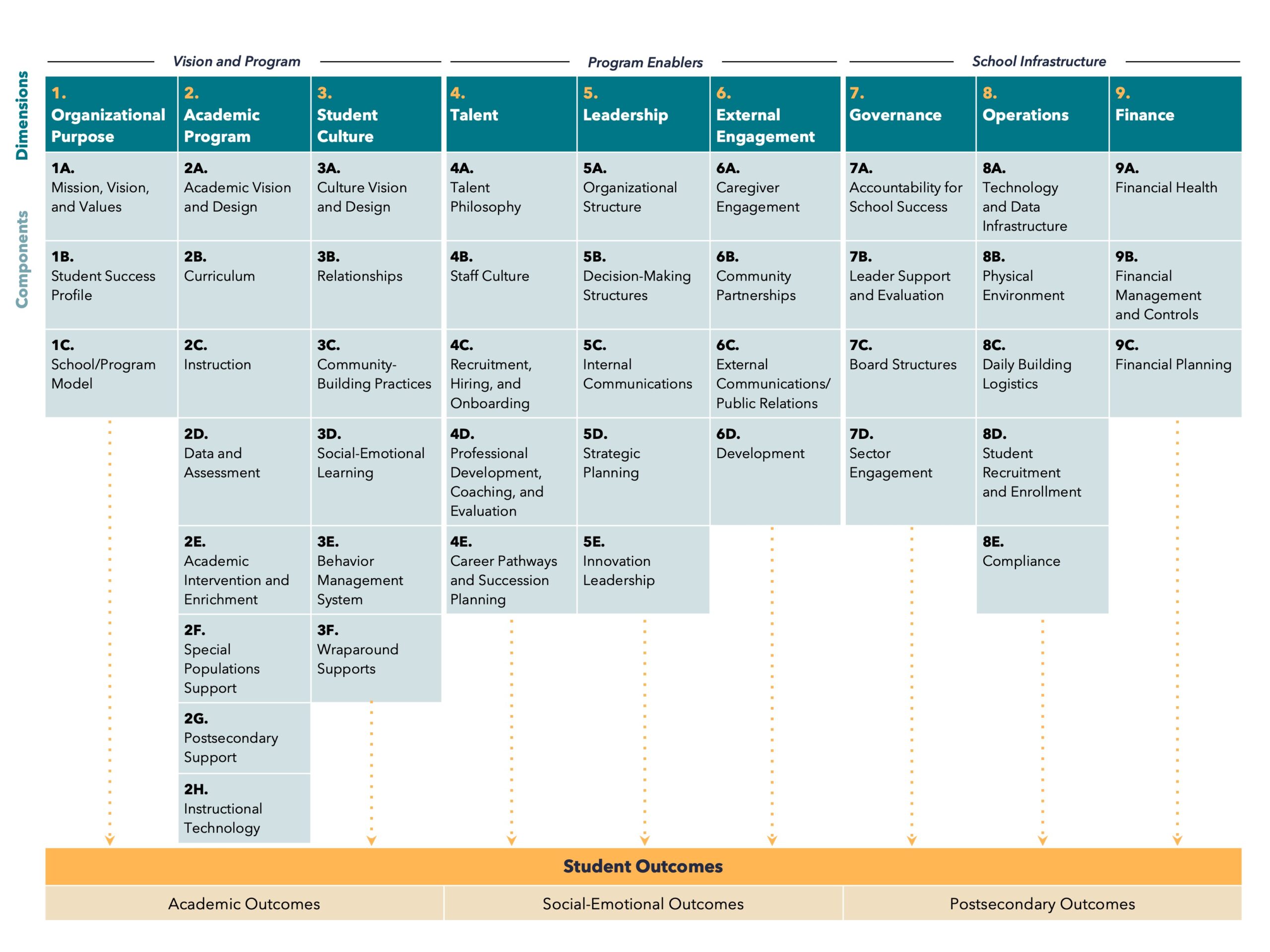
Bellwether’s School Quality Framework (SQF) defines nine dimensions of school excellence — from academics to student culture to operations — and breaks them down into clear, actionable components for schools and school leaders.
Bellwether’s School Quality Framework (click to enlarge)
Effective governance is one of the nine dimensions of a strong charter school or network. A strong, engaged board is essential for an excellent school; boards bring valuable experience and insight to school decisions, offer support to leadership and hire a new leader when necessary, tap their networks for resources, and connect schools to the community and a range of stakeholders.
While board members do not teach students, coach teachers, create the daily calendar, or manage school building upkeep, decisions made by the board shape the conditions for success throughout a school. Through strategic oversight, stewardship of resources, and supporting organizational health, boards help make possible what matters most: student success, high-quality teaching and learning in every classroom, and financial sustainability.
In addition, boards are responsible for oversight and accountability; the board actually holds the charter for every charter school, and it is up to the board to hold the school accountable for fulfilling the promises in the charter. The board monitors progress in each of the other eight dimensions of a high-quality school; thus, strong governance is both one element of a high-quality school, and where accountability for high quality rests.
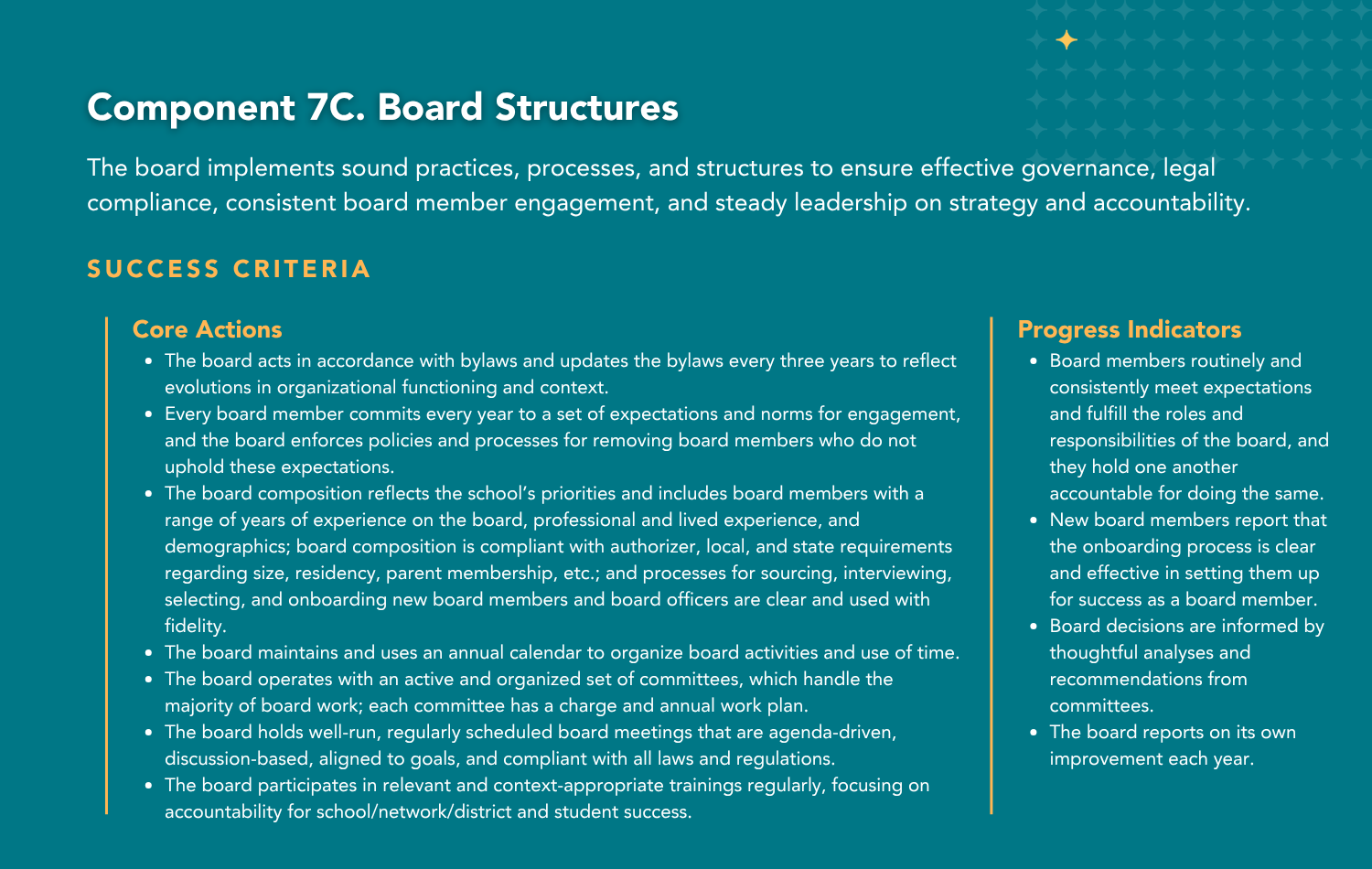
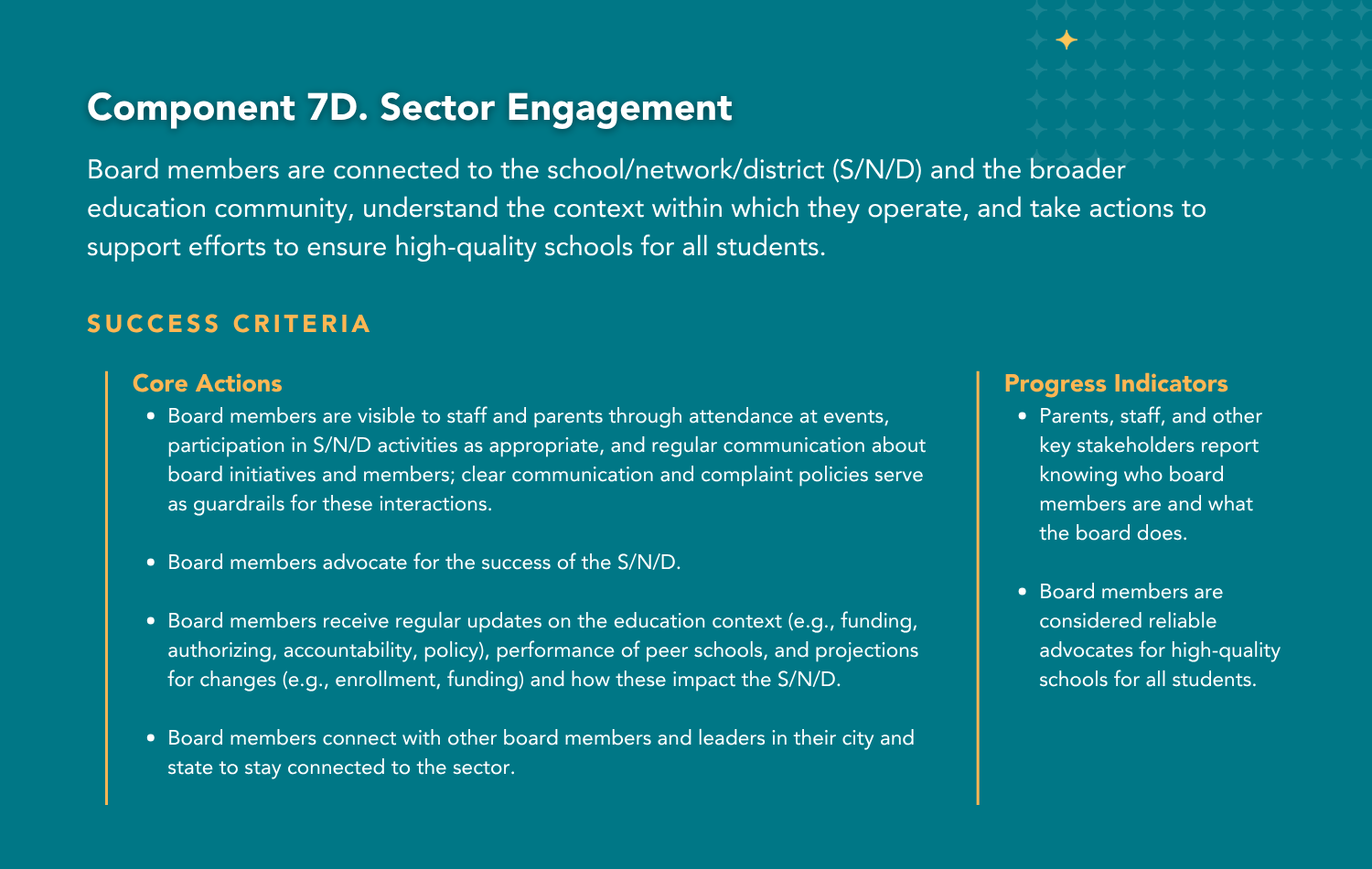
Dimension 7 of the SQF includes four interconnected components of effective governance: 7A. Accountability for School Success, 7B. Leader Support and Evaluation, 7C. Board Structures, and 7D. Sector Engagement.
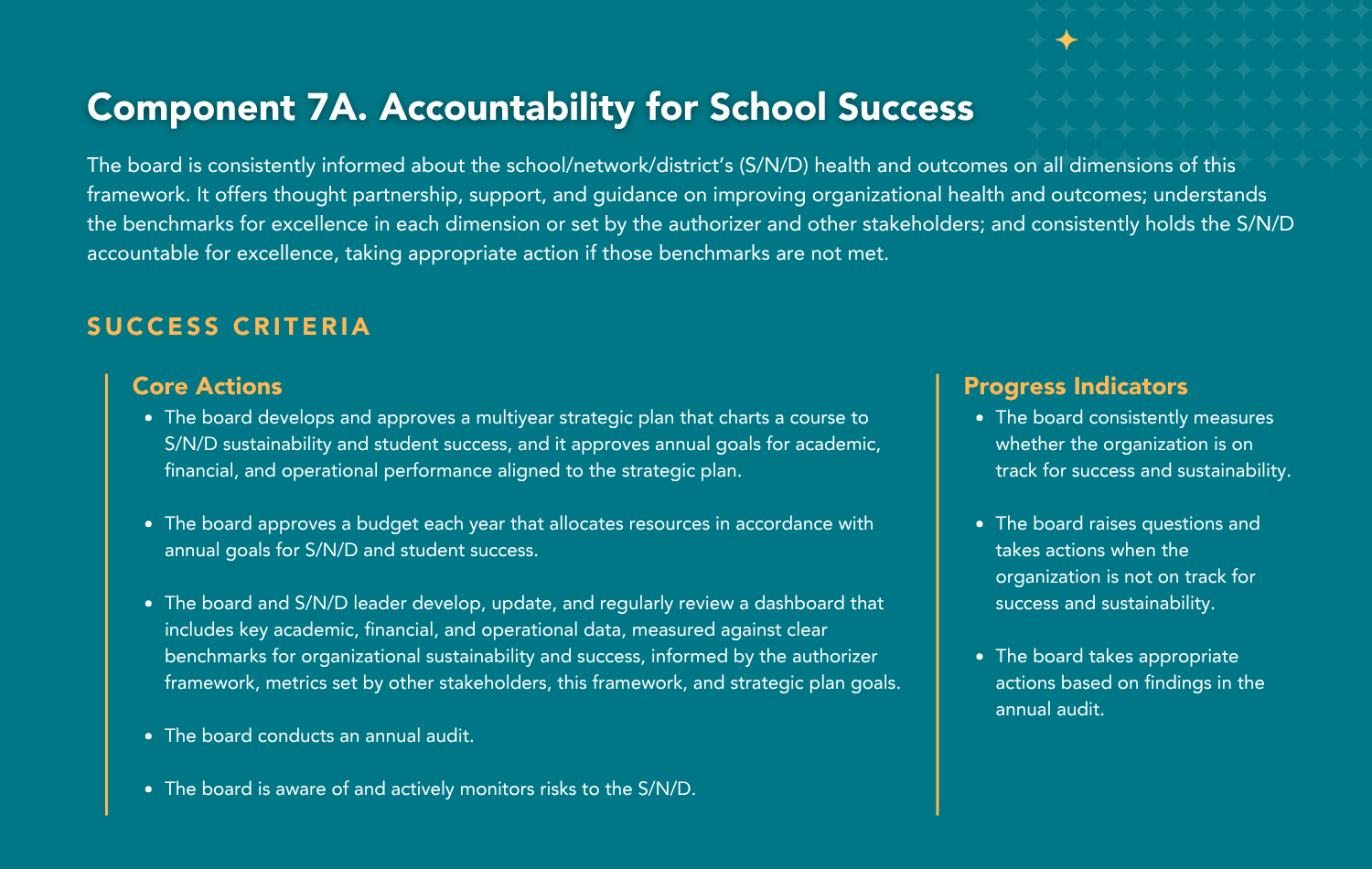
Component 7A. Accountability for School Success
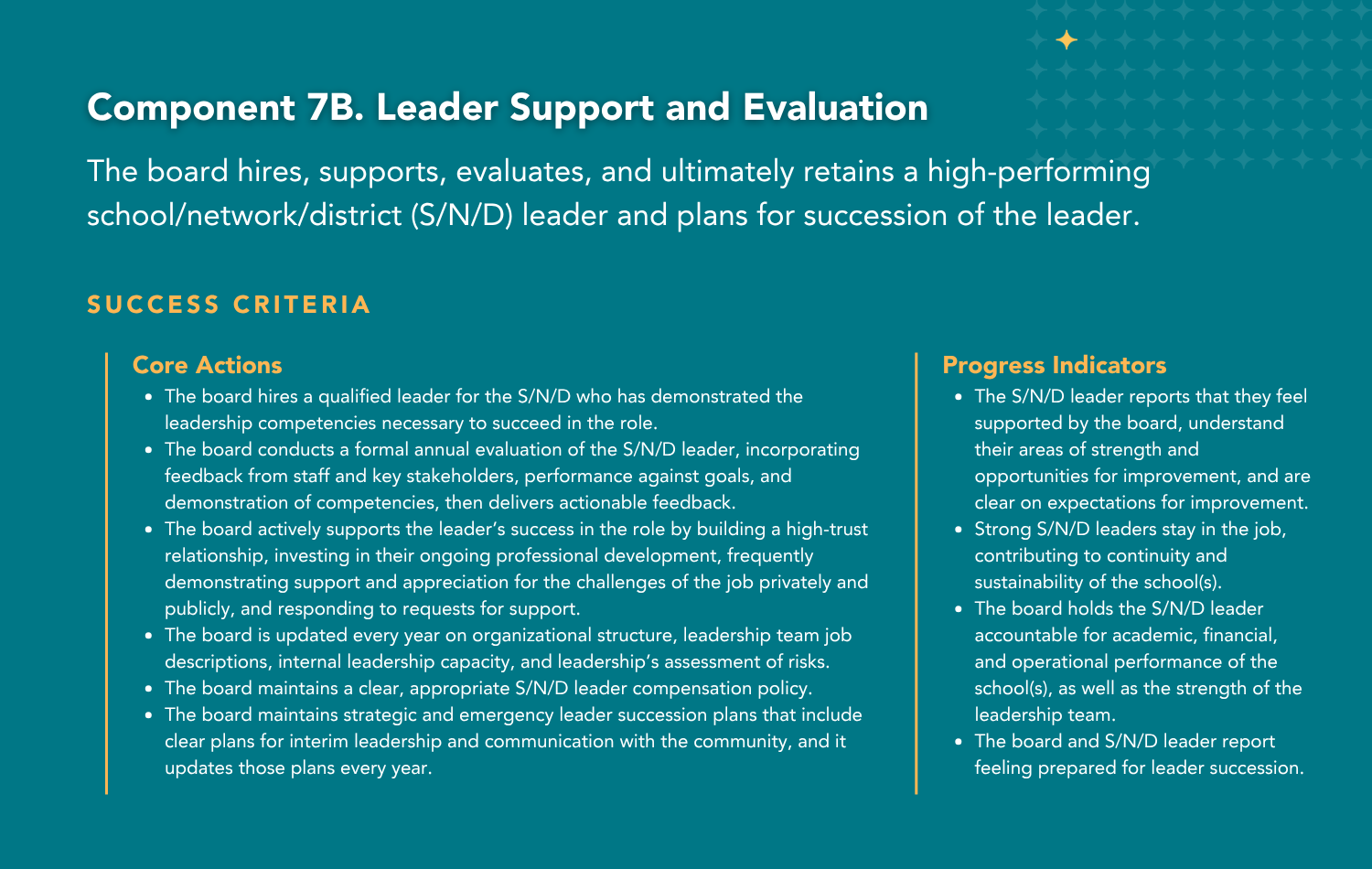
Component 7B. Leader Support and Evaluation
Component 7C. Board Structures
Component 7D. Sector Engagement
To see how the governance dimension of Bellwether’s SQF plays out in schools around the country, we recently connected with two leaders from Oklahoma City’s Harding Charter Prep — Superintendent Steven Stefanick and Board President Lisa Miller. Their answers have been edited for clarity and length.
Caitlin Piccirillo-Stosser: Steven, tell our readers about Harding Charter Prep. Where are you located, what grade levels do you serve, and how did you come to be the superintendent?
Steven Stefanick: Harding Charter Prep began in 1999 — just as school choice took root in Oklahoma — with our middle school site. We’ve been here a long time, and the school has changed a lot over the years, including its name a few times. Today, we serve about 1,200 pre-K through Grade 12 students and will expand to serve 3,000 students in the coming 8-10 years. Soon, we will have four school sites in our network. We’re excited to grow as rapidly as we can in the next decade to serve more students with a quality education.
Harding Charter Prep was my second job in education. I began my career in a traditional public school district for one year, then took a chance on a charter school. I started out as a math teacher in 2013; in fact, I had the privilege of teaching some of our current board members’ children. I developed a professional reputation for perseverance and hard work, and soon expanded my opportunities to grow within Harding. I’ve proudly served the gamut at Harding Charter Prep — from teacher and assistant principal to principal and superintendent — as our network expanded. This marks my 14th year with our network, and I continue to be inspired by the school community and am excited to continue the journey.
CPS: What sets your school’s academic model and supports for students apart?
SS: Back in the late 90s and early 00s, Oklahoma City was seeing a push for magnet or what we called “enterprise” schools that don’t give all students the same enrollment and access opportunities. Harding Charter Prep has always had an open access, college-prep model and we’re known for delivering on that promise. One hundred percent of our students are required to take Advanced Placement courses while in high school. The challenge for us is to ensure equitable supports are in place for all students and to ensure that all students are successful. In our last graduating Class of 2026, we got to celebrate 112 students walking the stage who raised a combined $7 million in scholarships, about 92% of whom enrolled in postsecondary institutions. The longer you’re a charter school, the more exposure you have to different families and communities, and we’re proud that our low socioeconomic enrollment rates are increasing, which means that we’re serving the families we want to serve and giving them the opportunity to break the cycle of poverty. It’s a huge part of our mission and focus at Harding Charter Prep and what we’ve always been about.
CPS: Lisa, tell our readers about your background and how you came to join Harding Charter Prep’s board.
Lisa Miller: I have nearly 30 years of experience working in finance, accounting, and human resources. During that time, I spent about 6 years working for an education company that offered online courses to middle and high school students, and supported opening virtual and blended-model schools. In addition to my professional experience in education, both of my kids attended Harding Charter Prep’s middle and high school campuses. At the time I joined the board, there were elected parent board members with each freshman class. I joined the board when my daughter was a freshman in 2013 and after she graduated, I became a “community member” and continued with my board service after my kids graduated in 2017 and 2018.
Working in education and being on the board is something I’m passionate about. Education is really a cornerstone for fixing a lot of the world’s issues — when people are educated, opportunities are limitless. It’s so important that every child has access to a quality education, and it should be a given as far as I’m concerned. I find my work on the board deeply rewarding.
CPS: How is Bellwether’s team supporting your school’s governance?
SS: Our partnership with Bellwether started several years ago on a project that intertwined strategic growth planning and governance as Harding Charter Prep expanded to open its first elementary school. Part of the partnership included thinking about governance structures that could sustain and support our growth into a multischool network. We did open our elementary school but quickly learned in the first cohort the challenges associated with moving from a small to a large entity without forsaking student learning. In Oklahoma, we’re the fourth-largest charter network, but in the country, we’re still considered small.
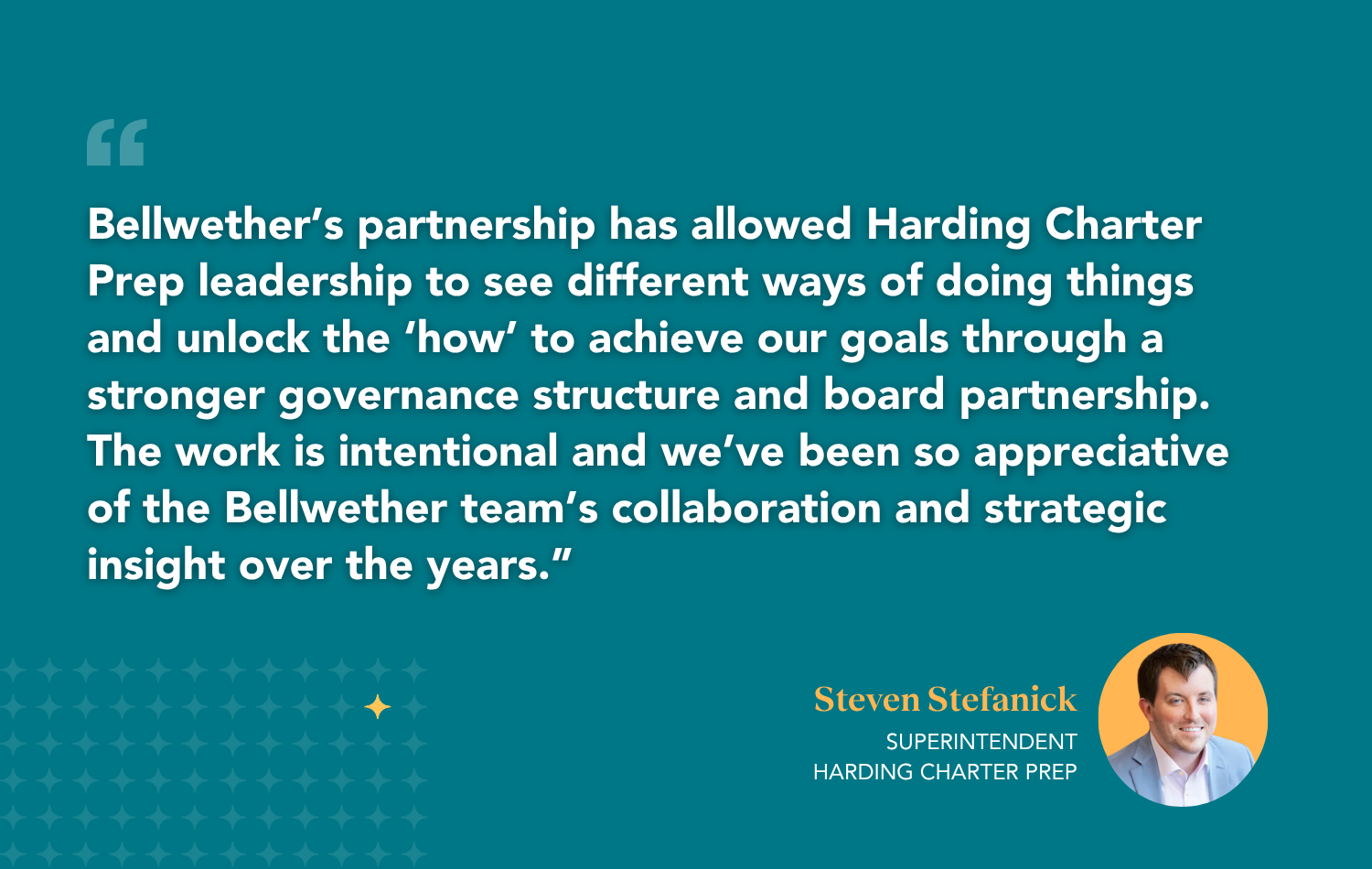
After the initial phase of our work with Bellwether, we were able to reconnect with your team on strategic planning to reach that next stage of becoming a large organization with 100+ employees and a multimillion-dollar budget. It’s made waves for us. The outside perspective that Bellwether provides gives us quality guidance and new ways of thinking. It’s so important, especially for an organization like ours that’s been around for decades and done many of the same things for a long time. Bellwether’s partnership has allowed Harding Charter Prep leadership to see different ways of doing things and unlock the “how” to achieve our goals through a stronger governance structure and board partnership. The work is intentional and we’ve been so appreciative of the Bellwether team’s collaboration and strategic insight over the years.
LM: Specific to your question about supporting effective governance and strengthening our board, the work Bellwether has done has been so important. When I started on the board, the board was just for the high school at the time, and we were doing the same things we’d always done. But since my youngest child graduated in 2018, we had teacher walkouts in Oklahoma, the COVID-19 pandemic, our middle and high school merged to form a district, we added Grade 5, we purchased an elementary school property and did a feeder pattern analysis. It was a time of tremendous change. And with that change, you have to be very strategic and thoughtful moving from a $3 million to $11 million budget. You just can’t operate the same way. Working with Bellwether has helped Harding Charter Prep’s leadership and board understand what we need to do to function as a larger network over the long term without weakening student learning.
CPS: Lisa, how do you and your fellow board members balance being a thought partner to Steven and his leadership team while also holding Harding Charter Prep accountable to ambitious academic and organizational goals?
LM: The important thing is communication and open dialogue. They’re nonnegotiables. Steven has to be able to come to the board with issues without expecting criticism delivered in a way that’s not helpful to him. We have constructive conversations and feedback loops even as disagreements arise. Our board members aren’t educators for the most part, so we have to place trust and faith in his ability and school leadership skills. But that goes both ways. Steven must also have trust and faith in us and our experience, which informs the board’s decision-making and how it can apply to the school’s operations. That level of ongoing dialogue, mutual trust, and communication are really important to be effective and functional going forward.
CPS: Has Bellwether’s partnership changed your thinking about how you support a school leader like Steven or your approach to ongoing leader evaluation, oversight, and accountability that is both rigorous and supportive?
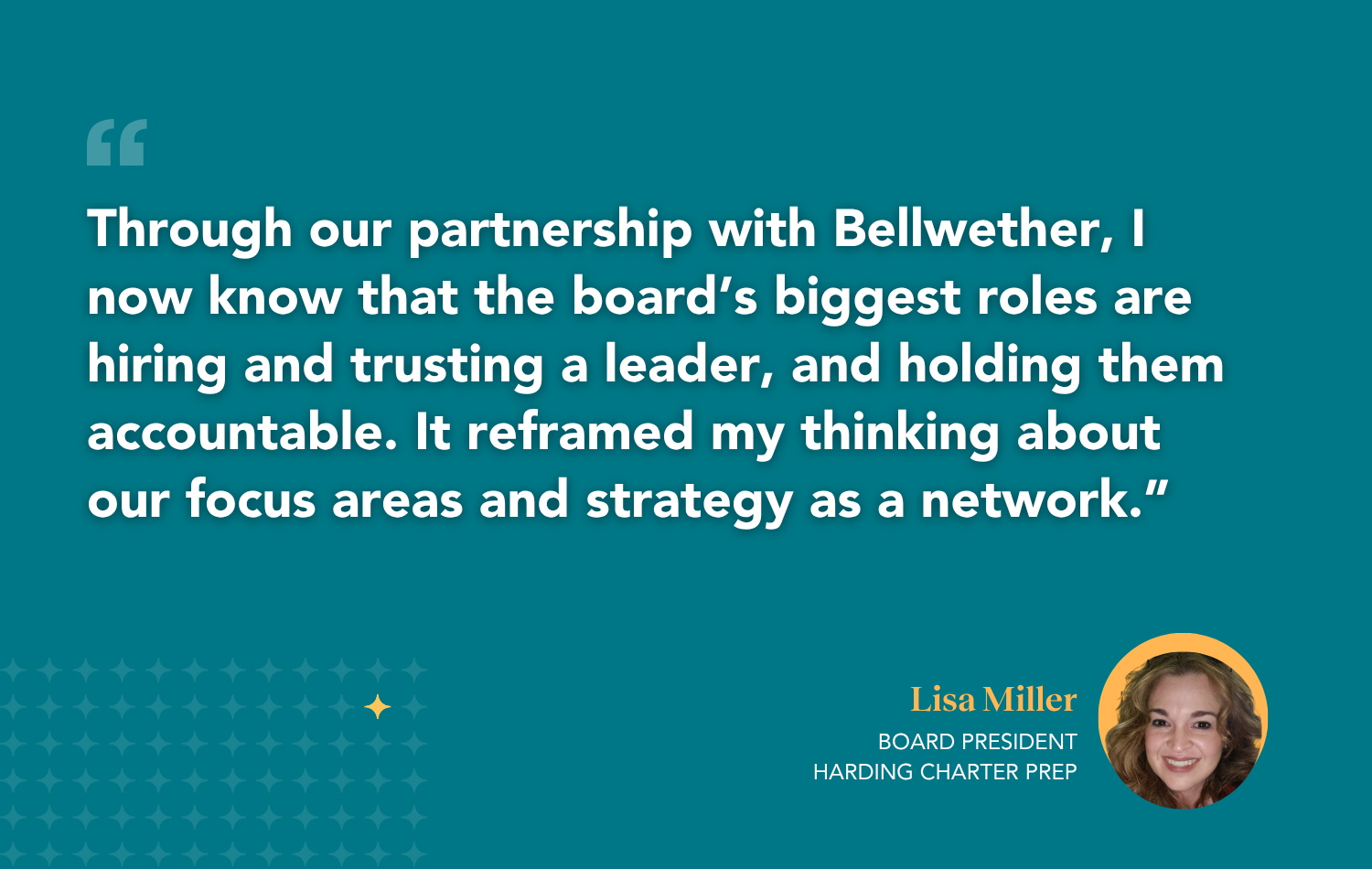
LM: Absolutely. Before we began working with Bellwether in 2023, the board had a list of things we typically did as a part of the status quo and didn’t always understand at a high level what the board’s focus should be. Bellwether helped us with a strategic plan alongside guidance and a framework for effective board governance. It broadened my thinking about what a board could and should be. Through our partnership with Bellwether, I now know that the board’s biggest roles are hiring and trusting a leader, and holding them accountable. It reframed my thinking about our focus areas and strategy as a network.
For example, before Steven, we had leaders who brought their strategic plan to us. Through the strategic guidance Bellwether provided, we now better understand the value of doing that strategic planning as a board together with Steven. We have to be a better thought partner and bring things to the table proactively versus reactively. It’s been a process and remains a work-in-progress for us to reach that point, and Bellwether has been really helpful in jumpstarting our strategic approach.
CPS: How does the board stay aligned on what “success” looks like across academics, finance, and operations?
LM: It’s essential to have well-functioning board committees. Our committees are set up to effectively do the work of governing and oversight to avoid bogging members down in board meetings. As committee members bring their findings and recommendations back to the full board, we can move forward efficiently. That committee work is so important on our board and we have open and thoughtful conversations. They also provide a mechanism to work with school staff across the network to engage and ask thoughtful questions that merge perspectives into effective decisions.
CPS: From a school leader’s perspective, what are some of the most important characteristics of a board member?
SS: There are two key factors that come to mind for me. One factor is board members’ balance of support and accountability, which should be the same role an effective superintendent or CEO plays. At the end of the day, students’ lives are what’s at stake and the most important and relevant factor in our decision-making, so you can be 100% supportive and not hold someone accountable and the students lose. Or you can be too hard on accountability and not supportive, with impacts on how staff support the students. There’s got to be a true balance on that front since the end game is student success.
Another factor is to be informed and involved at a governance level. Ask the hard questions. Dig deeper in the data. Ask for different data. Challenge your school or network leader in supportive ways and encourage them to grow. This is especially important for a leader like me who’s been here a long time. It may be harder to think outside the box because “we’ve always done things successfully.” But are we always as successful as we can be? Are all our students going to Harvard University? No. There’s always room for growth and improvement and the board can push a leader to innovate to reach a higher bar.
CPS: This question is for both of you. What are the most important and valuable ways for the board to engage with and “show up in” your school community or broader charter sector in Oklahoma?
SS: I view board members as Harding Charter Prep’s biggest public cheerleaders and supporters of our mission and values. Privately, board members need to hold accountability to the highest level. There’s also an important advocacy piece to their role on the board for quality schools since that’s what we all care about for every kid in every school, not just ours. Being an advocate for our students and holding community partners, legislators, and others accountable for results for students is important. We’re all here first and foremost for the kids who deserve a high-quality, functioning school.
LM: When I’m talking to prospective board members in the interview process, there are many things I want to see. Over the years through our partnership with Bellwether, we’ve become more strategic about electing board members and developing frameworks to vet members. I now ask what brings them to the board, whether they’re passionate about education (and why), their level of investment in full participation and all that it entails, their curiosity about trends in the education sector broadly, and whether they’re willing to ask questions and respectfully agree to disagree sometimes. It’s also important to ensure they understand the responsibility of being open to their work being public, following open records rules, and intuitively understanding the gravity of reviewing the school’s finances.
CPS: Is there anything else either of you would like to add about governance from a school leader’s and board president’s perspective, and how it shapes a high-quality education for students?
SS: There are two things I’d like to add about what can really damage a school or network. First, so many schools undervalue strong governance at the top. The most important work is in the classroom with a teacher and student, but without a broader quality structure in place, it’s hard to achieve that. The board’s oversight and work make it possible. So, a dysfunctional board and CEO partnership can trickle down into the organization and, eventually, to the classroom level. Second, you often see boards and staff collide when there’s a lack of cohesion or misalignment on mission and purpose. It’s so vital to get this right all the way through an organization, top to bottom. We just did a community survey of everyone from board members to parents to teachers to students at Harding Charter Prep and the number one thing that everyone is clear on is our mission. There was no exception to that, which means when something comes to the board, they know their mission and strategic vision and stay true to it regardless of the challenges that might arise.
LM: For anyone serving on a school’s or network’s board, I hope they’re doing it for the right reasons. It’s important to leave ego out of it — you’re here to ultimately serve students. The work can be hard at times, but it’s so crucial. Quality education for everyone is essential, and it takes this kind of work to make it happen. Board members have to take their responsibilities seriously, but it’s also a role that you can get so much joy out of. I go to graduation every year and hear the valedictorian speech, and they’re reminders of why I do what I do. Serving on a school’s board is very rewarding work.
To learn more about Bellwether’s School Quality Framework, reach out to Bill Durbin at bill.durbin@bellwether.org or Anson Jackson at anson.jackson@bellwether.org. To learn more about Bellwether’s governance work, reach out to Carrie Irvin at carrie.irvin@bellwether.org.
