
Built for Learning
Lessons From Emerging Artificial Intelligence Solutions and Approaches
Overview
The integration of artificial intelligence (AI) into ed tech tools has raised many questions about how such advanced technology can both ease burdens for students and teachers and facilitate deep learning. Bellwether’s prior work has explored this tension by diving into how AI could amplify productive struggle and how to measure the impact of AI-powered ed tech tools.
This series showcases those concepts in practice: Drawing on interviews with education leaders and ed tech founders from more than 20 organizations nationwide, this series identifies common design trade-offs, implementation challenges, and emerging approaches. It also includes five accompanying case studies that dive deep into specific organizations, illustrating how these broader themes can play out across contexts and use cases. Across the series, key themes include:
- Balancing cognitive support with productive struggle.
- Centering appropriate roles for teachers versus technology.
- Navigating measurement challenges to evaluate the medium- and long-term impact of AI-powered tools.
- Building infrastructure that reflects both practical and pedagogical considerations.
- Identifying sustainable business models that balance pedagogical commitments and market realities.
Practitioners and educators can use these themes to ask sharper questions of vendors about how their tools will use AI to best serve their specific students. Ed tech developers might find new ideas or approaches for addressing common challenges. And policymakers and funders will be able to better assess whether AI tools align with their educational priorities, and what infrastructure or ecosystem conditions are critical for effective, sustainable implementation.
Download and read Built For Learning and access the five accompanying case studies.
Case Studies
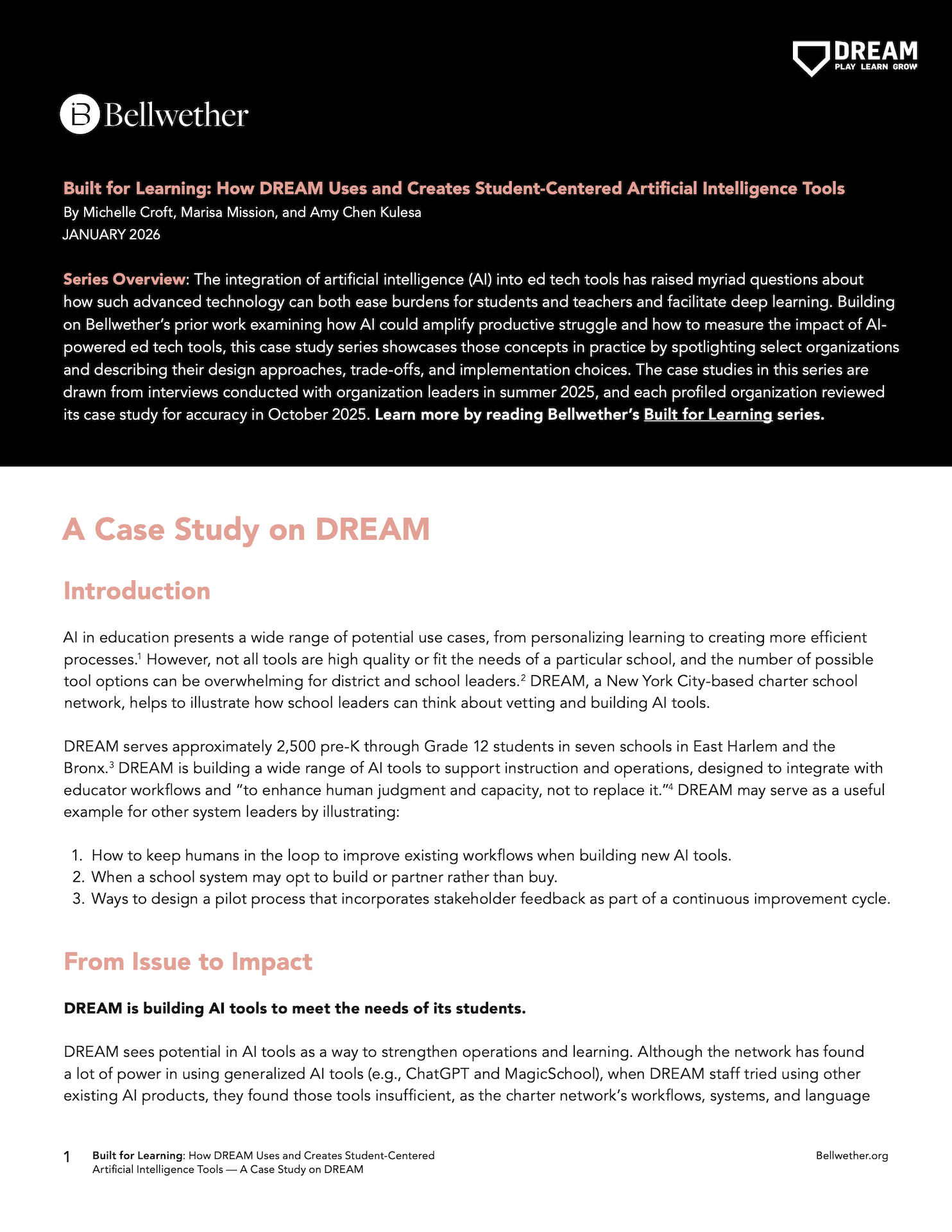
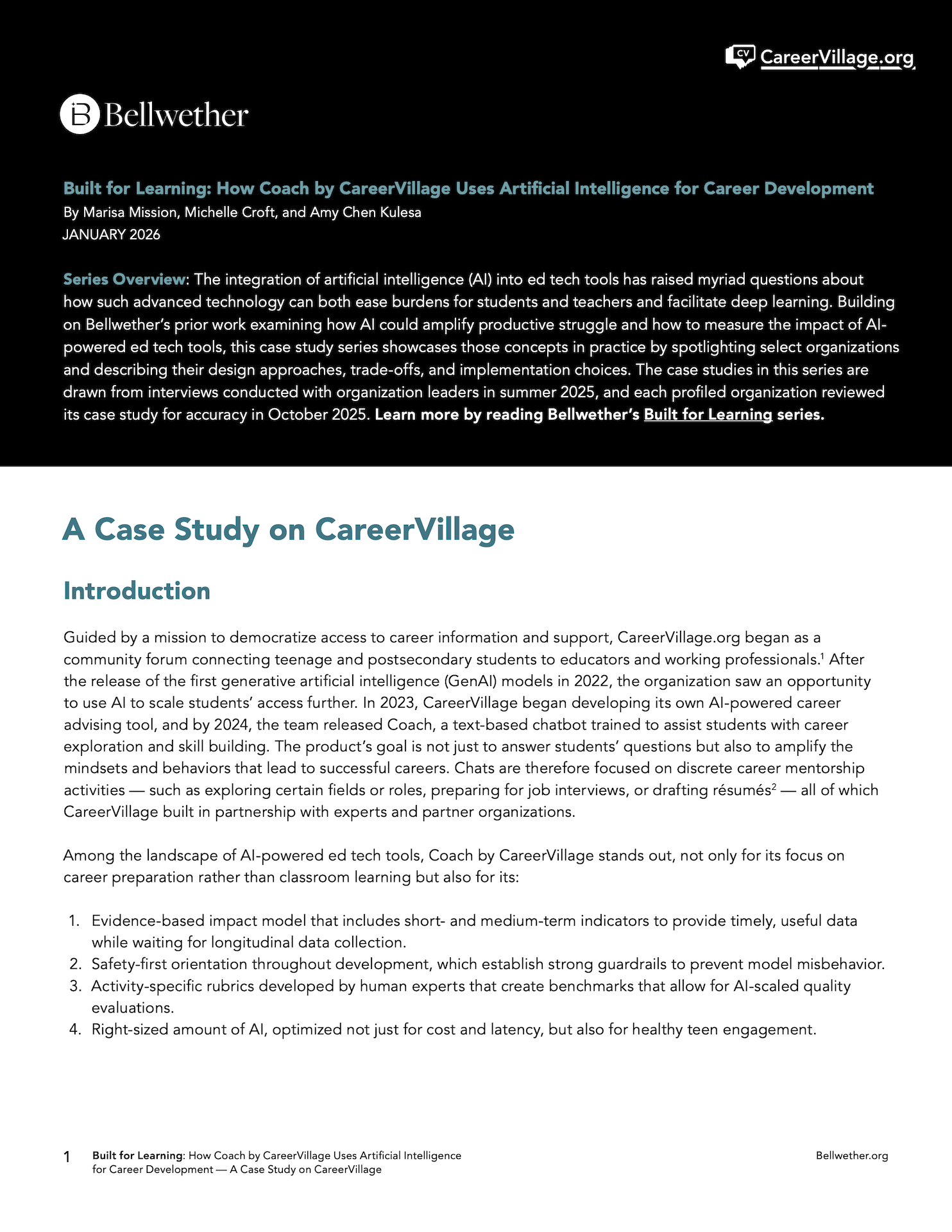
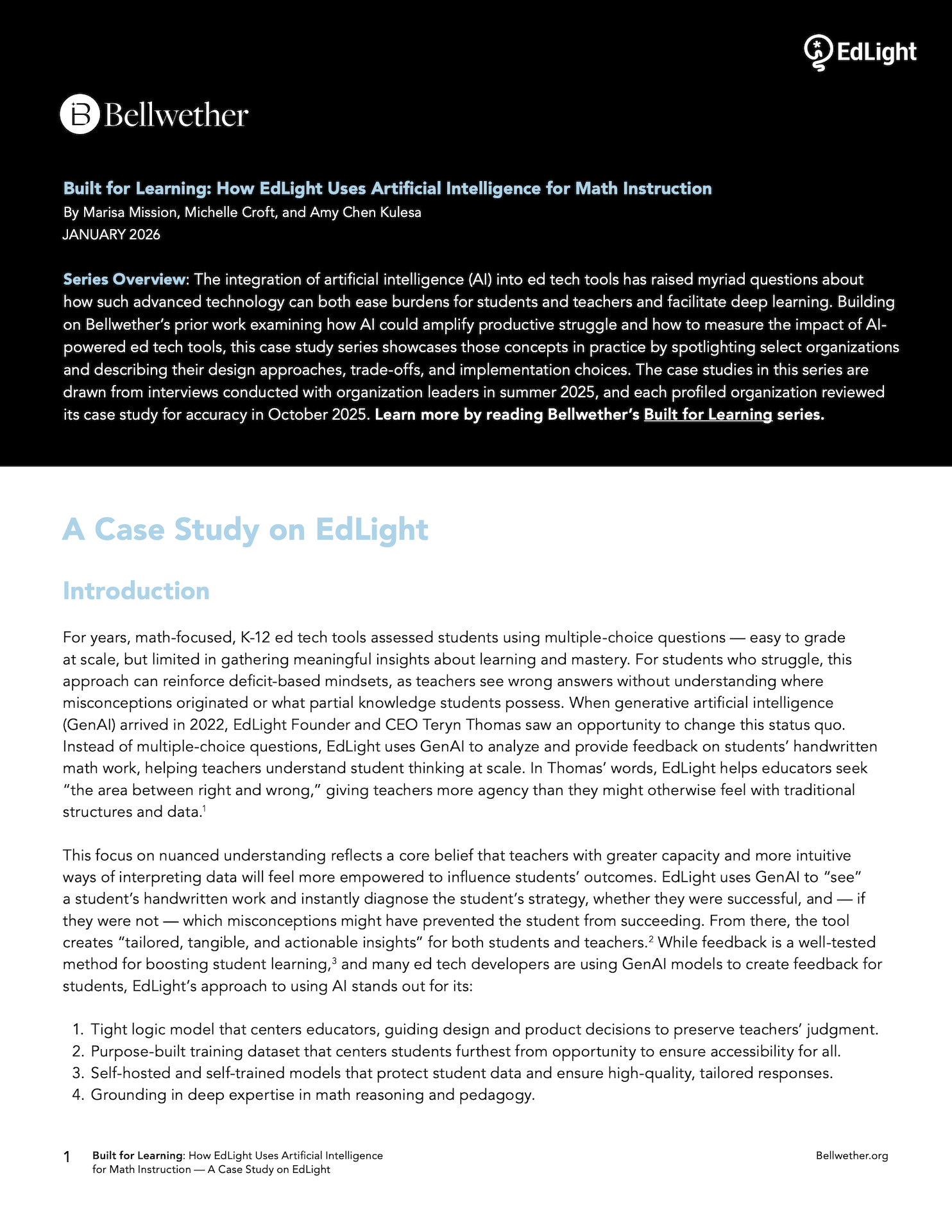
Built for Learning includes five case studies featuring organizations spanning a diverse range of settings, from literacy, writing, and mathematics instruction to career-connected learning and school operations. Some organizations serve elementary students, while others target high school or adult learners. What unites them is a commitment to centering pedagogy in their technical decisions and grappling seriously with questions of impact.
While each case study explores specific organizations’ design choices, it is likely too early to point at any one tool or practice as “the best.” Instead, the goal of this series is to help education leaders better understand the design choices, technical approaches, and implementation considerations that distinguish thoughtful AI integration from rushed adoption.
Built for Learning
DREAM
CareerVillage
EdLight
Coursemojo and Quill
Timely
Acknowledgments, About the Authors, About Bellwether
Acknowledgments
We would like to thank the many experts who gave their time and shared their knowledge with us to inform our work. Thank you also to the Bezos Family Foundation, Chan Zuckerberg Initiative, Charter School Growth Fund, and Overdeck Family Foundation for their financial support of this project. We would also like to thank our Bellwether colleagues Mark Baxter and Mary K. Wells for their input and former colleague Janine Sandy for her support.
Thank you to Amy Ribock, Kate Stein, Andy Jacob, McKenzie Maxson, Temim Fruchter, Julie Nguyen, and Amber Walker for shepherding and disseminating this work, and to Super Copy Editors.
The contributions of these individuals and entities significantly enhanced our work; however, any errors in fact or analysis remain the responsibility of the authors.
About the Authors

MARISA MISSION

MIHELLE CROFT

AMY CHEN KULESA
Bellwether is a national nonprofit that works to transform education to ensure young people — especially those furthest from opportunity — achieve outcomes that lead to fulfilling lives and flourishing communities. Founded in 2010, we help mission-driven partners accelerate their impact, inform and influence policy and program design, and bring leaders together to drive change on education’s most pressing challenges. For more, visit bellwether.org.
This report carries a Creative Commons license, which permits noncommercial reuse of content when proper attribution is provided. This means you are free to copy, display, and distribute this work, or include content from this report in derivative works, under the following conditions:
Attribution. You must clearly attribute the work to Bellwether and provide a link back to the publication at www.bellwether.org.
Noncommercial. You may not use this work for commercial purposes without explicit prior permission from Bellwether.
Share Alike. If you alter, transform, or build upon this work, you may distribute the resulting work only under a license identical to this one.
For the full legal code of this Creative Commons license, please visit www.creativecommons.org. If you have any questions about citing or reusing Bellwether content, please contact us.
